

Re-entry Permit for US Green Card Holders: When to Apply

The key timing decision comes before departure: a re-entry permit for US green card holders must be requested from inside the United States. According to U.S. Citizenship and Immigration Services, a permit is generally valid for two years from its date of issuance. After filing Form I-131 and attending the biometrics appointment, an applicant may travel while the application is pending rather than wait in the country for a decision. Filing and approval are separate milestones.
Planning an extended stay abroad involves more than choosing a departure date. The length of your trip, your permanent resident status, and the application timeline all matter. This guide explains what a re-entry permit for US green card holders does, who can apply, how travel works while an application is pending, and how to apply from inside the United States. It also clarifies what the permit does and does not establish, so you can understand the key steps before arranging a longer absence.
Table of Contents
What Is a Re-Entry Permit?
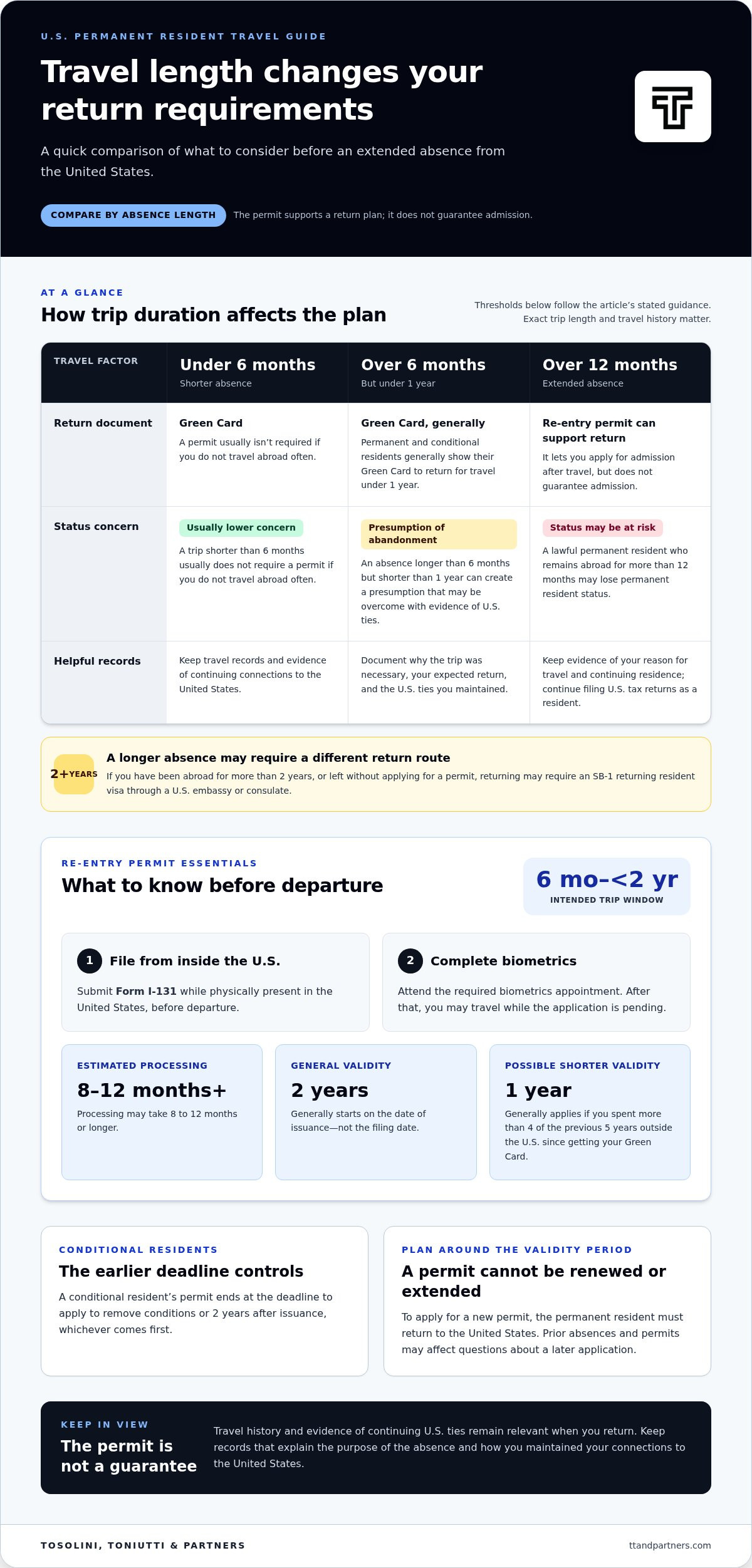
A re-entry permit is a travel document for a lawful permanent resident planning an extended absence from the United States. The application is Form I-131, filed while the applicant is physically present in the country. The permit is intended for trips lasting more than 6 months but less than 2 years, and lets its holder apply for admission after travel. It supports a return plan, but doesn’t guarantee admission. Travel documents and evidence of continuing U.S. ties remain relevant.
According to U.S. Citizenship and Immigration Services, a re-entry permit is generally valid for two years from its date of issuance. That period begins when the permit is issued, not when the application is filed. Processing is estimated to take 8 to 12 months or longer, so an application may remain pending for a substantial part of the planned timeline. Filing early helps separate the application process from the permit’s actual validity period.
Some applicants receive a shorter validity period. A permanent resident who has spent more than 4 of the previous 5 years outside the United States since obtaining a green card will generally receive a re-entry permit valid for only one year, according to U.S. Citizenship and Immigration Services. USCIS may also ask additional questions or limit a new permit’s validity when the applicant has spent substantial time abroad or has applied before. Prior travel history can therefore matter alongside the proposed absence.
A re-entry permit cannot be renewed or extended. The permanent resident must return to the United States and apply for a new permit. There is no official limit on repeat applications, but previous absences and permits may affect questions about a later application. A permit has a defined period of validity, so anyone planning a longer absence or who left without applying should check the return requirements before traveling back. This distinction matters when coordinating immigration documents with a longer-term travel plan.
Re-entry requirements for permanent and conditional permanent residents
Lawful permanent and conditional permanent residents can apply, but they must be physically present in the United States when filing. According to U.S. Citizenship and Immigration Services, permanent residents apply using Form I-131, Application for Travel Document.
Re-entry Permit Eligibility
Eligibility depends on holding permanent resident status and filing from inside the United States. A resident must file Form I-131 before departure, rather than apply from abroad. Conditional permanent residents can also apply, but their permit cannot extend beyond the deadline to apply to remove conditions. It ends at that deadline or two years after issuance, whichever comes first. This distinction matters when travel overlaps with a status deadline.
Maintaining Permanent Resident Status During Travel
A re-entry permit documents a permanent resident’s intention to return after an extended absence and supports an application for admission to the United States. It does not guarantee admission or replace the need to maintain evidence of ongoing U.S. ties. Keep records showing why the travel was necessary and how you maintained connections to the United States. Residents abroad should also continue filing U.S. tax returns as residents. These steps help present a consistent account of the trip and your continuing permanent residence.
Extended Travel and Abandonment
Lengthy travel can raise questions about whether a resident intended to keep the United States as a permanent home. According to U.S. Citizenship and Immigration Services, a lawful permanent resident who remains abroad for more than 12 months may lose permanent resident status. An absence longer than 6 months but shorter than one year can also create a presumption of abandonment, which may be overcome with evidence of U.S. ties.
Keep documentation that explains the travel’s purpose, your expected return, and connections maintained at home. If a resident has been abroad for more than 2 years, or departed without applying for a permit, returning may require an SB-1 returning resident visa through a U.S. embassy or consulate. The reasons for the absence and evidence supporting continued residence are central to that application.
Travel while an application is pending
A pending application does not always require you to stay in the United States until approval. You may travel after completing the required biometrics appointment.
Travel Before Approval
After USCIS receives Form I-131, you may travel abroad while the application is pending, but only after attending your biometrics appointment. You don’t have to wait for the travel document to be approved before departure. Plan the appointment around your intended travel date, since leaving before completing biometrics can disrupt the application process. Keep your filing records and appointment information accessible while outside the United States.
Reasons for Extended Travel Abroad
Green card holders may need to travel abroad for work, family responsibilities, or other personal reasons. The purpose and expected length of the absence can shape your travel plans, particularly if the trip may approach one year. Before leaving, consider whether the absence could affect your permanent resident status or future naturalization eligibility. A re-entry permit may support an extended travel plan, but it does not guarantee admission when you return.
Travel Without a Re-entry Permit
For travel lasting less than one year, permanent and conditional residents generally need to show their Green Card to return. A trip shorter than 6 months usually doesn’t require a permit if you don’t travel abroad often. However, an absence longer than 6 months but shorter than one year creates a presumption of abandonment. Evidence of continuing U.S. ties may help address that concern at inspection.
Naturalization has separate travel considerations. For most applicants, an absence longer than 6 months can affect eligibility, and applicants must spend at least half of their qualifying period in the United States. An absence exceeding one year breaks continuous residence for naturalization. Certain permanent residents working abroad may use Form N-470 to preserve residence for naturalization purposes. A permit and a naturalization application therefore address different consequences of international travel.
Applying for a re-entry permit from inside the United States
To apply, a lawful permanent resident must be physically present in the United States and file Form I-131, Application for Travel Document. USCIS does not accept re-entry permit applications online. File before departure, and allow time for the required biometrics appointment. USCIS recommends applying at least 60 days before traveling abroad.
Yes. You must attend a biometrics appointment, even if you completed one previously. You must be in the United States for the appointment, and USCIS will identify the appointment location in its notice. If you intend to travel while your application is pending, do not leave the country before completing biometrics.
Include the required two passport-style photos with the application. USCIS lists January 20, 2025, as the edition date for Form I-131 and its instructions, so use the corresponding form edition when preparing your documents.
Mailing details matter. USCIS changed the Form I-131 filing location on October 7, 2026, and warns that sending the application to the wrong direct filing address may delay processing. Use the current address in the USCIS filing instructions. Applications postmarked on or before November 9, 2026, may be sent to a prior filing location during the 30-day grace period.
After USCIS receives the application and you complete biometrics, you may travel while it remains pending; approval need not come first. Leaving before USCIS decides the case does not affect the application. Keep your filing receipt and appointment notice accessible abroad, and plan around the possibility that processing takes 8 to 12 months or longer. For help assessing how filing and travel timing interact, discuss your immigration matter.
Tosolini, Toniutti & Partners: E-2 VISA
Tosolini, Toniutti & Partners assists individuals and corporate clients with Green Card matters. If extended travel raises questions about your permanent resident status, the application process, or how your immigration plans fit together, legal guidance can help you understand the relevant considerations and prepare for the next step.
The firm’s Green Card services are relevant when a travel decision intersects with broader U.S. immigration needs. Share your travel timeline and the questions you need addressed so the discussion can focus on your circumstances and objectives.
To discuss Green Card matters, contact Tosolini, Toniutti & Partners.
Plan Your Next Immigration Step
Long-term travel can be part of a broader immigration plan, especially when work, family, and future residence decisions intersect. Before moving forward, consider how your travel intentions relate to your long-term goals and which questions need legal review. A re-entry permit for US green card holders is one part of that planning, not a substitute for considering the wider picture.
Tosolini, Toniutti & Partners works with Green Card matters and also handles E-2, E-1, and O-1 visas. If your circumstances involve more than one immigration pathway, a focused discussion can help clarify which issues belong in the same plan and what information to prepare for the next step.
Contact Tosolini, Toniutti & Partners to discuss your immigration matter and move ahead with a clearer plan.
Frequently Asked Questions
What is a U.S. re-entry permit for green card holders, and who needs one?
A re-entry permit for US green card holders is a travel document for lawful permanent residents planning an extended absence. It can help a green card holder apply for admission after travel, but it does not guarantee entry. It may be useful if you expect to remain abroad for an extended period and want documentation of your planned return. A permit differs from a returning resident visa, which may apply in other circumstances.
How long can a green card holder stay outside the U.S. without a re-entry permit?
A green card holder can generally return using the Green Card after an absence of less than one year, but trip length isn’t the only consideration. An absence longer than 6 months but shorter than one year can raise a presumption that permanent residence was abandoned. Keep evidence of U.S. ties, such as resident tax filings, and be prepared to explain the trip’s purpose and circumstances.
How do I apply for a re-entry permit using Form I-131?
File Form I-131 while physically present in the United States, and complete the required biometrics appointment before leaving. The application is filed by mail, not online, and requires two passport-style photos. Use the correct filing address and form edition, since mailing an application to the wrong location may delay processing. Keep copies of your application and notices for reference during travel.
Can I travel abroad while my re-entry permit application is pending?
Yes. You may travel abroad after USCIS receives your application and you attend your biometrics appointment. You do not need to wait for approval before departing, and leaving before a decision does not affect the application. Keep your filing receipt and biometrics notice accessible while you are away. Before traveling, consider whether the planned absence could affect other immigration matters, including naturalization eligibility and its separate residence requirements.
How long does re-entry permit processing take, and how can I check its status?
Processing for a re-entry permit for US green card holders is estimated to take 8 to 12 months or longer, so the case may remain pending during much of your planned trip. After filing, use the receipt number on your USCIS notice to check your case through USCIS’s case-status service. Keep the receipt and later correspondence together, and follow any instructions or deadlines in USCIS notices.
How long is a re-entry permit valid, and can it be renewed?
A permit is generally valid for two years from its issuance date, though some residents receive a shorter validity period based on prior time abroad. It cannot be extended or renewed. To obtain another permit, a permanent resident must return to the United States and file a new application from inside the country. Conditional residents should also account for the deadline to apply to remove conditions.



Comments