

Permesso di Soggiorno for Family Reunification Eligibility

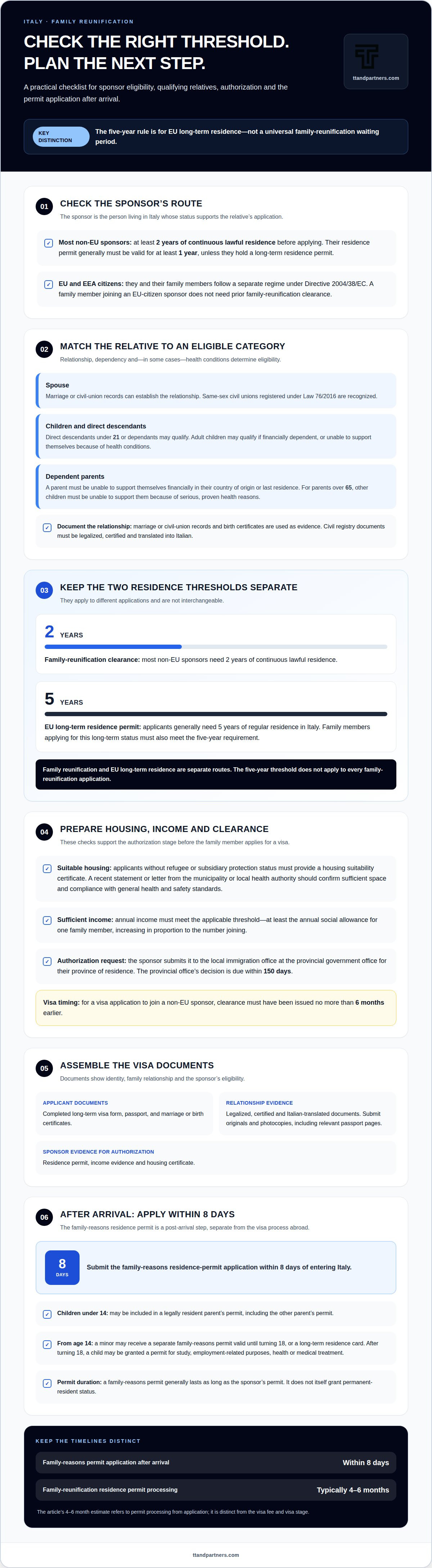
A five-year residence requirement does not apply to every family-reunification application in Italy. An Italian residence permit for family reunification is generally sought after an eligible relative enters Italy. Qualifying family members may include a spouse, minor children, dependent adult children, and dependent parents, subject to the applicable conditions.
It’s understandable to read the five-year rule as a general waiting period, but it applies to eligibility for Italy’s EU long-term residence permit, not as a universal precondition for family reunification. That distinction can shape both the sponsor’s application and the family member’s next steps.
This guide explains which relatives may qualify, how the five-year threshold fits, and what happens after arrival, including the usual requirement to apply for a family-reasons residence permit within 8 days. With the categories and sequence set out clearly, families can see which part of the process applies to them.
Table of Contents
Eligible family members
A sponsor is the person living in Italy whose status supports a relative’s application. Most non-EU sponsors need two years of continuous lawful residence before applying for family reunification. Their residence permit must generally be valid for at least one year, unless they hold a long-term residence permit.
An eligible family member is a relative who meets Italy’s relationship and dependency rules. The categories include a spouse, direct descendants under 21 or dependants, and dependent parents. Adult children may qualify if financially dependent, or unable to support themselves because of health conditions. A dependent parent must be unable to support themselves financially in their country of origin or last residence.
Parent eligibility can involve additional conditions. For parents over 65, the other children must be unable to support them because of serious, proven health reasons. Same-sex civil unions registered under Law 76/2016 are recognized for family reunification. Marriage or civil-union records and birth certificates establish the relationship; civil registry documents must be legalized, certified, and translated into Italian.
An EU long-term residence permit is a separate status for qualifying residents and their eligible family members. Applicants generally need five years of regular residence in Italy, and family members applying for this permit must also meet the five-year residence requirement. This is distinct from the conditions for joining a family member through reunification. EU and EEA citizens and their family members follow the separate regime under Directive 2004/38/EC. Unlike the non-EU sponsor route, a family member joining an EU-citizen sponsor does not need prior family-reunification clearance.
A family-reunification residence permit typically takes 4-6 months from application; the visa fee and permit-processing timeline relate to different stages.
Five-year residence requirement for applicants and family
The five-year residence rule applies to Italy’s EU long-term residence permit, not every family-reunification application. Applicants and family members seeking that long-term status generally need five years of regular residence in Italy. For family-reunification clearance, most non-EU sponsors instead need two years of continuous lawful residence. These are separate thresholds for different applications.
A housing suitability certificate confirms that the accommodation can adequately house the arriving family. Applicants without refugee or subsidiary protection status must provide one. A recent statement or letter from the municipality or local health authority should confirm sufficient space and compliance with general health and safety standards. The sponsor’s annual income must also meet the applicable threshold: at least the annual social allowance for one family member, increasing in proportion to the number joining.
Family-reunification clearance is the authorization that allows a family member to proceed with a visa application. The sponsor submits the request to the local immigration office at the provincial government office for their province of residence. The provincial office’s decision is due within 150 days. For a visa application to join a non-EU sponsor, the clearance must have been issued no more than six months earlier.
Visa documents establish identity, the family relationship, and the sponsor’s eligibility. Applicants generally need a completed long-term visa form, a passport, and marriage or birth certificates. Relationship documents must be legalized, certified, and translated into Italian. Submit originals and photocopies, including relevant passport pages. The sponsor’s residence permit, income evidence, and housing certificate support the authorization stage.
A family-reasons residence permit is the document a relative applies for after entering Italy. Submit the application within 8 days of arrival. This post-arrival step is distinct from the visa process abroad. For guidance on coordinating the Italian immigration application process, use the available contact channel.
Residence permit for family reasons after arrival
After entering Italy through family reunification, a relative applies for a family-reasons residence permit. Its duration and format depend on the family member’s age and the sponsor’s permit.
Children Included in a Parent’s Permit
A child under 14 may be included in a legally resident parent’s residence permit. The child may also be included in the other parent’s permit, linking the child’s residence documentation to a parent’s status.
From age 14, a minor may receive a separate family-reasons permit, valid until turning 18, or a long-term residence card. Keep the child’s identity and family documents available when preparing the application, since they establish the relationship and support the child’s residence record. After turning 18, a child may be granted a permit for study, employment-related purposes, health, or medical treatment.
Permit Validity and Permanent-Resident Status
A family-reasons residence permit generally lasts as long as the sponsor’s permit. It does not give the holder permanent-resident status: an EU long-term residence permit is a distinct status with separate eligibility requirements.
New electronic EU long-term residence permits show validity of 10 years. After that period, personal data must be updated for the card to remain valid as an identity document. This card-validity period should not be confused with the underlying status or the duration of a family-reasons permit.
Renewal is the next step before a family-reasons permit expires. File the renewal at least 60 days before the expiry date, and submit an extension request to the police headquarters before the original permit expires. If authorities refuse an application, an appeal against a negative family-reunification decision generally has a 30-60 day deadline from notification. The notification date matters, so the response must be addressed promptly and supported by the relevant documents. A child’s age, the sponsor’s permit validity, and the reason for continued residence all shape which permit route applies.
Authorization for family reunification
Authorization is the formal approval that lets an eligible relative proceed with a family-reasons visa. In Italy, the process is governed by Articles 29 and 29-bis of Legislative Decree 286/1998. For most non-EU sponsors, the application depends on lawful residence, income, suitable housing, and proof of family relationship.
The sponsor submits an authorization request to the local immigration office at the provincial government office for their province of residence. The process may involve obtaining authorization before a family member applies for a visa. The provincial government office’s decision is due within 150 days of the application. For a visa application to join a non-EU sponsor, the clearance must have been issued no more than six months earlier.
When the sponsor seeks to reunite with one family member, their income must reach at least the annual social allowance. The required amount rises in proportion to the number of relatives joining. Applicants also need suitable housing. A recent local government or local health authority statement should confirm sufficient space and compliance with general health and safety standards. These requirements tie the sponsor’s status and household capacity to the relatives included in the request.
Relationship documents establish which relatives may be included. Marriage or birth certificates must be legalized, certified, and translated into Italian by the competent Italian Consulate in the country where the relatives were born or reside. The family member then applies for an entry visa and, after arriving, for a residence permit within the applicable deadline. Each stage serves a distinct purpose: authorization does not replace the visa or the post-arrival permit application.
If your case involves sponsor eligibility, housing evidence, or family documents, seek guidance on family-reunification authorization.
Tosolini, Toniutti & Partners: RESIDENCE PERMIT
Tosolini, Toniutti & Partners assists with Italian residence permit matters, including family-reunification cases. Legal guidance can help assess a sponsor’s eligibility, organize family documents, and coordinate the authorization, visa, and post-arrival permit stages.
Each stage has a distinct role: authorization supports the visa application, while the family-reasons permit follows arrival in Italy. Guidance can help keep these steps aligned with the family relationship and the sponsor’s residence status. Tosolini, Toniutti & Partners provides legal assistance with residence permit applications and related requirements.
For assistance with your residence permit matter, contact Tosolini, Toniutti & Partners.
Plan the next stage with clarity
Your next step is to develop a coherent immigration plan around your family’s circumstances. An Italian residence permit for family reunification application should be considered in light of the sponsor’s status and the family’s plans in Italy. Clarifying these priorities can help shape decisions beyond the immediate application.
Tosolini, Toniutti & Partners assists with Italian immigration matters, including residence permits. The firm also handles E-1, E-2, and O-1 visas, supporting clients with distinct cross-border immigration needs. If you are ready to discuss your situation, contact Tosolini, Toniutti & Partners.
A considered next step can help you move forward with greater confidence and a clearer plan for your family.
Frequently Asked Questions
Who Can Benefit from this Service?
Families seeking to establish or maintain lawful residence together in Italy may benefit from immigration assistance. A sponsor can explore reunification for a qualifying spouse, child, or dependent parent, while the joining relative needs the appropriate entry and residence documents. Tosolini, Toniutti & Partners assists with Italian immigration and residence permit matters, including cases where eligibility, sponsor status, or family documents need careful assessment.
What is an Italian residence permit for family reunification?
An Italian residence permit for family reunification is a residence permit for an eligible relative joining a family member in Italy. It is distinct from the entry visa used to travel to Italy: the visa supports entry, while the residence permit records the relative’s authorization to stay after arrival. The sponsor’s status and the family relationship determine the relevant application route.
Who is eligible to sponsor a family member for reunification in Italy?
A non-EU citizen legally residing in Italy may sponsor eligible relatives if they meet the applicable residence, income, and housing conditions. Most non-EU sponsors need two years of continuous lawful residence, while holders of international protection are exempt from this waiting rule. EU citizens follow a separate regime for family members, so the sponsor’s citizenship and residence status determine which procedure applies.
Which family members qualify for Italian family reunification?
Eligible relatives can include a spouse, minor children, dependent descendants, and dependent parents. An adult child may qualify when financially dependent or unable to support themselves because of a health condition. A parent over 65 may qualify under additional conditions, including serious and proven health reasons preventing other children from providing support. Registered same-sex civil unions are recognized for reunification purposes.
What income and housing requirements must the sponsor meet in Italy?
The sponsor must show sufficient annual income and suitable accommodation for the relatives joining. For one family member, the income threshold is at least the annual social allowance; it rises with the number of relatives. A recent municipal authority or local health authority statement can document adequate space and general health and safety standards. Sponsors holding political asylum do not need supporting income or accommodation documents for reunification.
How do you apply for family reunification authorization in Italy?
The sponsor begins by submitting a clearance request to the immigration one-stop shop at the provincial government office responsible for their province. The application establishes the family relationship and addresses the sponsor’s eligibility, income, and accommodation. After authorization, the relative applies for an entry visa at the Italian embassy or consulate responsible for their country of origin, using the required identity and civil-status documents.


Comments