

O-1 Visa for Entrepreneurs: A Strategic Guide to US Extraordinary Ability in 2026

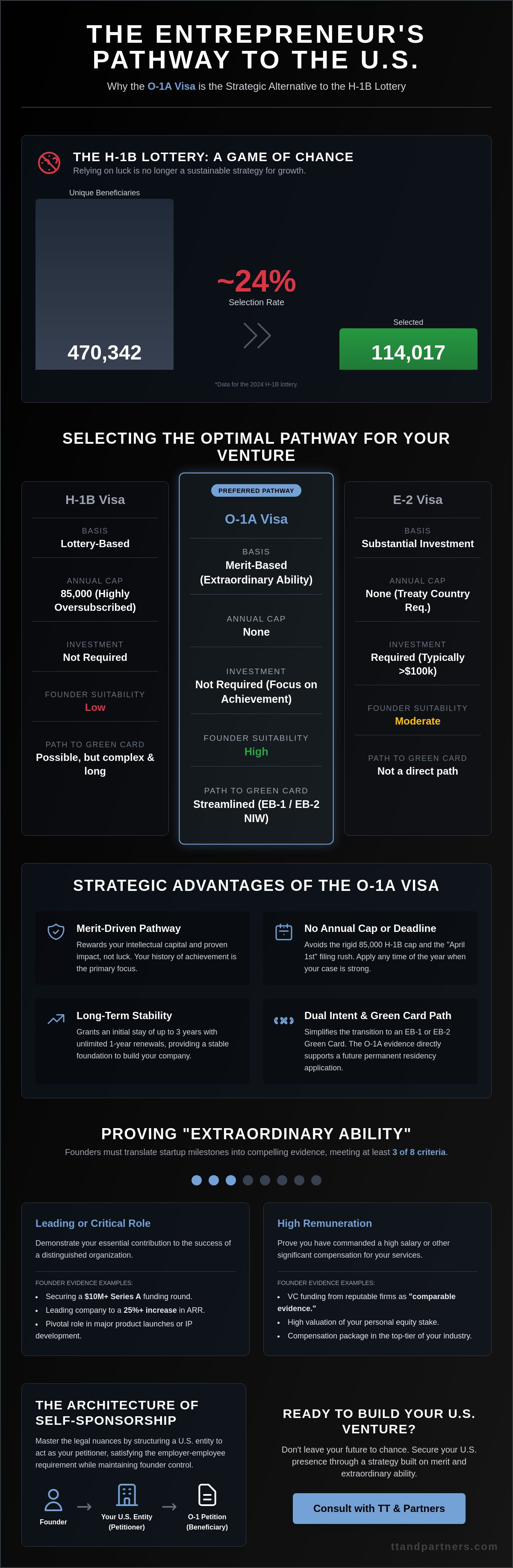
The 2024 H-1B lottery results revealed a stark reality for global talent: with only 114,017 selections out of 470,342 unique beneficiaries, relying on chance is no longer a sustainable strategy for growth. You've likely felt the weight of these constraints, where your pursuit of an O-1 visa for entrepreneurs or the management of steep E-2 investment requirements feels like an uphill battle against rigid administrative barriers. It's a frustrating paradox to possess the vision for a visionary enterprise yet remain sidelined by a random number generator.
This guide provides the intellectual framework to master the strategic architecture of the O-1A, allowing you to secure US residency for your startup through the lens of extraordinary ability rather than luck. You'll learn how to leverage VC funding rounds and complex equity structures as definitive evidence of your professional caliber. We'll outline the precise steps to establish a US legal entity that functions as your sponsor, transforming your individual innovation into a permanent presence within the American market.
Key Takeaways
Discover why the O-1 visa for entrepreneurs serves as the premier pathway to the US, bypassing the H-1B lottery and the restrictive capital requirements of traditional investor visas.
Learn to translate your startup’s milestones—from venture funding to intellectual property—into compelling evidence that satisfies the USCIS "Extraordinary Ability" criteria.
Evaluate the strategic architecture of the O-1A against alternatives like the E-2 treaty visa and the International Entrepreneur Rule to determine the most sustainable foundation for your venture.
Master the legal nuances of self-sponsorship by structuring your US entity to satisfy the employer-employee relationship requirement while maintaining founder control.
Understand how to construct a rigorous legal narrative that anticipates potential Requests for Evidence, ensuring your petition reflects the intellectual depth of your professional journey.
Table of Contents Strategic Advantages of the O-1 Visa for Entrepreneurs in 2026 Deciphering the 8 Extraordinary Ability Criteria for Startup Founders O-1 vs. E-2 and IER: Selecting the Optimal Pathway for Your Venture The Architecture of Self-Sponsorship: Structuring Your US Entity Navigating the O-1 Application Process with TT & Partners
Strategic Advantages of the O-1 Visa for Entrepreneurs in 2026
The O-1A visa stands as the most sophisticated instrument for international business leaders aiming to scale within the United States. It's a merit-driven pathway that rewards intellectual capital and proven impact rather than the luck of a lottery. Unlike the H-1B, which remains constrained by a rigid annual cap of 85,000 slots, the O-1 visa for entrepreneurs provides an uncapped solution for those who can demonstrate extraordinary ability. This distinction is vital for founders who can't afford the uncertainty of a random selection process that, in recent years, has seen selection rates drop below 15% for some categories.
The structural benefits of the O-1A extend beyond its availability. It offers an initial stay of up to three years, with the unique advantage of unlimited one-year renewals. This creates a stable long-term foundation for building a company. Since there's no numerical annual limit, applicants can file at any time of the year, avoiding the "April 1st" filing pressure associated with other work visas. The various O-1 visa classifications provide a structured hierarchy for talent, with the O-1A specifically reserved for those in the top percentage of their field in science, education, business, or athletics.
Building a bridge to permanent residency is a core strategic goal for most founders. While the O-1 is technically a non-immigrant visa, it functions with a "dual intent" flexibility that simplifies the transition to an EB-1 or EB-2 Green Card. The evidence used to secure an O-1A often mirrors the requirements for the EB-1A (Extraordinary Ability) or the EB-2 National Interest Waiver. This alignment means the O-1 isn't just a temporary permit; it's the first phase of a permanent US presence.
The O-1A vs. Traditional Work Visas
Founders often find the H-1B's rigid employer-employee relationship and prevailing wage requirements incompatible with early-stage growth where salaries might be variable. The O-1A offers a more flexible framework, allowing for diverse compensation structures including equity and performance-based bonuses. Unlike the E-2 Treaty Investor visa, which requires a "substantial" personal financial investment typically exceeding $100,000, the O-1A focuses on the individual's history of achievement. The O-1A represents a merit-based architecture for global innovation, prioritizing intellectual capital over mere financial stake.
2026 Policy Landscape for Extraordinary Ability
The regulatory environment in 2026 reflects the maturity of USCIS policy updates initiated in 2022 and 2024, which specifically expanded criteria for STEM and tech founders. Adjudicators now place higher weight on venture capital backing from reputable US firms as "comparable evidence" of high salary or commercial success. Following the 2023 Executive Order on Artificial Intelligence, entrepreneurs in critical and emerging technology sectors benefit from clarified standards. This focus on "National Interest" has led to more predictable processing times, especially for those whose ventures align with US technological leadership. To align your expansion strategy with these current standards, you can consult with our team through our contact page.
Deciphering the 8 Extraordinary Ability Criteria for Startup Founders
Securing an O-1 visa for entrepreneurs requires more than just a successful business. It demands a structured architectural approach to your professional history. To qualify, you must meet at least three of the eight specific criteria outlined in the Official O-1 Visa Requirements. For a founder, this process involves translating venture milestones into the rigid, evidence-based language of USCIS. You aren't just building a company; you're documenting a legacy of excellence that sets you apart from your peers in the global market of 2026.
Critical Roles and High Remuneration
Proving a "Leading or Critical Role" requires demonstrating that your presence was essential to the success of a distinguished organization. If your leadership resulted in a 25% increase in annual recurring revenue or the successful close of a $10 million Series A round, these are quantifiable data points. High remuneration is often the most direct path for founders. Even if your base salary is modest, the valuation of your equity and the capital raised from top-tier investors serve as powerful metrics. VC term sheets serve as evidence of professional value. These documents show that sophisticated market actors have appraised your talent at a premium, placing your compensation well above the industry average for similar roles.
Judging, Memberships, and Awards
Acceptance into elite accelerators like Y Combinator or Techstars provides a strong foundation for the "Membership" criterion. These programs maintain acceptance rates below 3%, making them exclusive professional associations. To satisfy the "Judging" requirement, you might serve as a mentor for startup competitions or peer-review technical papers for industry journals. Awards don't need to be a Nobel Prize to be effective. "Lesser Nationally or Internationally Recognized Prizes" can include prestigious grants, such as those from the Small Business Innovation Research (SBIR) program, or being named to influential industry lists. Each piece of evidence must be framed within the context of its exclusivity and prestige.
Evidence Checklist for Founders
Mapping your original contributions is the most nuanced part of the application. This involves documenting how your patents, proprietary algorithms, or unique business models have significantly impacted the sector. You'll need expert opinion letters from industry titans who can testify to the "originality" and "significance" of your work. For a deeper dive into organizing these documents, consult our O-1 Visa Criteria: The 2026 Strategic Checklist for Extraordinary Talent. Collecting this evidence early ensures that your O-1 visa for entrepreneurs application is built on a foundation of facts rather than claims. If you're ready to begin this structural mapping of your career, contact us for a professional assessment.
O-1 vs. E-2 and IER: Selecting the Optimal Pathway for Your Venture
The choice between visa categories reflects the underlying architecture of a business. For many, the O-1 visa for entrepreneurs stands as a testament to individual merit rather than capital reserves. While the E-2 Treaty Investor visa remains a staple for European founders with significant liquidity, it demands a substantial investment that often exceeds $100,000 in at-risk capital. In contrast, the O-1A focuses on the founder's intellectual and professional trajectory. This makes it a cleaner fit for those who prioritize talent over treasury.
The International Entrepreneur Rule (IER) provides a third, albeit temporary, alternative. Following the USCIS threshold adjustments on October 1, 2024, the IER allows founders to stay in the US for up to five years through parole status. To qualify, the venture must have received at least $311,071 from qualified US investors within 18 months of the application. While the O-1 requires no specific ownership percentage, the IER mandates a minimum 10% stake. This creates a distinct shift from ability to equity requirements, requiring a different style of strategic planning.
The Investment vs. Talent Debate
Bootstrapped founders often find the O-1 more sustainable than the E-2 because it doesn't tie legal status to a specific dollar amount sitting in a bank account. If your operations rely heavily on the movement of goods or services between the US and your home country, the E-1 Treaty Trader Visa: The 2026 Strategic Guide offers a pathway focused on trade volume rather than capital investment. This distinction is vital for service-based startups where the primary asset is the founder's expertise. It's about building a foundation that matches the company's actual growth phase rather than forcing an artificial capital injection.
O-1 to Green Card Transition
Transitioning from an O-1 visa for entrepreneurs to a permanent Green Card requires a long-term vision. Because the O-1A criteria mirror the EB-1A Green Card requirements so closely, founders can often reuse 80% of their existing evidence. If the EB-1A threshold feels too high, the EB-2 National Interest Waiver (NIW) serves as a robust secondary option. The NIW bypasses the labor certification process if the founder's work has substantial merit. Understanding the financial implications is essential; you should consult How Much Is a Green Card? The 2026 Cost and Strategy Guide to map out your long-term fiscal commitment. For personalized mapping of these routes, you can reach out through our contact page.
The Architecture of Self-Sponsorship: Structuring Your US Entity
Building a US venture requires a foundation as precise as a blueprint. For the O-1 visa for entrepreneurs, this foundation is the "Employer-Employee Relationship." USCIS doesn't allow pure self-petitioning; there must be a distinct legal entity acting as the petitioner. Even if you own 100% of the shares, the company's governance must prove you're an employee subject to its control. This isn't a mere formality. It's the structural integrity of your legal status.
The Board of Directors provides the "Right of Control" required by 8 CFR 214.2(o)(2). They must possess the legal authority to hire, fire, and supervise the beneficiary. In the 2026 regulatory environment, USCIS scrutinizes these relationships to ensure they aren't illusory. A well-composed board creates a clear separation between your role as a visionary founder and your role as a sponsored professional, satisfying the standards established in the 2010 Neufeld Memo.
Choosing between an LLC and a C-Corp is a decision of business architecture. C-Corporations offer a traditional hierarchy that USCIS officers recognize immediately. LLCs provide tax flexibility but require more complex Operating Agreements to establish the necessary oversight. The goal is to create a functional system where the entity exists independently of the individual, ensuring the petition stands up to rigorous administrative review.
Establishing the US Petitioner
Incorporating early is essential for establishing the petitioner's history. A US entity must be active and capable of entering into contracts. For those managing multiple projects or working independently, an "Agent" can serve as the petitioner. This structure is ideal for freelancers who need a centralized sponsor for varied engagements. You can explore the nuances of LLC Incorporation: A Strategic Guide to US Business Architecture and how to select your advocate in our O-1 Visa Sponsor Guide: Choosing the Right Petitioner in 2026.
Governance and Control
Corporate bylaws must be drafted with precision to satisfy the "Separation of Power" requirement. They should explicitly detail how the board exercises its right of control over the founder. The entity also needs to demonstrate the financial capacity to pay the offered wage, often verified through bank statements or 2025 tax filings. For founders with diverse interests, a detailed "Itinerary" provides the temporal framework for their activities across different ventures, ensuring every professional move is documented and authorized.
If you're ready to design your corporate structure for immigration success, contact our strategic advisors today.
Navigating the O-1 Application Process with TT & Partners
Constructing a successful petition for the O-1 visa for entrepreneurs resembles the assembly of a complex architectural project. It requires more than a collection of certificates; it demands a cohesive legal narrative. This narrative functions as the conceptual framework of the case, transforming a disparate list of media mentions and venture capital rounds into a singular vision of extraordinary ability. We don't just list achievements. We curate them to show how your presence in the US market will drive innovation and provide a functional benefit to the economic fabric.
When USCIS issues a Request for Evidence (RFE), we treat it as an opportunity for intellectual rigor rather than a setback. Since the USCIS policy updates effective April 1, 2024, the scrutiny on founder-led petitions has intensified. Current data suggests RFE rates for high-level specialty visas can fluctuate near 25 percent. We manage these phases with a precision that leaves no room for ambiguity, responding with technical data and expert testimonials that reinforce the original structural integrity of the petition.
For founders operating on accelerated venture capital cycles, time is a critical resource. Premium Processing remains a vital tool, guaranteeing a decision within 15 calendar days. This speed allows entrepreneurs to transition from Italian markets to US operations without the 6 to 10 month delays typical of standard adjudication. It's a strategic choice for those who need to be on the ground in Silicon Valley or New York to close a Series A or oversee a product launch.
The TT & Partners Methodology
Our approach bridges the distance between Italian heritage and American innovation. We apply the same precision found in our guide to International Litigation 2026: A Strategic Guide to our immigration practice. We ensure Italian entrepreneurs remain compliant with both domestic and foreign regulations as they scale. We understand the "Made in Italy" ethos and how to project that value within the American regulatory framework, ensuring your business structure is as resilient as it is ambitious.
Next Steps: Consultation and Strategy
Building an extraordinary profile doesn't happen overnight. We develop a 12 month roadmap to identify and fill evidentiary gaps, focusing on high-impact publications and leadership roles. Whether you're preparing for a consular interview in Rome or a change of status within the United States, the strategy remains constant and disciplined. Success in the O-1 visa for entrepreneurs category is the result of deliberate planning and professional alignment. Schedule a strategy session with Tosolini, Toniutti & Partners to begin your expansion into the US market.
Architecting Your US Expansion for 2026
Success in the American market begins with a structural foundation that's as robust as the venture itself. Navigating the O-1 visa for entrepreneurs involves a precise alignment of your professional milestones with the 8 regulatory benchmarks defined by USCIS. By 2026, the strategic advantage lies in self-sponsorship models that allow founders to maintain operational control while demonstrating extraordinary ability. This pathway offers a level of flexibility that traditional E-2 or IER options often lack, especially for those who've already secured significant venture capital or industry awards.
At TT & Partners, we apply a design-led methodology to legal strategy, drawing on decades of experience in US-Italy cross-border immigration. We don't just process paperwork; we build the legal architecture necessary for high-stakes business relocation. Our boutique expertise ensures that every application reflects professional excellence and visionary intent. It's about creating a sustainable presence in a new urban fabric through rigorous planning and technical accuracy.
Your vision deserves a framework that supports its highest ambitions.
Frequently Asked Questions
Can I qualify for an O-1 visa if my startup is pre-revenue?
Yes, you can qualify without revenue by demonstrating extraordinary ability through venture capital funding or prestigious accelerator participation. USCIS policy updates from January 2022 specifically clarify that high-value investment from entities like Y Combinator or Sequoia Capital serves as evidence of professional recognition. Founders often utilize 3 or more of the 8 regulatory criteria to build a successful case that emphasizes their intellectual contribution.
Does equity count toward the O-1 high salary requirement?
Equity compensation counts toward the high remuneration criterion when supported by a formal valuation or recent funding round data. You'll need to provide a 409A valuation or a cap table illustrating the specific dollar value of your shares. According to 8 CFR 214.2(o), the total compensation package must be significantly higher than the 90th percentile for your specific role and geographic location in the United States.
What is the minimum investment for an O-1 visa?
There's no statutory minimum investment required for the O-1 visa for entrepreneurs. Unlike the EB-5 program which requires 800,000 USD or more, the O-1 focuses on your individual expertise and the strategic potential of your venture. While 0 USD in personal investment is acceptable, having 100,000 USD or more in seed funding often helps validate the business's viability and your role within the organization.
Can I sponsor myself for an O-1 visa through my own LLC?
You can sponsor yourself through your own LLC provided a legal separation exists between you as the employee and the company as the petitioner. This typically requires a Board of Directors or a separate manager who has the authority to hire, fire, or supervise your work. Establishing this employer-employee relationship is a critical structural element that satisfies the 2010 USCIS Neufeld Memorandum requirements for self-employed individuals.
How long does the O-1 visa for entrepreneurs last?
The initial O-1 visa period lasts for a maximum of 3 years. This timeframe is tied to the specific duration of the event or business plan submitted in your petition. If your project's timeline spans 36 months, USCIS will generally grant the full period. You should ensure your employment agreement and itinerary reflect this 3-year horizon to maximize your initial stay and maintain professional continuity.
What happens if my O-1 visa application is denied?
You have the option to file a motion to reopen, appeal to the Administrative Appeals Office, or submit a new petition with stronger evidence. Data from 2023 indicates that many applicants choose to re-file immediately with additional documentation rather than pursuing lengthy appeals. A denial doesn't prevent you from applying again if you've addressed the specific deficiencies identified in the official USCIS decision letter.
Can my spouse and children join me on an O-1 visa?
Your spouse and unmarried children under 21 are eligible for O-3 nonimmigrant status. This allows them to reside in the United States and attend school, though they aren't permitted to work under this specific classification. They'll need to file Form I-539 to change or extend their status. This family unity ensures your professional transition remains sustainable and balanced while you build your American enterprise.
Is there a limit to how many times I can renew my O-1 visa?
There's no limit to the number of times you can renew an O-1 visa for entrepreneurs. Extensions are typically granted in 1-year increments for existing projects, while new 3-year periods are available if you initiate a new business venture or a significant expansion. This flexibility makes the O-1 a highly functional, long-term solution for visionary leaders who intend to scale multiple companies over several decades.


Comments