

International Litigation 2026: A Strategic Guide to US-Italy Legal Disputes

Updated: Apr 11
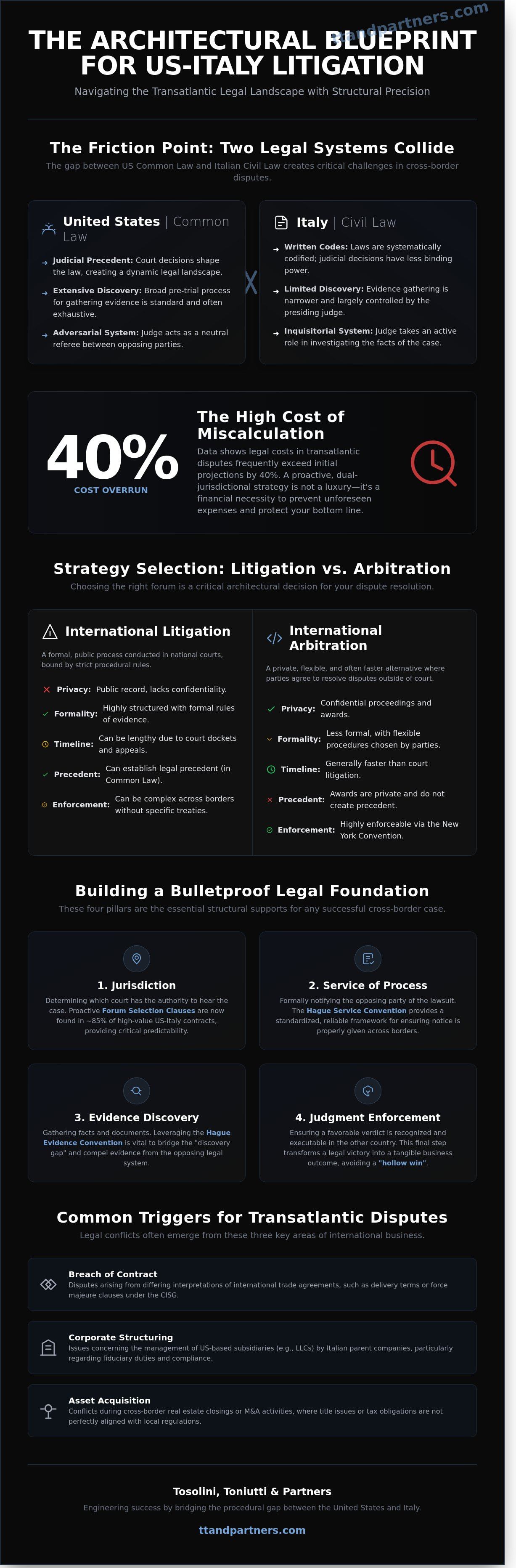
What if the structural integrity of your cross-border strategy depended not on the strength of your argument, but on the precise calibration of the forum where it's heard? Most legal departments recognize that the gap between Italian civil codes and US common law creates a friction that can destabilize even the most robust commercial partnerships. You likely feel the weight of this uncertainty when considering the 2024 data showing that legal costs in transatlantic disputes often exceed initial projections by 40 percent. This lack of transparency in foreign courts can feel like building on shifting sand.
We'll show you how to apply architectural precision to your dual-jurisdictional strategy, ensuring you manage the complexities of international litigation with a clear, functional roadmap. This guide provides the structural framework you need to decide between litigation and arbitration while securing the ability to enforce judgments across borders with total confidence. We're providing the blueprint to transform legal uncertainty into a stable, visionary path forward for your transatlantic interests.
Key Takeaways
Adopt a proactive, dual-jurisdictional stance to navigate the increasing complexity of US-Italy trade and investment landscapes in 2026.
Secure your legal foundation by mastering the nuances of jurisdiction, service of process, and the critical role of forum selection clauses in commercial contracts.
Determine whether the formal structure of international litigation or the privacy of arbitration offers the most effective path to your specific resolution.
Overcome the "discovery gap" between US and Italian systems by leveraging the Hague Evidence Convention to obtain essential evidence and testimony.
Apply an architectural philosophy to legal disputes, treating each case as a precisely engineered project that bridges the procedural gap between the United States and Italy.
Table of Contents
Navigating the Landscape of International Litigation in 2026
International litigation represents the complex intersection of distinct legal systems where disputes transcend national borders. It demands a mastery of procedural codes that often conflict, requiring more than just legal knowledge; it necessitates a structural understanding of how different jurisdictions interact. As we move through 2026, the volume of trade between Italy and the United States continues to expand. Data from early 2025 suggests that transatlantic investment has reached record levels, making a proactive legal posture essential for any entity operating in this corridor. This specific brand of litigation isn't merely a court battle. It's a high-stakes coordination of sovereignty, treaty law, and procedural strategy.
Cross-border disputes differ fundamentally from domestic cases because they collide with the principles of national sovereignty. When a conflict arises, the "Legal Architecture" approach becomes vital. This methodology involves building a claim or defense that possesses the structural integrity to withstand scrutiny in two separate legal environments simultaneously. It's about ensuring that a victory in a New York court doesn't become a hollow win that's unenforceable in Rome. For those managing complex assets, seeking professional consultation at ttandpartners.com/contact ensures that the foundation of your legal strategy is sound across both territories.
Why US-Italy Legal Disputes Require a Dual-Perspective Strategy
The divide between Italy's Civil Law tradition and the United States' Common Law system creates a unique friction. Italian courts rely heavily on written codes and statutes, while US courts are shaped by judicial precedent and extensive discovery processes. Bilateral treaties, such as the 1984 Treaty on Mutual Legal Assistance, serve as the scaffolding for these interactions. A legal team restricted to a single country's perspective often lacks the vision to anticipate how a move in one jurisdiction will echo in the other. Success in international litigation requires a holistic view of the entire transatlantic legal fabric to prevent procedural collapse.
Common Triggers for Transatlantic Legal Conflicts
Disputes often emerge from the very structures designed to facilitate growth. In 2026, the most frequent catalysts for legal action include:
Breach of contract: Misunderstandings in international trade agreements often stem from differing interpretations of force majeure or delivery terms under the CISG (Contracts for the International Sale of Goods).
Corporate structuring: Issues frequently arise from LLC incorporation and the management of US-based subsidiaries by Italian parent companies, particularly regarding fiduciary duties.
Asset acquisition: Conflicts during real estate closings involving Italian nationals often trigger international litigation when title issues or tax obligations aren't perfectly aligned with local regulations.
Effective resolution in these areas requires more than reactive measures. It demands a design-thinking approach to law where every contract clause and corporate filing serves as a pillar of a much larger, global structure. By 2026, the cost of legal misalignment has risen by 12% compared to previous years, making precision an absolute requirement for transatlantic success.
While this guide focuses on commercial litigation, the same principles of jurisdictional precision apply to personal legal planning. For example, those navigating complex international lives can explore family law to ensure their personal assets and family structures are protected across different legal systems.
Structural Foundations: Jurisdiction and Service of Process
Successful international litigation starts with a rigorous blueprint. Just as an architect analyzes soil stability before laying a foundation, a legal team must determine which court holds the specific power to hear a case. Jurisdiction isn't a mere formality; it's the structural framework that dictates every subsequent move. Forum selection clauses now appear in approximately 85% of high-value commercial contracts between Italian and American firms. These clauses provide a predictable map, yet they aren't always bulletproof. If a contract is silent, the doctrine of forum non conveniens applies. This requires a court to weigh private and public interest factors to decide if a different venue is significantly more appropriate for the dispute.
Personal jurisdiction requires that a defendant has "minimum contacts" with the forum. For an Italian company, this might mean a physical office or a sustained stream of commerce in a specific US state. Subject matter jurisdiction is different; it concerns the court's authority over the specific type of legal claim. In the US, federal courts often handle these cases if the amount in controversy exceeds $75,000 and involves diverse citizenship. Every claim must fit within these narrow parameters to survive a motion to dismiss.
Determining the Proper Forum: Where Should You Sue?
Choosing between US federal courts and Italian tribunals involves a cold calculation of resources and strategy. US courts offer aggressive discovery rules and jury trials, which can be advantageous but also expensive. Italian tribunals, governed by the Code of Civil Procedure, focus on written evidence and court-appointed experts. Long-arm statutes in states like New York or California allow US courts to reach Italian entities if they've conducted business or caused a tortious act within those borders. A 2024 risk assessment suggests that litigating in Italy can be 60% more cost-effective for debt recovery, while the US remains the preferred site for complex intellectual property disputes.
Navigating the Hague Service Convention
The Hague Service Convention is the mandatory architecture for serving process between Italy and the US. It's not a suggestion; it's a treaty requirement. Common pitfalls, such as failing to provide a certified Italian translation or bypassing the formal Central Authority, often lead to immediate dismissal. As of 2026, the Central Authority functions as the primary digital clearinghouse for the electronic transmission and authentication of judicial documents between treaty nations. Precision in this phase is vital. Small errors in the service packet can delay a case by 12 months or more. If you're planning a cross-border strategy, it's wise to consult with partners who understand these technical nuances. Effective international litigation relies on this initial technical accuracy to ensure the case reaches its merits.
Strategy Selection: Comparing Litigation and International Arbitration
The architecture of a dispute resolution defines its ultimate stability. Just as an architect selects materials based on the site's environmental stressors, legal counsel must choose a forum that aligns with the specific commercial context of Italy-US trade. This structural choice determines whether a case follows the rigid tracks of national courts or the more fluid, tailored path of arbitration. The decision isn't merely procedural; it's a strategic foundation that dictates the speed, cost, and finality of the result.
Litigation remains the traditional pillar of legal conflict. It's public, formal, and strictly governed by national procedural codes. For a US entity, this means facing the Italian Giudice Ordinario under the Italian Code of Civil Procedure; for an Italian firm, it might mean the complexities of a US jury trial. While international litigation offers a clear path for public vindication, it often lacks the specialized technical nuance required for complex cross-border architectural or engineering disputes. Decisions in court are bound by rigid precedents that don't always reflect the evolving needs of global commerce.
Arbitration offers a private, sophisticated alternative. It's often more efficient for complex business deals because parties select their own decision-makers. The 1958 New York Convention acts as the global gold standard here. With 172 contracting states as of 2024, an arbitration award is frequently easier to enforce across borders than a standard court judgment. This framework provides a level of certainty that international litigation sometimes struggles to match, especially when assets are spread across multiple jurisdictions. If you're looking to build a secure framework for your cross-border ventures, you can contact us to discuss the most resilient strategy for your specific project.
When to Choose Litigation in National Courts
Use litigation when public policy or specific regulatory hurdles are at stake. If you need a legal precedent to influence future contracts, the public record of a court is vital. In Italy, the Giudice Ordinario provides a structured environment, though cases can take 500 to 1,000 days to reach a first-instance conclusion. US jury trials offer a different risk profile, often resulting in higher damages but less predictability than European bench trials.
The Advantages of International Arbitration for Business
Confidentiality: It protects proprietary trade secrets and sensitive financial data from the public eye.
Expertise: Parties can appoint arbitrators with specific US-Italy commercial knowledge, ensuring the decision-makers understand industry-specific technical jargon.
Neutrality: This eliminates the "home court advantage," placing both parties on equal footing in a third-party venue like Paris or Zurich.
Executing the Plan: Evidence Discovery and Judgment Enforcement
Successful international litigation requires more than a favorable verdict; it demands a structural understanding of how evidence is built and how value is recovered. The US legal framework relies on broad disclosure, where parties exchange vast amounts of information before trial. Italy follows a civil law tradition where the judge controls evidence gathering, focusing on specific, pre-defined documents. This gap creates a strategic friction that counsel must bridge through meticulous planning. It's not just about the law; it's about the architecture of the case itself.
Obtaining Evidence Across Borders
The Hague Evidence Convention of 18 March 1970 provides the primary framework for cross-border cooperation. Litigants use 'Letters of Request' to ask foreign courts for testimony or document production. In the United States, 28 U.S.C. § 1782 serves as a vital tool. It allows Italian parties to obtain discovery from US-based entities for use in foreign proceedings without a reciprocal requirement. This can include depositions, which don't exist in the same format within the Italian system. However, practitioners must account for the General Data Protection Regulation (GDPR) under Regulation (EU) 2016/679. Transferring personal data from Milan to New York requires strict adherence to Article 44. You can't ignore these privacy constraints without risking the structural integrity of your evidence.
Enforcing Foreign Judgments in the US and Italy
Winning a case is merely the foundation; the structure is only complete when assets are secured. In the US, state courts recognize Italian judgments under the Uniform Foreign-Country Money Judgments Recognition Act, provided the original proceedings met due process standards. Conversely, Italy utilizes the 'Exequatur' process under Law 218/1995 to validate US court orders. By January 1, 2026, the 2019 Hague Judgments Convention will mandate that any judgment seeking enforcement must be final and conclusive in its state of origin, leaving no room for pending appeals or procedural stays. Identifying assets requires a forensic lens. In the US, this involves searching UCC filings and real property records across 50 states. In Italy, it requires access to the Anagrafe Tributaria and the Pubblico Registro Automobilistico to map out a debtor's holdings. Effective international litigation involves identifying these tangible assets early, ensuring the final judgment isn't just a symbolic victory.
Strategic planning is the key to recovering cross-border assets. Contact our legal strategy team to discuss your enforcement needs.
Engineering Success: The TT and Partners Approach to Litigation
At Tosolini, Toniutti & Partners, we view international litigation as a calculated architectural project rather than a series of reactive maneuvers. Our philosophy centers on structural integrity; every case demands a blueprint that accounts for the specific stresses of two distinct legal systems. Success requires more than just legal knowledge. It needs a vision that spans the Atlantic. We don't just react to conflict. We design resolutions that respect the delicate balance between New York's procedural rigor and Italy's substantive traditions.
Moving from a state of dispute to a final resolution requires professional poise and a deep commitment to the long-term health of your enterprise. We eliminate the friction often found in cross-border cases. By maintaining
Mastering the Architecture of Transatlantic Dispute Resolution
Navigating US-Italy legal conflicts in 2026 requires more than tactical awareness; it demands a structural blueprint that anticipates shifts in jurisdiction and the 1970 Hague Convention protocols. Success rests on two pillars: the precise selection between litigation and arbitration and the rigorous execution of evidence discovery across borders. Our firm applies a Legal Architect approach to every case, ensuring every motion and filing contributes to a stable, long-term outcome. We don't just react to conflict; we design the path toward its resolution.
With over 25 years of specialized experience in cross-border corporate and real estate disputes, we provide the dual-jurisdictional expertise necessary to bridge the gap between Italian civil law and the US federal system. By integrating digital forensic standards with traditional advocacy, we ensure your interests remain protected in the evolving landscape of international litigation. It's time to build a strategy that withstands the complexities of the modern global market. We look forward to helping you secure a definitive and sustainable resolution.
Frequently Asked Questions
How long does international litigation typically take between the US and Italy?
International litigation between these two jurisdictions typically spans 3 to 5 years. Italian civil courts average 500 days for the first instance alone, while US federal cases often reach a resolution within 24 months. Complex matters involving the Hague Convention for service of process add 6 to 9 months to the initial timeline.
Can I enforce a US court judgment in Italy without a new trial?
You can enforce a US judgment in Italy through the "delibazione" process under Law 218/1995 without retrying the merits. Italian Courts of Appeal verify seven specific criteria, including proper service and compatibility with public policy. This recognition procedure generally concludes within 12 to 18 months depending on the court's current backlog.
What is the cost difference between litigation and international arbitration?
International arbitration typically carries a 25% higher initial cost than traditional court proceedings due to tribunal fees and administrative charges. However, it often proves more economical long-term because it limits the grounds for appeal. Litigation involves lower filing fees but costs frequently exceed $150,000 when multi-year proceedings and local counsel fees accumulate.
Do I need a separate lawyer in both the US and Italy for my case?
You need licensed counsel in both countries to navigate the distinct procedural mandates of each legal system. Italian law requires a "procuratore" for local filings, while US courts demand state-specific bar admission. A firm with dual-qualified partners ensures your international litigation strategy remains cohesive and prevents conflicting legal arguments across borders.
What happens if a contract doesn't specify which country's law applies?
Courts apply "conflict of laws" principles, such as the Rome I Regulation in Italy, to determine the applicable legal framework. They usually select the law of the country with the closest connection to the contract's performance. In 85% of commercial disputes, this results in applying the law where the service provider's headquarters are located.
Can US discovery rules be used to get documents from an Italian company?
US discovery rules apply to Italian entities only through the specific framework of the 1970 Hague Evidence Convention. You can't use broad US discovery requests; instead, you must identify specific documents for the Italian Ministry of Justice to review. This formal process typically adds 4 to 7 months to the evidentiary phase of international litigation.
Is it possible to appeal an international arbitration award?
Appealing the substance of an international arbitration award is generally not permitted under the 1958 New York Convention. You can only move to set aside an award for narrow procedural irregularities, such as lack of proper notice or the tribunal exceeding its authority. Data shows that fewer than 10% of these challenges succeed in national courts.
How has the 2026 ETIAS update affected travel for legal proceedings?
The 2026 ETIAS update requires US citizens to obtain digital travel authorization before entering the Schengen Area for hearings or depositions. This permit costs 7 Euros and remains valid for 3 years once linked to your passport. Legal teams should submit applications 30 days before departure to avoid delays during high-traffic periods.



Comments