

Letters Rogatory from Italy to the US: Filing Steps and Fees

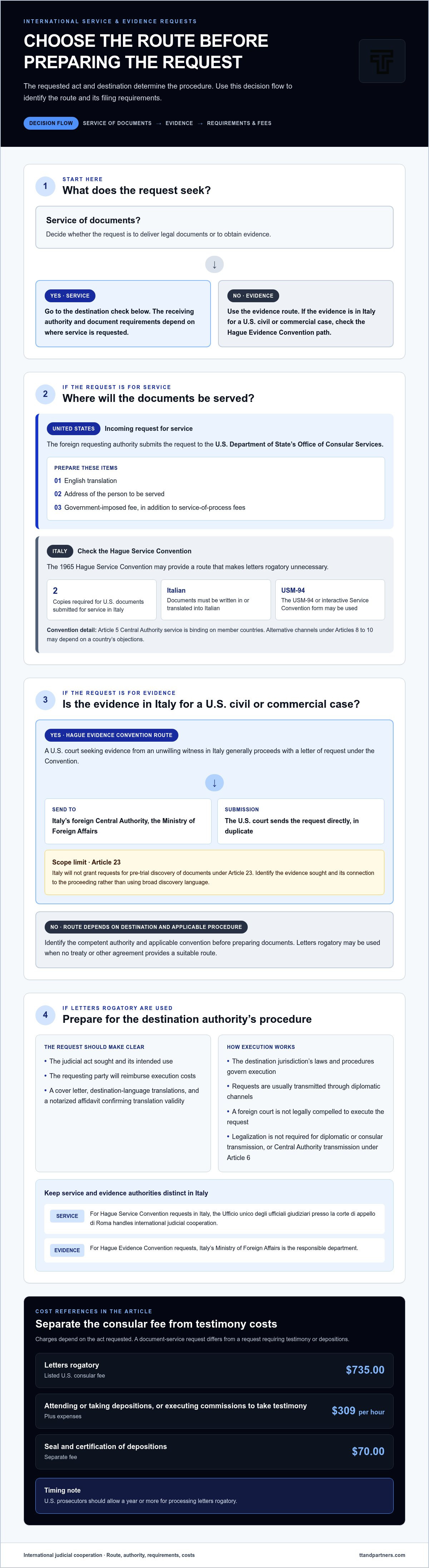
The letters rogatory process from Italy to the US begins by identifying the correct route: a convention-based service request may make letters rogatory unnecessary. For an incoming request to serve documents in the United States, the foreign requesting authority submits it to the U.S. Department of State’s Office of Consular Services. The request must be translated into English, include the recipient’s address, and include a government-imposed fee in addition to service-of-process fees.
It is understandable to focus on where to file, but the route and required charges depend on the request and the applicable procedure. This guide explains how to initiate service, how the relevant conventions affect the process, where an incoming request is sent, and how consular fees apply.
You’ll also learn how service requests differ from requests to obtain evidence, so you can identify the correct procedural path before preparing the documents.
Table of Contents
How do I initiate an international service of process request?
First determine whether the request seeks service of documents or evidence. The applicable convention and destination jurisdiction determine the route. For service in the United States, the foreign requesting authority submits the request to the U.S. Department of State’s Office of Consular Services.
Italian Central Authority
An Italian Central Authority is the designated body responsible for handling a particular convention-based request. For Hague Service Convention requests in Italy, the Ufficio unico degli ufficiali giudiziari presso la corte di appello di Roma handles international judicial cooperation. For Hague Evidence Convention requests, the Ministry of Foreign Affairs is the responsible department. These roles are distinct, so identify whether the request concerns service or evidence before preparing it.
For a request from Italy to the United States, the Italian court initiates the request, which then moves through diplomatic channels. The Rome office’s role in service requests within Italy does not make it the U.S. receiving authority. Match the transmission route to the request’s purpose and destination, then address the documents to the competent U.S. authority.
Hague Evidence Convention Requests
A Hague Evidence Convention request formally seeks evidence in a civil or commercial matter between participating authorities. If a U.S. court case requires evidence from an unwilling witness in Italy, the request generally proceeds as a letter of request under the Convention. The U.S. court sends it directly to Italy’s foreign Central Authority in duplicate.
Scope matters. Italy will not grant requests for pre-trial discovery of documents under Article 23. A request should therefore identify the evidence sought and its connection to the proceeding, rather than use broad discovery language. The Convention allows direct submission to a Central Authority, without involving the State Department. This route differs from diplomatic transmission of letters rogatory.
U.S. Rules for Letters Rogatory
U.S. rules govern how a request is carried out in the destination jurisdiction. A letter rogatory asks a foreign authority to take evidence or serve process, and execution follows the destination state’s laws and procedural rules. The U.S. authority handling the request must therefore apply U.S. procedures to testimony, document requests, or service.
For incoming service, provide an English translation, the address of the person to be served, and payment of the government-imposed fee in addition to service-of-process fees. These are practical filing requirements, not substitutes for the request itself. State clearly what action is requested so the U.S. authority can identify the appropriate procedure.
For service in Italy, the 1965 Hague Service Convention may provide a route that makes letters rogatory unnecessary. U.S. documents for service in Italy must be submitted in duplicate and written in or translated into Italian. The USM-94 or interactive Service Convention form may be used. Article 5 Central Authority service is binding on member countries; alternative channels under Articles 8 to 10 may depend on a country’s objections.
What are letters rogatory?
Letters rogatory are formal requests from a court in one country asking a judicial authority in another country to perform a legal act. They may seek service of process or evidence for use in a pending case, subject to the destination country’s laws. Courts generally use them when no applicable treaty or other agreement provides a suitable route.
For an Italy-to-U.S. request, diplomatic transmission means sending the court’s request through official channels between the two countries. U.S. prosecutors should allow a year or more for processing letters rogatory. Costs depend on the requested act: the listed U.S. consular fee for letters rogatory is $735.00, while testimony and deposition services can involve separate charges.
Transmission channels describe the authorized routes for delivering a request to the foreign authority. Under Article 4, letters rogatory may pass through interested parties, judicial channels, diplomatic or consular agents, or a Central Authority. In practice, they are usually transmitted through diplomatic channels. The route matters because a foreign court is not legally compelled to execute a request; comity supports its execution.
Prepare a clear request describing the judicial act sought and its intended use. Include a cover letter, translations into the destination country’s official language, and a notarized affidavit confirming the translations’ validity. For a request from Italy intended for use in the United States, prepare the documents in English. The request should also state that the requesting party will reimburse the authority for execution costs.
Legalization is authentication of documents for official use abroad. It is not required when letters rogatory travel through diplomatic or consular channels or through a Central Authority under Article 6. This exemption concerns legalization; it does not remove translation or execution-cost requirements. Keep the request, cover letter, translation affidavit, and any supporting documents together so the receiving authority can review them as one filing.
Separate the base consular charge from any services connected to testimony. According to the U.S. Department of State, attending or taking depositions, or executing commissions to take testimony, costs $309 per hour plus expenses. A seal and certification of depositions carries a separate $70.00 fee. The applicable charges turn on the act requested, the time involved, and related expenses, so a request for document service differs from one requiring testimony.
Interested parties bear the costs and other expenses of processing and executing letters rogatory under Article 12. State the reimbursement undertaking in the request and account for the relevant consular services when preparing it. A complete, properly translated submission gives the receiving authority the information needed to assess the requested act and associated costs.
Convention scope in civil and commercial proceedings
A convention sets out the agreed procedures participating countries can use for cross-border judicial requests. For Italy and the United States, distinguish service of process under the Hague Service Convention from evidence requests under the Hague Evidence Convention.
The Hague Evidence Convention covers requests for evidence when both the requesting and receiving authorities are in countries that are parties to it. Italy is a signatory to the 1970 Convention. In a civil or commercial case, a U.S. court seeking testimony from an unwilling witness in Italy generally uses a letter of request under that Convention. The court sends the request in duplicate directly to Italy’s Central Authority.
Scope also limits what the receiving authority may execute. Italy’s Central Authority will not grant pre-trial discovery of documents under Article 23 of the Hague Evidence Convention. A request should therefore identify specific evidence connected to the proceeding, rather than seek broad document discovery. The distinction between targeted evidence and pre-trial discovery affects whether the request fits the Convention’s procedures.
Service of process follows a separate convention and purpose: delivering judicial documents to a person in another country. Italy is a party to the 1965 Hague Service Convention. Under Article 5, service through a Central Authority is binding on member countries. Articles 8 to 10 provide alternative channels, which may depend on a member country’s objections. For U.S. documents going to Italy, the request must be in duplicate and written in or translated into Italian.
The Inter-American Convention on Letters Rogatory has its own defined scope, applying under Article 2 to civil and commercial proceedings before an appropriate judicial or other adjudicatory authority in a State Party. Article 3 excludes procedural acts involving measures of compulsion. This is a separate convention; its provisions should not be assumed to govern an Italy-to-U.S. request without establishing that the relevant authorities and countries fall within its framework.
Civil and commercial requests may use the Hague conventions when their subject and participating authorities meet the relevant scope. Criminal matters follow distinct assistance routes: the U.S.-Italy Mutual Legal Assistance in Criminal Matters Treaty is dated November 13, 1985, and U.S. criminal defendants seeking judicial assistance abroad are directed to letters rogatory under Article 5(j) of the Vienna Convention on Consular Relations. Family-law requests require identifying the precise act sought and the applicable convention, rather than assuming civil or commercial procedures automatically cover them.
Submission to the U.S. Department of State
For criminal evidence requests from Italy, transmit letters rogatory through diplomatic channels to the U.S. Department of State’s Bureau of Consular Affairs, Overseas Citizens Services, Office of American Citizens Services and Crisis Management, European Division. The Department receives and routes the request; the competent U.S. court or authority carries out the requested judicial act under U.S. procedures.
A submission route is the official channel for delivering a request to the authority responsible for handling it. Before filing, determine whether the request seeks evidence in a criminal matter, evidence under a convention, or service of process. These categories do not all use the same channel.
For criminal evidence, address the request to the State Department office named above and use diplomatic channels. Describe the assistance sought, such as taking testimony or obtaining identified documents, and explain its connection to the foreign proceeding. A precise description helps the receiving office determine the next step and identify the U.S. authority competent to act.
For evidence in a civil or commercial matter covered by the Hague Evidence Convention, a U.S. court’s request to Italy goes directly to Italy’s Central Authority in duplicate. This convention route does not involve the State Department. A Hague Convention letter of request is not interchangeable with criminal letters rogatory: the proceeding and requested act determine the route.
Incoming service of process follows a separate submission path. Foreign requesting authorities send requests for service in the United States to the U.S. Department of State’s Office of Consular Services. The documents must be translated into English, include the person’s address, and include the government-imposed fee in addition to service-of-process fees. These requirements apply to service, not evidence-taking.
Organize the filing around the requested act. Include the court’s request, a cover letter, required translations, and a notarized affidavit confirming the translations’ validity. State that the requesting party will reimburse the judicial authority for execution costs. Clearly identify supporting documents so the receiving office can distinguish the request from exhibits and translation materials.
Transmission through a diplomatic channel does not mean the State Department performs every requested act. For example, a request for testimony may require action by a competent U.S. court, while a service request follows the applicable service procedure. Letters rogatory are executed under the destination jurisdiction’s laws and procedural rules. A foreign court is not legally compelled to execute them, so clearly identify the request’s purpose and the assistance sought.
Follow this sequence: classify the proceeding, choose the matching channel, prepare the request and supporting papers, and transmit them through the appropriate official route. This distinction is central to filing letters rogatory from Italy to the United States.
Consular fees for letters rogatory
A consular fee is a charge for a service performed by a U.S. consular officer. The listed U.S. consular fee for letters rogatory is $735.00. Treat this as a distinct charge, not a complete estimate of every expense tied to a request. The requested act matters: taking testimony, certifying depositions, or arranging service can involve separate charges.
According to the U.S. Department of State, attending or taking depositions, or executing commissions to take testimony (per hour or part thereof), costs $309 per hour plus expenses. This charge applies to testimony-related work. For a request seeking testimony, account for both the hourly amount and expenses; a request seeking another act may have a different fee structure.
A deposition certification fee covers the seal and certification of deposition materials. The U.S. consular fee for providing a seal and certification of depositions is $70.00. Telephone depositions have separate listed charges: swearing in witnesses costs $265.00, while supervising telephone depositions costs $265.00 per hour or part of an hour after the first hour. These charges relate to specific services, so distinguish them from the general letters rogatory fee.
Some deposition requests are exempt from U.S. consular fees. Under 22 CFR 22.1 Schedule of Fees item 53(a), no fees are charged for depositions requested by U.S., state, or local government officials, or by parties found indigent by a court. The exemption concerns consular fees for those depositions; it should not be treated as a general waiver of every cost associated with processing or executing a request.
Service of process and evidence-taking also involve different cost components. Incoming service requests in the United States require a government-imposed fee in addition to service-of-process fees. Italian formal service fees are charged per defendant and per address, with the exact price depending on the specific service address. Italian Letters Rogatory service carries an additional government fee. Do not assume that the Hague Service Convention route and a letters rogatory request have identical charges.
To organize a request, list each requested act separately: service, testimony, deposition supervision, or certification. Then distinguish the applicable consular fee from execution expenses and other process fees. Article 12 places processing and execution costs on the interested parties. This breakdown gives the parties a practical basis for budgeting, while avoiding the mistake of treating the $735.00 fee as the only possible charge.
Tosolini, Toniutti & Partners: E-2 VISA
Tosolini, Toniutti & Partners assists individuals and businesses with E-2 VISA matters when U.S. immigration planning is part of a broader Italy-U.S. legal context. Letters rogatory address cross-border court requests; they are separate from visa applications. Keeping those processes distinct helps you identify the right legal support for each issue.
If your next step involves pursuing an E-2 VISA or considering a GREEN CARD, the firm can help with those immigration matters. Its work also includes E-1 VISA and O-1 VISA cases, allowing support to align with the immigration pathway relevant to your circumstances.
For guidance on an immigration matter connected to your U.S.-Italy plans, contact Tosolini, Toniutti & Partners.
Choose the Right Next Step for Your Cross-Border Matter
A court request and an immigration plan serve different purposes, but both benefit from a clear understanding of the legal objective. Before proceeding with the letters rogatory process from Italy to the U.S., define what the request must accomplish and how it fits into the wider dispute or business matter.
For cross-border disputes, Tosolini, Toniutti & Partners provides international litigation support. For separate U.S. immigration needs, the firm handles E-1, E-2, and O-1 visas. Keeping these matters distinct helps direct each issue to the appropriate legal pathway.
If you’re considering legal support for a cross-border matter, contact Tosolini, Toniutti & Partners to discuss a suitable next step. A well-defined objective gives you a stronger starting point for the work ahead.
Frequently Asked Questions
What are the hurdles?
The main hurdles are choosing the correct legal route, defining the requested act, and preparing usable documents. Evidence requests differ from service of process, while civil and commercial proceedings differ from criminal matters. Broad document demands can also face treaty limits: Italy’s Central Authority will not grant pre-trial document discovery under Article 23 of the Hague Evidence Convention. Specify the evidence sought and its connection to the case.
What is it?
Letters rogatory are formal requests from a court in one country asking a judicial authority in another country to perform an act for a pending case. The act may involve serving documents or obtaining evidence, subject to the destination country’s procedures. For example, an Italian court may seek testimony from a witness in the United States. The request seeks judicial assistance; it is not itself a U.S. court order.
What’s it used for?
Courts use letters rogatory to seek judicial assistance across national borders, particularly when no applicable treaty provides the relevant procedure. A request may seek service of court documents or evidence, such as testimony. The requested act determines what to prepare: serving a defendant requires different information from asking a witness to testify. Identify the act precisely and explain its connection to the proceeding.
What are letters rogatory and when are they used to obtain evidence from the United States for an Italian court case?
Letters rogatory are formal requests from an Italian court asking a U.S. authority to obtain evidence for an Italian proceeding. For criminal matters, the request follows the relevant diplomatic route; U.S. prosecutors seeking treaty guidance contact the Department of Justice’s Office of International Affairs, Criminal Division. For civil or commercial evidence, determine whether both authorities can use the Hague Evidence Convention before preparing the request.
What is the step-by-step process for an Italian court to request evidence from the United States through letters rogatory?
For the letters rogatory process from Italy to the US, first classify the proceeding and define the evidence sought, such as testimony from a named witness or identified records. Prepare the request and supporting papers in English, then transmit them through the appropriate diplomatic channel. Criminal evidence requests go to the designated State Department office for European matters. The competent U.S. authority carries out the request under U.S. procedures.
What information and documents must an Italy-to-US letters rogatory request include?
A clear letters rogatory process from Italy to the US starts with a request describing the proceeding, the evidence sought, and the judicial act requested. Include a cover letter, English translations, and a notarized affidavit confirming their validity. State that the requesting party will reimburse execution costs. Supporting documents should explain the purpose of each item, especially when seeking testimony or specific records.
Do letters rogatory from Italy need translation into English, authentication, or consular legalization?
For use in the United States, prepare English translations and include a notarized affidavit confirming their validity. Legalization is not required when letters rogatory are transmitted through diplomatic or consular channels or through a Central Authority under Article 6. Keep translation and legalization distinct: the exemption from legalization does not remove the need for understandable documents or the translation affidavit.
Can Italian lawyers attend or conduct depositions in the United States under letters rogatory?
A letters rogatory request does not by itself establish that Italian lawyers may conduct a deposition in the United States. Testimony must be handled under U.S. procedures, and the request should specify the evidence sought. Separate consular arrangements may apply to testimony services. The U.S. Department of State lists fees for attending or taking depositions and executing commissions to take testimony, alongside related expenses.



Comments