

Legal Due Diligence for a US Business Acquisition: Costs and Scope

What does M&A due diligence actually cost, and what does the review cover? Legal due diligence for a business acquisition in the US examines the target’s contracts, corporate records, disputes, intellectual property, and regulatory compliance, while broader diligence also assesses financial, operational, and commercial risks. Industry data points to typical professional service fees and hourly rates across the market to help buyers budget effectively.
It’s reasonable to expect a careful review before committing to a purchase. Due diligence helps test the information a seller provides, surface issues that could affect the deal, and inform negotiations before the transaction proceeds.
This article explains what M&A due diligence means, which legal, financial, and regulatory matters buyers commonly review, and how lawyer rates and the agreed scope shape costs. It also clarifies why the right review depends on the business, the transaction, and the risks that need attention.
Table of Contents
What Does “Due Diligence” Mean in an Arizona Business Sale?
In a business sale across the United States, including transactions handled by firms like Tosolini, Toniutti & Partners, due diligence tests the target’s records and conduct before the buyer commits. The review helps identify potential risks that could affect the agreement, negotiations, or closing.
Regulatory and Government Checks
Regulatory due diligence examines whether the target’s activities and transaction raise government or compliance concerns. In the United States, antitrust review may involve the Department of Justice and Federal Trade Commission, while the Committee on Foreign Investment in the United States reviews certain foreign investments for national security effects. Buyers also review Foreign Corrupt Practices Act compliance, government filings, sanctions screening, and export-control policies. These checks can reveal approval needs or risks that affect whether and how a deal proceeds.
Contracts and Control-Change Terms
Contract review identifies material agreements and terms that could be triggered by a sale. A buyer examines customer, supplier, financing, and technology contracts for pricing, termination rights, required consents, and anti-assignment or change-of-control clauses. Those provisions may affect whether an agreement continues after closing or requires another party’s approval. Intellectual property review should also trace ownership through employee and contractor assignment agreements, while data privacy and cybersecurity assessment considers the target’s systems and applicable frameworks such as GDPR or CCPA.
Timing and Purchase Structure
Due diligence should take place before the parties enter binding contracts, so findings can inform transaction terms. In an asset purchase, the agreement identifies which assets and liabilities transfer; in a stock or equity purchase, the buyer acquires ownership of the entity, so its existing obligations remain relevant. Findings can shape the purchase price, representations and warranties, indemnities, and closing conditions, including required consents or approvals. This gives the buyer a basis to address identified risks in the agreement.
Buyer Document Requests
A legal document request should assemble the records needed to verify the target’s ownership, obligations, and legal history. Request corporate formation documents, amendments, meeting minutes, officer and director lists, and security-holder records, plus material contracts and required consents. Include litigation records, intellectual property registrations and assignment agreements, and policies covering sanctions and export controls. Reviewing these materials together can expose gaps between the target’s disclosures and its documented commitments.
Antitrust, regulatory compliance, permits, and licenses
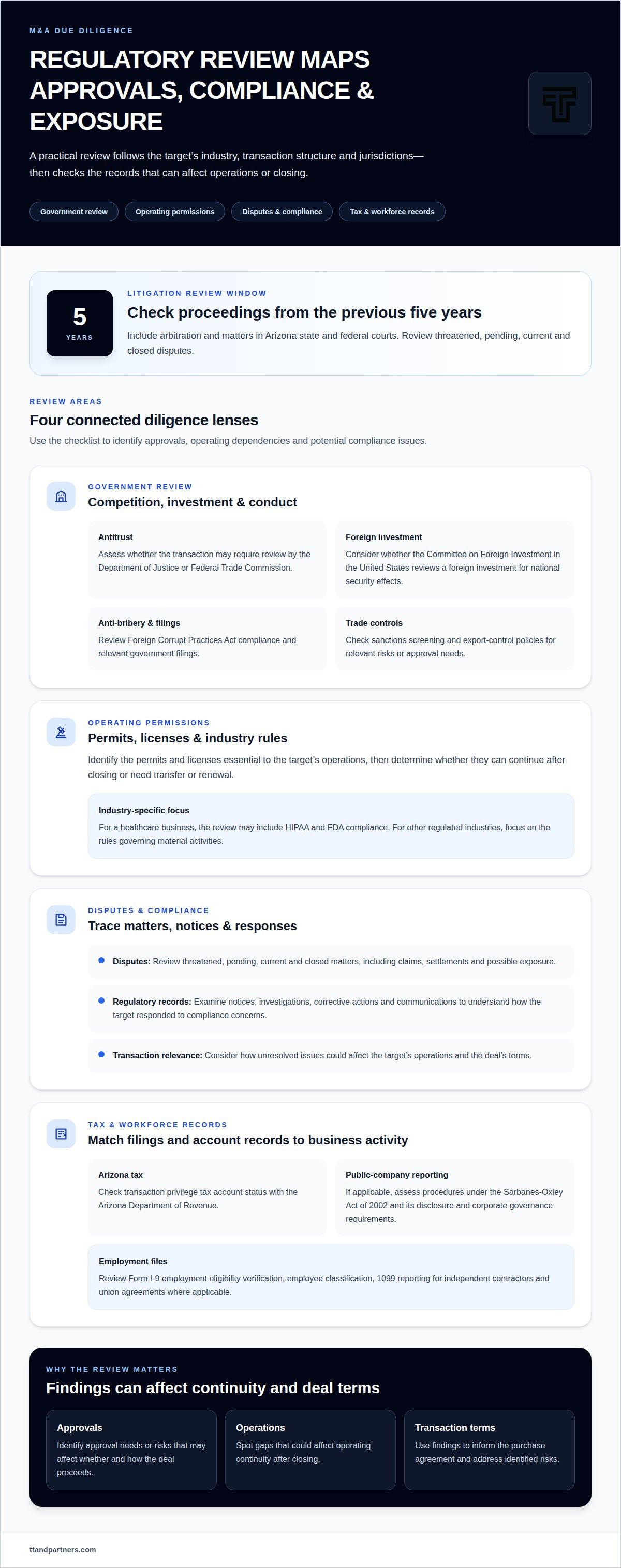
A regulatory review examines whether the target company’s operations meet applicable requirements. Its scope depends on the industry, transaction structure, and jurisdictions involved.
Antitrust, Permits, and Licenses
Antitrust diligence assesses whether a transaction may require review by the Department of Justice or Federal Trade Commission. Buyers also identify permits and licenses essential to the target’s operations, then determine whether they can continue after closing or require transfer or renewal. For a healthcare business, the review may include HIPAA and FDA compliance; for other regulated industries, it should focus on the rules governing material activities. A gap can affect operating continuity and the transaction’s terms.
Litigation and Regulatory Compliance
Litigation diligence reviews threatened, pending, current, and closed disputes, including cases in Arizona state and federal courts. The checklist covers proceedings from the previous five years, including arbitration, to assess claims, settlements, and possible exposure. Regulatory records add context: notices, investigations, corrective actions, and communications can show how the target has responded to compliance concerns. Together, these materials help the buyer understand unresolved issues and their potential effect on operations.
Tax and Regulatory Compliance
Tax and regulatory diligence compares the target’s filings and account records with its business activities. In Arizona, the review includes the transaction privilege tax account status with the Arizona Department of Revenue. The applicable checks depend on how the target earns revenue, where it operates, and which activities it conducts. For a business with public-company reporting obligations, assess its procedures under the Sarbanes-Oxley Act of 2002, which sets disclosure and corporate governance requirements for public companies.
Employment files also warrant a thorough review. Assess Form I-9 employment eligibility verification, employee classification, 1099 reporting for independent contractors, and union agreements where applicable. These records can reveal compliance issues that affect staffing, costs, or post-closing operations.
Financial statements, audits, liabilities, and forecasts
A financial review tests whether reported performance supports the proposed transaction. Buyers compare historical results, working capital, liabilities, and forecasts to assess the target’s ability to sustain operations.
Financial Statement Review
Financial statement review compares three to five years of results, using audited statements if available. It examines revenue, expenses, cash flow, debt, and accounting practices for inconsistencies or unusual movements. Mergers and acquisitions teams also compare forecasts with historical performance, capital expenditures, and investments. Material gaps can change the buyer’s view of value and the target’s ability to fund ongoing operations.
Financial Records and Working Capital
Financial records show how cash moves through the business and whether working capital supports daily obligations. Review receivables, payables, inventory, debt schedules, capital expenditures, and 401(k) balances alongside cash-flow records. Compare customer concentration with sales patterns: reliance on a few accounts can expose revenue vulnerability. Forecast assumptions should match documented orders, costs, and operating capacity, not simply repeat management’s projections.
Tax Filings and Financial Statements
Tax filings should be reconciled with financial statements to identify differences in reported revenue, deductions, or liabilities. Review federal and Arizona tax returns for recent years, then trace material balances to supporting records and tax correspondence. Unpaid assessments, inconsistent filings, or unexplained adjustments may alter expected cash needs. This comparison can distinguish recurring tax obligations from items tied to a past transaction.
Red flags span legal, tax, environmental, and operational records. Examine threatened, pending, current, and closed litigation, tax notices, EPA notices, and public-agency investigations. Arizona reviews may include Phase I environmental site assessment reports. Investigate unexplained reserves, contingent liabilities, overdue payables, and forecasts that diverge from historical results. Compare litigation reserves and projected growth with the underlying records. Findings can inform price discussions, liability allocation, and closing protections.
Legal due diligence costs and lawyer rates
The cost of legal due diligence for a business acquisition in the US depends on the review’s design, not one hourly rate alone. Before work begins, define the budget, scope, deadlines, and expected report type. A focused review of corporate records and material contracts requires different actions from a broader examination of litigation, intellectual property ownership, regulatory filings, and financial statements. The target’s document quality also affects how much time counsel spends resolving gaps.
Rates provide a benchmark, not a total-cost estimate. Clio’s 2025 Legal Trends data reports the average U.S. The same data reports an average U.S. M&A partner rates rose 8.8% in 2025, according to LexisNexis Counsel Link’s 2026 Trends Report. Thomson Reuters reports that worked rates across U.S. law firms rose 7.3% in 2025. Staffing mix and responsibility for document review therefore influence billed hours.
For legal due diligence for a business acquisition in the US, review volume and complexity can expand the work. Multiple subsidiaries, fragmented records, cross-border agreements, pending litigation, or unclear intellectual property assignments may require additional analysis. Align the checklist with transaction priorities while retaining coverage of ownership, liabilities, and closing risks. Set escalation rules for material findings, such as a disputed trademark or a contract requiring consent. This directs attention toward decisions that could affect the deal.
Request a written scope identifying covered entities, contracts, financial records, jurisdictions, deliverables, and deadlines. Set a process for reporting exceptions as they emerge, instead of waiting until every document is reviewed. If tax, technical, or environmental experts participate, define their responsibilities and how their conclusions inform the legal report. These choices help connect findings to price, representations, indemnities, and closing actions. For acquisition-related property transactions, discuss real estate closing support.
Tosolini, Toniutti & Partners
Tosolini, Toniutti & Partners can help address immigration considerations that may accompany a U.S. business acquisition. For an international buyer whose plans involve living in the United States, immigration planning is a separate question from reviewing the target’s contracts, liabilities, or financial records. The firm offers Green Card services, alongside other immigration options, for individuals and corporate clients.
Consider this support when your acquisition plans also raise questions about your own U.S. immigration pathway. Keeping those matters distinct helps clarify which legal issues relate to the transaction and which relate to your status and plans. For guidance on how immigration considerations fit your circumstances, contact Tosolini, Toniutti & Partners.
Plan the Next Step With Clarity
A legal due diligence process for a business acquisition in the US can inform more than the transaction itself. For an international buyer, the acquisition may also prompt separate questions about plans to live or work in the country. Keep those questions distinct: transaction counsel evaluates the business and deal terms, while immigration planning addresses the buyer’s personal circumstances and goals.
Tosolini, Toniutti & Partners offers E-2, E-1, and O-1 visas, as well as Green Cards. If your acquisition is part of a wider plan to establish a future in the United States, consider how those immigration matters fit alongside the business decision. A measured conversation can help clarify which issues need attention next, without treating one decision as a substitute for the other.
For a discussion of your immigration options, contact Tosolini, Toniutti & Partners. Move forward with a clear view of both the business decision and your personal plans.
Frequently Asked Questions
What is M&A due diligence?
M&A due diligence is the buyer’s investigation of a business before completing a merger or acquisition. It tests whether the company’s records support the deal assumptions and helps identify issues that could change the transaction’s structure or terms. For example, a buyer may compare disclosed ownership records with the people authorized to approve or sign the transaction.
What does legal due diligence cover in a US business acquisition?
Legal due diligence reviews the target’s legal position and the documents that govern its business. Beyond commercial agreements, buyers may examine corporate authority, required equity-holder consents, disclosure schedules, intellectual property ownership, disputes, and regulatory records. The goal is to connect each finding to a transaction decision, such as obtaining an approval, revising a representation, or setting a closing condition.
What are the steps and typical timeline for legal due diligence in a US acquisition?
The work generally moves from defining scope and document requests to reviewing records, raising follow-up questions, evaluating findings, and incorporating material issues into deal documents. Acquisition due diligence for a business purchase can take two to six months on average. A standard M&A diligence timeline from letter of intent to closing decision is about six weeks, or 30 to 45 business days; complexity and record quality affect timing.
How much does legal due diligence cost for a small or mid-sized business acquisition?
There is no dependable total based on business size alone: document volume, deal complexity, deadlines, and the review’s scope determine billable work. Clio’s 2025 Legal Trends data reports an average U.S. lawyer rate of $349 per hour and an average These are market rate benchmarks, not a quote or a project total.
How should buyers review contracts, change-of-control clauses, and liabilities?
Build a contract schedule that identifies each agreement’s parties, term, renewal date, termination rights, and consent requirements. Then connect obligations to possible liabilities: for example, a customer agreement with termination rights after a control change could affect expected revenue. Compare those clauses with the seller’s disclosures, and record unresolved issues for negotiation, closing conditions, or allocation of responsibility in the purchase agreement.
What employment, benefits, and labor-law issues should buyers investigate?
Review employee and contractor classifications, employment eligibility records, benefit-plan documents, unpaid compensation, and any union agreements. For a 401(k) plan, examine plan balances and IRS Form 5500 filings alongside plan records. Also identify pending employment claims, changes to executive compensation, and obligations triggered by the transaction. These details can reveal costs or commitments that continue after ownership changes.



Comments