

Italian residency for non-EU family members: Which permits apply

The right permit depends on the Italian sponsor’s status and whether they have exercised EU free-movement rights. Italian residency for non-EU family members may involve an EU family residence card or a national residence permit for family reasons. These routes have different eligibility rules and documentary requirements.
It’s understandable to focus first on which relatives qualify, but the sponsor’s circumstances also shape the application. This distinction matters because a spouse or dependent relative may follow a different route depending on whom they are joining.
This guide explains which permits may apply, which non-EU relatives may qualify, and who can enter Italy as an accompanying family member. It also outlines how to document family ties, so you can identify the route that fits your situation and the evidence you may need.
Table of Contents
Which residence permits are available to family members of EU citizens?
The route for Italian residency for non-EU family members depends on the sponsor’s status and the applicant’s relationship to them. A qualifying relative of an EU citizen may apply for a residence card under EU rules, while another family member may fall under a national family-permit route.
Residence Card and Permit Categories
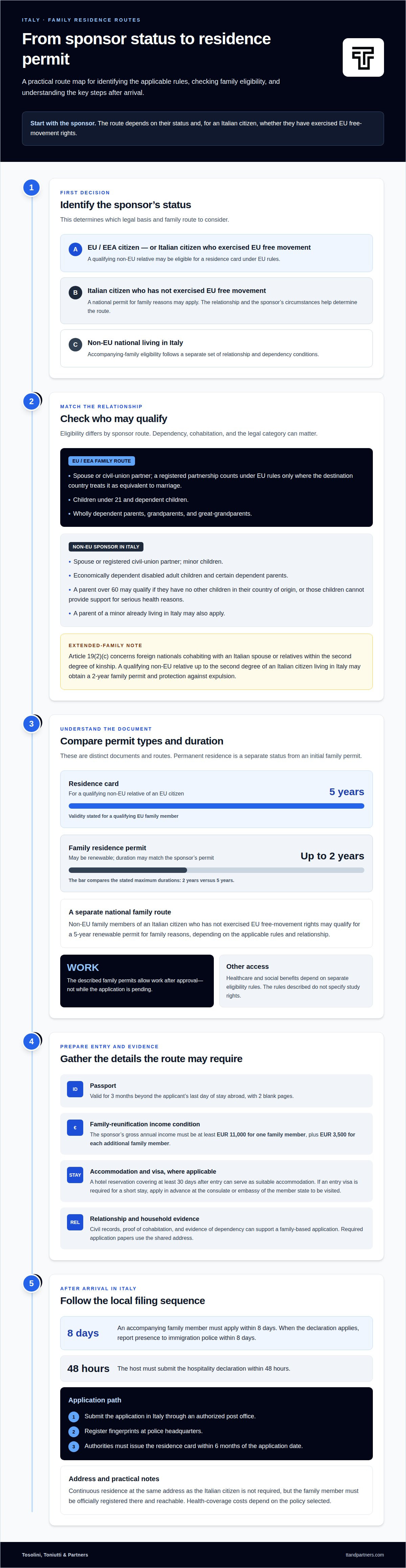
A residence card applies to a qualifying non-EU relative of an EU citizen, while a national family permit may apply in other circumstances. This distinction matters because the legal basis and application route differ. Italy’s Legislative Decree No. 30/2007 provides for residence cards under Articles 10 and 14. The described family permits allow holders to work after approval. The rules do not establish work rights while an application is pending or specify study rights.
Permit Duration and Renewal
A residence card for a qualifying EU family member is valid for five years. A family residence permit may last up to two years and can be renewed; its duration may also match the sponsor’s permit. These timeframes matter when planning a renewal. Permanent residence is a separate status, not the same document as an initial family permit.
After arriving in Italy, an accompanying family member must apply within 8 days. The application is submitted in Italy; an authorized post office receives it, and the applicant registers fingerprints at police headquarters. Authorities must issue the residence card within 6 months of the application date.
Health coverage costs depend on the policy selected. A residence permit allows the holder to work, while access to healthcare and social benefits depends on separate eligibility rules. The local police headquarters handles fingerprint registration, and the application is filed in Italy.
Visa refusals on public-policy, public-security, or public-health grounds require a genuine, present, and sufficiently serious threat. A refusal must provide written factual and legal reasons and explain how and by when to appeal. Incomplete evidence or processing can contribute to delays; the residence-card issuance period is 6 months.
Eligible non-EU relatives of Italian nationals
Eligibility depends on the sponsor’s status and the family relationship. The rules for Italian residency for non-EU family members differ depending on whether an Italian citizen has exercised EU free-movement rights.
Core Family Member Eligibility
Core family members are close relatives, such as a spouse or qualifying child, whose relationship may support a family residence application. This distinction matters because EU rules and Italy’s national route do not treat every relative the same way.
For EU and EEA citizens, spouses and civil-union partners may qualify. A registered partnership counts under EU rules only when the destination country treats it as equivalent to marriage. Children under 21 and dependent children may qualify under the relevant family route. Wholly dependent parents, grandparents, and great-grandparents may also be eligible.
For an Italian citizen who has not exercised free-movement rights, Article 23(1-bis) of Legislative Decree No. 30/2007 addresses permits for family reasons. The sponsor’s circumstances help determine which rules apply to Italian residency for non-EU family members.
Extended Family Member Eligibility
Extended family members fall outside the core group and may qualify through dependency or a specific national provision. Their relationship alone may not establish eligibility, so it is important to identify the applicable legal route.
Article 19(2)(c) of Italy’s Consolidated Immigration Act concerns foreign nationals cohabiting with an Italian spouse or relatives within the second degree of kinship. Non-EU relatives up to the second degree of an Italian citizen living in Italy may obtain a family permit lasting 2 years. This provision also protects them against expulsion.
Non-EU family members of an Italian citizen who has not exercised EU free-movement rights may qualify for a five-year renewable permit for family reasons. The relationship, dependency, cohabitation, and sponsor’s status help determine the applicable category.
Who can apply for entry as an accompanying family member?
Eligible relatives depend on whether the sponsor is an EU/EEA citizen or a non-EU national living in Italy. According to the Italian Ministry of Foreign Affairs and International Cooperation, children under 21 years old may apply for an Italian family-reasons visa as family members of an EU/EEA citizen. Spouses and qualifying civil-union partners may also apply. Wholly dependent parents, grandparents, and great-grandparents may qualify under the relevant EU/EEA family route.
For a non-EU sponsor, eligible accompanying relatives include a spouse or registered civil-union partner, minor children, economically dependent disabled adult children, and certain dependent parents. A parent over 60 may qualify if they have no other children in their country of origin, or those children cannot provide support for serious health reasons. A parent of a minor already living in Italy may also apply.
Entry documents include a passport valid for 3 months beyond the applicant’s last day of stay abroad, with two blank pages. Where an entry visa is required for a short stay, the family member applies in advance at the consulate or embassy for the member state they plan to visit. For family reunification, the sponsor’s gross annual income must be at least EUR 11,000 for one family member, plus EUR 3,500 for each additional family member. A hotel reservation covering at least 30 days after entry can serve as suitable accommodation.
After arrival, the family member must report presence to immigration police within 8 days when the declaration applies. A host must submit the hospitality declaration within 48 hours. The family member need not live continuously at the same address as the Italian citizen, but must be officially registered there and reachable. The required application papers use the shared address, linking registration to the sponsor’s home.
Invitation letter and proof of family relationship
An invitation letter can explain why a relative plans to travel to Italy and whom they will join. It may identify the host and visitor, their relationship, the intended stay, and the address where the visitor will live. For example, a parent joining an Italian citizen can include the planned address and the family reason for travel. The letter supports the application but does not replace official records proving the relationship.
For a family-reasons visa, vital records such as birth or marriage certificates must show the family connection. Each record must have an Apostille issued by the Secretary of State in the state where it was issued, as well as an Italian translation. Together, these documents connect the original record to the application and make the family relationship clear to Italian authorities.
Applicants for the described family permit must provide evidence of their relationship and proof that they live with their Italian relative. Records linking both people to the same address can support evidence of a shared home. Authorities may conduct home visits to verify that the non-EU family member genuinely lives with the Italian relative. Cohabitation is therefore an ongoing condition, not merely a detail in the initial invitation.
For an accompanying family member over 65 years old, private health insurance is required to enter Italy. The policy should cover the relative during the intended stay; an invitation letter does not serve as proof of insurance. Parents travelling to join a family member should keep the insurance document with their entry papers. Together, the invitation, civil records, address evidence, and insurance document support distinct parts of the application.
Tosolini, Toniutti & Partners
Tosolini, Toniutti & Partners assists with Italian residency matters where a relative’s route depends on the sponsor’s status. The firm can help clarify whether the case involves an EU family residence card or a national family-permit route. This distinction matters when an Italian citizen has not exercised EU free-movement rights, as the applicable rules and evidence may differ.
Legal support can be useful when family records, dependency, and shared residence all need to be considered. A spouse’s marriage certificate, a child’s birth record, and evidence of a relative’s dependency each establish different aspects of the relationship. Tosolini, Toniutti & Partners can help organize these issues around the relevant category, so the application reflects the family relationship and sponsor’s circumstances.
Timing can also matter. A family member applying after arrival must meet the applicable deadline, while a relative applying from abroad may need an entry visa first. Tosolini, Toniutti & Partners can help assess which stage applies and how the entry process connects with the later residence application. This is especially relevant when relatives are preparing to relocate together or the sponsor’s immigration status is changing.
Consider seeking legal guidance before submitting an application if the family relationship involves dependency, extended relatives, or documents issued in different countries. The firm’s broader immigration practice also includes Green Card matters, which may be relevant to families handling separate U.S. immigration questions alongside an Italian move. The appropriate focus depends on the family’s circumstances and immigration matter.
For guidance on an Italian family-residence matter, contact Tosolini, Toniutti & Partners.
Frequently Asked Questions
Are there language requirements?
The family reunification visa itself does not require Italian-language proficiency. However, family records issued abroad must be accompanied by an Italian translation, and relevant vital records may need an Apostille. For example, a spouse applying with a marriage certificate should account for translation and document formalities, even though the visa does not require an Italian-language test.
How does the application process work?
The process depends on whether the sponsor is an EU citizen or a non-EU resident in Italy. For family reunification, the sponsor first requests entry clearance from the competent Prefecture’s Immigration Desk. The relative then applies for a family-reasons visa at an Italian consulate abroad. After arrival, the family member follows the applicable residence application process in Italy.
Understanding family reunification visa in Italy: What is it and why is it useful?
Italy’s family reunification visa allows an eligible relative abroad to join a non-EU sponsor living in Italy. It is useful when the family member needs permission to enter before beginning residence procedures. Before applying, the sponsor must have held a residence permit for at least a year for specified reasons. Entry clearance must be used within six months of issue.
Which family members can an Italian citizen bring to Italy?
An Italian citizen may bring a qualifying spouse, children, and dependent relatives, but the route depends on the family relationship and the citizen’s circumstances. Children under 21 and dependent children may qualify under applicable family rules. Dependent parents or grandparents may also qualify. For an older parent, eligibility can depend on whether other children in the country of origin can provide support.
What Italian residence permit can a non-EU family member of an EU citizen apply for?
A qualifying non-EU relative may apply for a residence card as an EU citizen’s family member. Italy’s Legislative Decree No. 30/2007 provides for these cards under Articles 10 and 14. The card is distinct from a national family residence permit, which may apply under a different route. The sponsor’s citizenship and free-movement circumstances help determine the relevant category.
What are the eligibility rules for non-EU family members of Italian citizens?
Eligibility turns on the relationship and whether the Italian citizen has exercised EU free-movement rights. A spouse and qualifying dependent relatives may be eligible under the relevant family route. Article 19(2)(c) also concerns relatives within the second degree who cohabit with an Italian citizen. For this group, cohabitation and the family relationship are central to the permit route.



Comments