

How to Get a Work Visa for Italy from the US: A 2026 Guide

What if the first step toward working in Italy isn’t a visa application, but choosing the right work route? Understanding how to get a work visa for Italy from US starts with the proposed job or activity. Standard employment, highly qualified work, an intracompany transfer, and remote work may follow different processes.
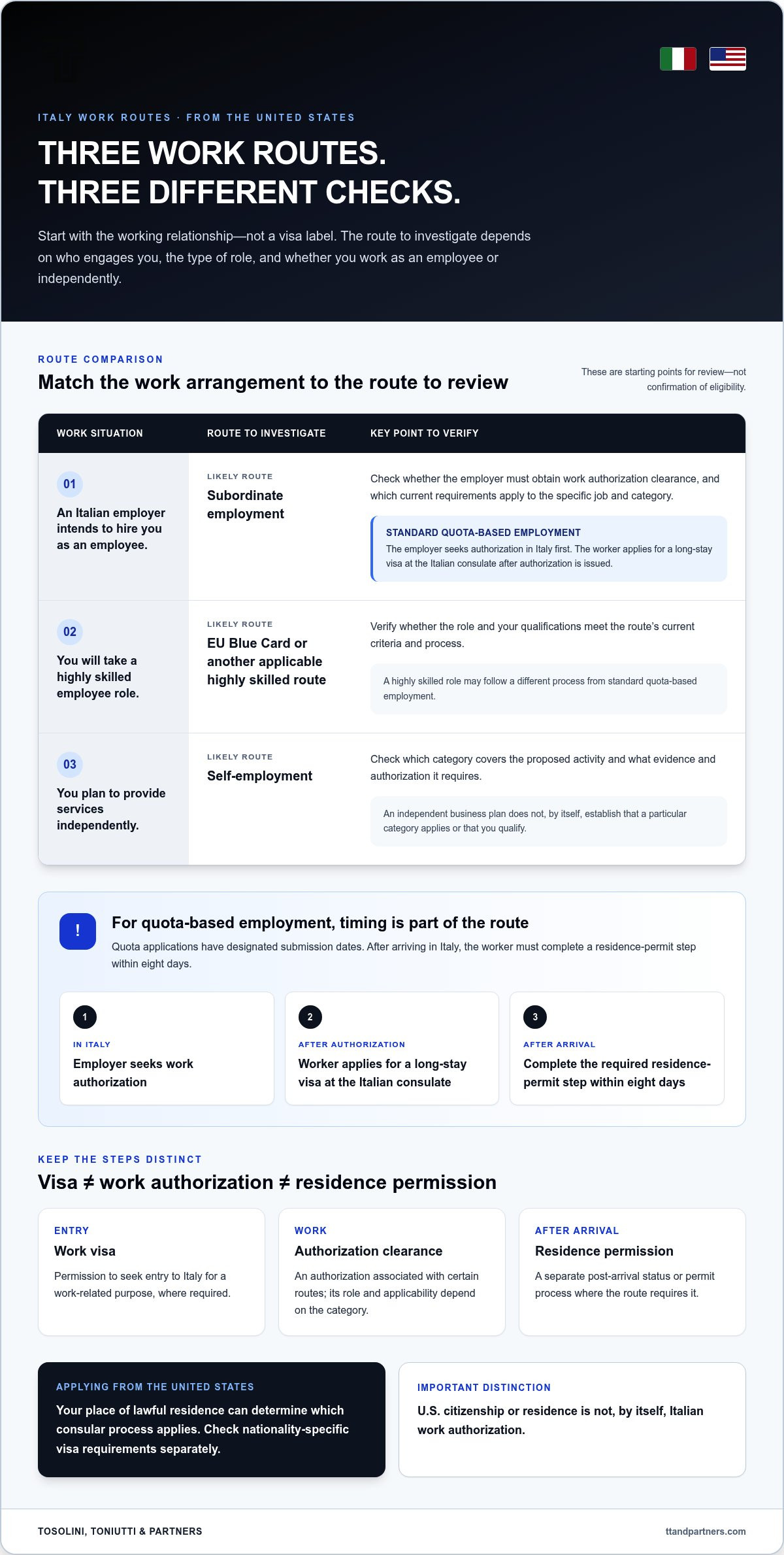
For standard quota-based employment, the Italian employer first seeks work authorization in Italy. The worker applies for a long-stay visa at the Italian consulate only after that authorization is issued. Timing matters: quota applications have designated submission dates, and after arrival, the worker must complete a residence-permit step within eight days.
This 2026 guide explains how to identify a likely route, how employer authorization and the visa application connect, and what documents and timing issues to prepare for. It also covers key post-arrival obligations and how cross-border legal guidance can help when your circumstances involve both countries. Tosolini, Toniutti & Partners assists with Italian immigration and residency matters, guided by its mission: “Your bridge between Italy and the United States.”
Table of Contents
How to get a work visa for Italy from the US: understand the starting point
Permission to enter Italy, authorization to work, and permission to reside there are separate legal concepts. A visa may allow you to travel to Italy for a stated purpose, but it doesn’t replace any work authorization or residence procedure required for your proposed activity. Confusing these steps can lead to preparing the wrong application or overlooking a later requirement.
An Italian work visa is a long-stay visa for a person planning to travel to Italy for work when their circumstances require one. The appropriate route depends on the arrangement: for example, whether an Italian employer will hire you, the role is highly skilled, or you plan to work independently. The route determines which authorizations and application steps may apply, so assess your circumstances against current official guidance.
Definition box
Work visa: Permission to seek entry to Italy for a work-related purpose, where required. It is distinct from work authorization and any residence permission required after arrival.
Work authorization clearance: An authorization associated with certain routes. Its role and applicability depend on the category.
Residence permission: A separate post-arrival status or permit process where the route requires it.
US citizenship or residence is not, by itself, Italian work authorization. Nationality can affect visa requirements, while your place of lawful residence can determine which consular process applies. These are related but different questions. Before deciding how to get a work visa for Italy from US, identify your nationality and current place of lawful residence, then verify the rules for your route.
Does applying from the US change the process?
Applying from the United States doesn’t change the nature of the proposed work or automatically determine which Italian route fits. It may affect where you can submit a visa application. Consular jurisdiction can depend on lawful residence, so check the current rules of the official post responsible for your circumstances. Check nationality-specific requirements separately rather than inferring them from a US address or passport.
Use the applicable consular instructions to prepare your application, while allowing for case-specific requests. An official post may ask for evidence beyond its published checklist. Keep supporting records organized and consistent with the facts in your application. The precise documents depend on your route and circumstances.
Work visa, authorization clearance, and residence permission: what each term means
For certain employed-work routes, the Italian employer seeks work authorization clearance to support the worker’s subsequent visa application. This clearance is not the visa itself, and it does not amount to permission to reside after arrival. Its role and the required sequence depend on the specific category, since not every work route follows the same procedure.
Where required, you apply for the visa after the authorization stage, then complete the applicable residence procedure after arriving in Italy. The Schengen Area visa policy provides general context on entry rules, but it is not a substitute for route-specific Italian work and residence instructions.
At a high level, identify the work route, establish which authorization applies, apply for the relevant visa, and complete any required residence steps after arrival.
Which Italian work route may fit your plans?
Start with the working relationship, not a visa label. The route to investigate may depend on who will engage you, where the work will be performed, and whether you’ll be an employee or work independently. These distinctions help narrow how to get a work visa for Italy from US, but don’t establish eligibility. Each category has its own criteria and application process, which you must check against current official guidance.
These routes aren’t interchangeable. A job offer, an independent business plan, or work that can be done remotely doesn’t by itself establish that a particular Italian work category applies or that you qualify. Use the table to identify a route for further review, not as a substitute for its official requirements.
If an Italian employer will hire you
For certain subordinate-work routes, the Italian employer has a central role in seeking the required authorization, including work authorization clearance where applicable. The employer’s authorization task is distinct from your visa application. You prepare and submit your application under the procedure that applies to you. Confirm the current sequence, responsibilities, and requirements for the particular employment category before proceeding.
If your work is highly skilled or self-employed
If you’re considering a highly skilled employee role, investigate the EU Blue Card or another applicable route. If you plan to work independently, consider which self-employment category may apply. Neither label guarantees eligibility. Freelance plans, remote work, or business ownership alone don’t establish that a route fits. Compare the actual work arrangement and supporting evidence with current official criteria. An early cross-border case evaluation can help clarify which questions to resolve.
How the Italy work visa process works from the United States
A clear plan keeps the employer’s responsibilities, your visa application, and any post-arrival requirements distinct. The steps below are a planning framework, not a guarantee that every Italian work route follows the same sequence. Confirm the current instructions for your specific category and consular process before taking action.
The work route determines who applies for authorization and which visa process follows. Keep that principle in view as you coordinate the stages:
Identify the route. Match the proposed activity and working relationship to a category to investigate, such as subordinate employment, highly skilled work, or self-employment. Don’t begin with a generic visa checklist. First establish which route’s rules apply.
Coordinate any required authorization. For certain subordinate-work applications, the Italian employer requests work authorization. Establish who is responsible for each action and what evidence will document the job and authorization.
Prepare the application. Gather the documents required for your category and consular process. Check that details about your identity, work arrangement, and supporting authorization align across the file.
Apply through the applicable process. Follow the current instructions of the relevant Italian consular authority, including how to submit the application and supporting materials.
Follow post-arrival instructions. Visa issuance and residence formalities are distinct. Check whether your route requires a residence-permit application after entry, then follow the current procedure and deadline.
What happens before the visa application?
For applicable subordinate-work routes, the employer requests the required work authorization through the Italian immigration process. Before you submit your visa application, coordinate the job offer, proposed work category, and authorization evidence with the employer. Requirements and sequencing can vary, so don’t assume that every category has the same authorization step or order. Avoid relying on an unverified processing estimate.
Use this stage to resolve inconsistencies early. The role described in the employment documents, for example, should correspond to the category being pursued. Keep copies of relevant employer communications and authorization records so you can prepare your application against the requirements that apply.
What happens when you apply and after arrival?
Application forms, passport evidence, photographs, and other supporting documents depend on current official instructions. The consular authority may request additional documentation, and a complete file does not guarantee approval. The relevant authority assesses the application and decides whether to issue the visa. Submitting every listed item does not promise a particular outcome.
After entry, check whether your route requires a separate residence-permit step and confirm its current deadline and procedure before travel. Keep the visa decision and application records accessible, and note any instructions that apply after arrival. For anyone assessing how to get a work visa for Italy from US, the most reliable preparation is route-specific: verify each stage against current official guidance rather than treating a general sequence as universal.
What should you prepare before applying for an Italian work visa?
Build your file around the route you’re pursuing, not a generic document list. The official checklist for your work category and consular process determines which documents you need. Examples from an official subordinate-work checklist include a passport, application form, photograph, and work-authorization evidence. These examples aren’t exhaustive and may not apply in the same way to another route or applicant.
Organize potential evidence into clear groups. This makes it easier to see what you have, what the official instructions require, and what still needs clarification:
Identity: Passport and any identity materials specified in the current instructions.
US status, where relevant: If you aren’t a US citizen, evidence of lawful US status or residence may be relevant to the consular process. Verify what applies to your circumstances.
Employment or activity: Records describing the proposed job or independent work, as required for your route.
Authorization: Evidence of any work authorization required for the category, such as work-authorization clearance where applicable.
Application evidence: The current form, photograph, and supporting materials specified by the official checklist.
Documents and evidence to check against official instructions
For every item, verify the required format, whether originals or copies are needed, any translation rules, and how long the document must remain valid. Don’t assume instructions for one work category apply to another. An employed-work checklist, for example, may include authorization evidence that isn’t relevant in the same way to a different activity. The applicable official instructions determine what belongs in your file.
Keep a working copy of the checklist you used and note when you reviewed it. This helps you spot outdated forms or requirements before filing. If your employment details or US residence circumstances change during preparation, review the relevant instructions again instead of relying on an earlier version.
Common planning errors that can delay a well-prepared application
Three avoidable missteps are choosing a category before confirming the actual work arrangement, treating a US residence document as a substitute for Italian work authorization, and relying on an old checklist. Even a carefully assembled application can be incomplete for the route or consular process that applies. Submitting every listed item doesn’t guarantee approval.
Before submission, use this short review:
Confirm the work category matches the proposed employment or activity.
Check the latest official checklist for the applicable consular process.
Verify document formats, translations, copies, and validity rules.
Confirm that any required authorization evidence is included.
Review the application for consistent names, dates, and work details.
An Italy work visa application involves coordinating facts and documents across jurisdictions. Tosolini, Toniutti & Partners assists with Italian immigration and residency matters, including cross-border considerations.
How Tosolini, Toniutti & Partners can help with an Italy work visa
An Italian work-visa matter can involve decisions and documentation in both countries. Tosolini, Toniutti & Partners is a cross-border legal practice with a presence in the United States and Italy, assisting with Italian immigration and residency matters. This perspective brings the applicant’s circumstances, proposed work, and relevant Italian process into one considered assessment.
Why cross-border context matters in an Italy work visa case
Nationality, US residence, an employer’s role, and the intended work arrangement may all shape the questions to resolve before an application is prepared. The firm has represented Italian individuals and corporate entities since 2005, with experience in matters connected to both countries. Its attorneys speak English, Italian, Spanish, French, Portuguese, and Russian.
This coordinated perspective is useful when a case involves more than one jurisdiction. A prospective employee may need to clarify what the employer handles in Italy and what the applicant must address through the US-side visa process. An independent professional may need to describe the proposed activity and identify which immigration questions require careful review. The firm’s mission is “Your bridge between Italy and the United States.”
A practical next step for your application
Before an initial case evaluation, organize the facts that define your situation. A concise summary can make the discussion more focused and help identify which questions to address first:
Your nationality and current US residence status
The work you plan to perform and whether it is employment or independent activity
Any prospective Italian employer and the role or offer under discussion
Any authorization or application steps already completed
Questions about the relevant visa route or residence requirements
An initial case evaluation can help you assess how these facts fit together and clarify which immigration questions merit attention. It is a starting point, not a prediction or guarantee of approval. Tosolini, Toniutti & Partners provides the initial case evaluation without a consultation fee.
For applicants assessing how to get a work visa for Italy from US, gathering these details before seeking guidance can make the conversation more precise. If your circumstances involve both countries, an initial case evaluation can help focus the discussion on your Italian immigration and residency plans.
Take the next step with a clear plan
Turn your proposed work arrangement and personal circumstances into a focused set of questions. That preparation gives you a stronger starting point for understanding how to get a work visa for Italy from US, while leaving room to assess the rules that apply to your situation. Immigration decisions are individual, and no general guide can determine the outcome of an application.
Tosolini, Toniutti & Partners provides cross-border US-Italy immigration and legal services. Request an initial case evaluation without a consultation fee to discuss your circumstances and frame the questions relevant to your plans. An evaluation does not guarantee a visa decision or outcome.
Frequently Asked Questions
Can a US citizen work in Italy without a work visa?
Not based on US citizenship alone. A US passport does not itself authorize you to take a job in Italy. The required visa and work authorization depend on the planned activity and applicable route. Before accepting work or making plans around a start date, establish which category fits and check its current official requirements. Permission to travel and permission to work are separate questions.
Do I need a job offer before applying for an Italian work visa?
For subordinate employment, you’ll generally need a prospective Italian employer because the employer has a role in the authorization process. That may not describe every route: highly skilled work and self-employment have their own criteria and procedures. Before applying, clarify whether the arrangement is employment or independent activity, what the role involves, and which route’s current instructions apply.
What is work authorization clearance for Italy?
Work authorization clearance is an authorization used in certain Italian work-immigration processes. For applicable subordinate employment, the Italian employer requests it. It is not the worker’s visa. After the authorization stage, the applicant still follows the visa process that applies to their case. Its role varies by route, so don’t assume every work category requires it.
Can I apply for an Italian work visa from the United States if I am not a US citizen?
Possibly, depending on your lawful US residence, nationality, and the consular jurisdiction rules that apply to your case. A non-US citizen may need to provide evidence of US status or residence as part of the relevant process. Check the responsible Italian consular authority’s current instructions before preparing the application. Living in the United States does not itself determine eligibility for an Italian work route.
How long does it take to get a work visa for Italy?
There isn’t one reliable timeframe for every applicant. The overall timing can depend on the work category, whether authorization is required first, quota-related timing where applicable, and the consular process. Check current official information for each stage rather than relying on an estimate for another route or applicant. Build flexibility into your plans, since a published estimate cannot guarantee when a decision will be made.
Does an Italian work visa also give me a residence permit?
No. A work visa and a residence permit are distinct, even when one follows the other. Where the route requires a post-arrival residence application, the visa doesn’t replace that step. Under the work-visa procedure described in this guide, the residence-permit application is due within eight days of arrival. Confirm the applicable procedure and deadline for your specific route before traveling.
Does submitting all required documents guarantee an Italian work visa?
No. A complete application doesn’t guarantee approval. The relevant consular authority assesses the case and makes the decision, and it may request additional evidence. Review more than the presence of each checklist item: confirm that your documents support the same work arrangement and that the route matches your circumstances. Treat the official checklist as a preparation tool, not a promise of the result.



Comments