

How to Draft Clear Bilingual US-Italy Commercial Agreements

A bilingual agreement can be precise in both languages and still leave the parties with different understandings of what they signed. When drafting bilingual US-Italy commercial agreements, prepare the English and Italian texts as coordinated versions, explain how discrepancies will be resolved, and state the governing law and language provisions clearly.
Each version should express the same commercial meaning. A clause that reads smoothly in English may not convey the same obligation in Italian, particularly for performance, payment, liability, or termination. Which version governs depends on the applicable law and the agreement’s terms, so treat the language-precedence clause as a substantive choice, not boilerplate.
This guide explains how to structure the two texts, reduce discrepancies, and address clauses that shape a cross-border commercial relationship. It also covers review, execution, and issues where Italian and U.S. legal considerations may intersect, helping you approach the agreement with greater clarity before signing.
Table of Contents
Drafting bilingual agreements for Italian suppliers
Drafting bilingual US-Italy commercial agreements involves decisions about language, governing law, and the supplier’s work. Decide whether to use English, Italian, or both, then state how the signed texts relate.
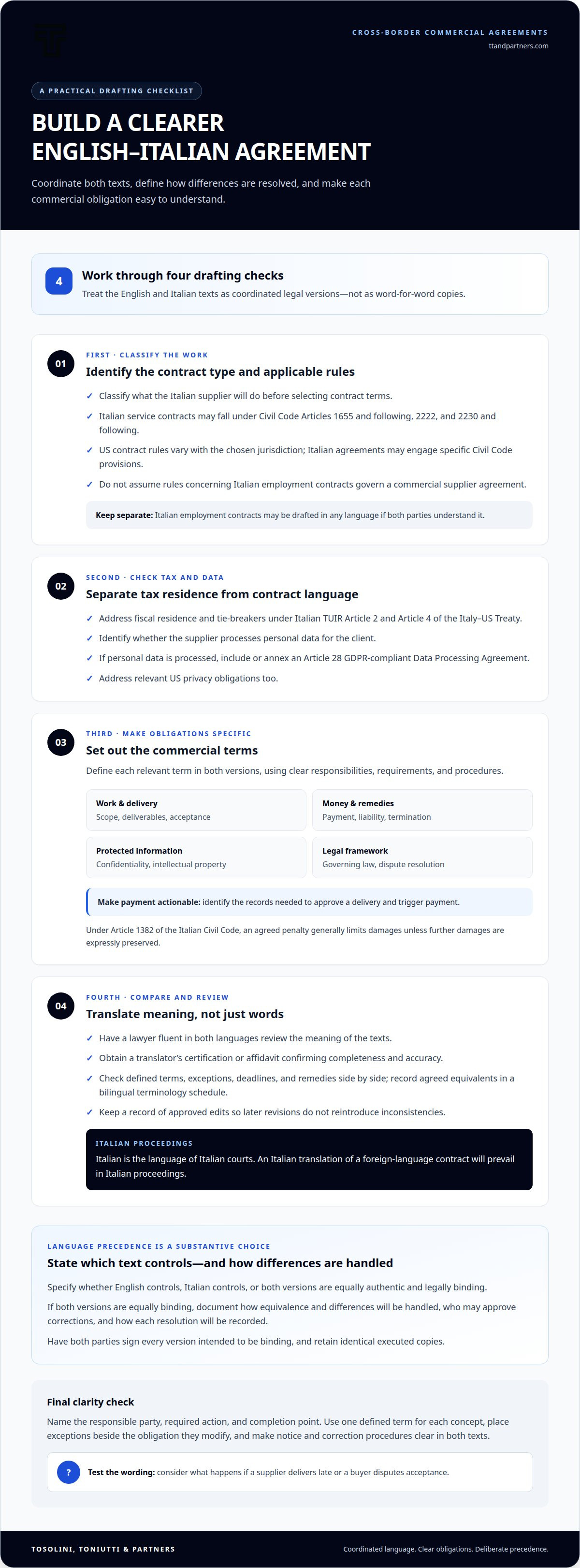
Identify Contract Types and Applicable RulesClassify the supplier’s work before selecting terms. Italian service contracts may fall under Civil Code Articles 1655 and following articles, 2222, and 2230 and following articles. US contract rules vary with the chosen jurisdiction, while Italian agreements may engage specific Civil Code provisions. Italian employment contracts may be drafted in any language if both parties understand it. Don’t assume that employment rule governs a commercial supplier contract.
Determine Tax Residence and Data ClausesSeparate tax residence from the commercial contract’s language. Italian TUIR Article 2 and Article 4 of the Italy-US Treaty address fiscal residence and tie-breakers. Identify whether the supplier processes personal data for the client and document that activity. When it does, the contract must include or annex an Article 28 GDPR-compliant Data Processing Agreement, according to the European Union. Address relevant US privacy obligations too.
Set Out Commercial Agreement ClausesDefine scope, deliverables, acceptance, payment, confidentiality, intellectual property, liability, termination, governing law, and dispute resolution. For example, identify the records required to approve a delivery and trigger payment. Under Article 1382 of the Italian Civil Code, an agreed penalty generally limits damages unless further damages are expressly preserved. Signing and enforcement depend on contract type, applicable law, and execution method.
Translate and Review the AgreementDrafting bilingual US-Italy commercial agreements also means reviewing meaning, not just matching words. Have a lawyer fluent in both languages assess the texts, and obtain a translator’s certification or affidavit confirming completeness and accuracy. Italian is the language of Italian courts, and an Italian translation of a foreign-language contract will prevail in Italian proceedings. Translation and review costs depend on the document’s length, complexity, and review scope.
Clarity and comprehension in cross-border agreements
Define each obligation by naming the responsible party, the required action, and the completion point. For example, state which party supplies technical drawings and when approval is due. Replace phrases such as “promptly” with an agreed date or a clearly defined event. This makes the English and Italian texts easier to compare.
Use one defined term for each concept throughout both versions. If “Products” means specified components, use it consistently in delivery, inspection, and warranty clauses. Avoid switching among “goods,” “materials,” and “items” when the agreement refers to the same thing.
Separate duties from conditions and exceptions. A payment clause should specify the invoice trigger, required supporting documents, and any acceptance condition. Place each exception next to the obligation it modifies, rather than burying it in a distant schedule.
Make timelines and procedures actionable. Explain how a party gives notice, who receives it, and when it takes effect. For a defect report, specify the required details and the process for correcting the issue. Use the same sequence in both language versions.
Before signing, test the wording against a realistic disagreement. For example, consider what happens if a supplier delivers late or a buyer disputes acceptance. The United Nations Convention on Contracts for the International Sale of Goods allows courts applying it to consider all relevant circumstances. Clear terms help establish the parties’ intended process. For a cross-border real estate closing, Tosolini, Toniutti & Partners can assist with the transaction.
Risks of inconsistent multilingual contract versions
A mismatch between English and Italian wording can trigger disputes over duties, remedies, or delivery. A disciplined approach to drafting bilingual US-Italy commercial agreements treats each language version as a controlled legal text.
Identify Translation and Terminology RisksCompare clauses by meaning, not by matching words alone. A familiar English term may have a different legal effect in Italian. Check defined terms, exceptions, deadlines, and remedies side by side. For example, confirm that “business days” follows the same calendar and calculation method in both texts. Record agreed equivalents in a bilingual terminology schedule and use them consistently throughout the contract.Have a translator certify or swear by affidavit that the Italian text is complete and accurate. A lawyer fluent in both languages can review concepts that literal translation may distort. Keep a record of approved edits so later revisions do not reintroduce earlier inconsistencies.
Specify the Controlling Language VersionState expressly whether English controls, Italian controls, or both versions are equally authentic and legally binding. The governing law and contract wording affect which version applies. An English-prevails clause establishes a hierarchy, but may not resolve every issue if both texts have equal legal effect.If both versions are equally binding, create a written record of how equivalence and differences will be handled. Identify who may approve corrections and how the parties will document each resolution. Do not rely on an informal promise to reconcile future disputes. Have both parties sign every version intended to be binding, and retain identical executed copies.
Before signing, compare the final versions clause by clause and resolve every identified discrepancy. Treat changes to one text as changes to the other, including revisions to exhibits and schedules. For teams drafting bilingual US-Italy commercial agreements, this final review helps prevent an updated English clause from leaving an outdated Italian counterpart in the signed contract.
What clauses should a US-Italy commercial agreement include?
Choose governing law and dispute procedures deliberately. According to the European Union, Rome I Regulation (EC) No. 593/2008 addresses the parties’ freedom to choose applicable contract law. Name the selected law and explain how notices, negotiation, and dispute resolution work. This gives each party a clear framework for interpreting obligations across borders.
Define payment, delivery, acceptance, and remedies in operational terms. State when invoices become payable and what records support them. Under Article 1382 of the Italian Civil Code, an agreed penalty generally limits damages to that amount unless the parties expressly preserve further damages. Article 1384 allows courts to reduce a manifestly excessive penalty.
Allocate intellectual property, confidentiality, and data duties separately. Italian Law No. 633/1941 does not automatically transfer a service provider’s economic rights to the paying party. Identify the rights being transferred or licensed and the permitted uses. If an Italian supplier processes personal data for a client, the contract must include or annex an Article 28-compliant Data Processing Agreement, according to the European Union.
Specify termination triggers, cure procedures, and liability limits. Article 1453 of the Italian Civil Code concerns termination for breach, so define the breach and any opportunity to remedy it. Address liability-cap exceptions carefully, including willful misconduct and gross negligence in connection with Article 1229. For a cross-border matter involving a dispute, discuss your legal matter with the firm.
Tosolini, Toniutti & Partners
Tosolini, Toniutti & Partners helps individuals and corporate clients address legal issues arising from US-Italy business activity. The firm’s immigration and business services are relevant when a commercial transaction connects with broader U.S. expansion or immigration planning. Contract terms and immigration questions are distinct, but both can shape how a cross-border venture is structured.
Consider involving the firm when a supplier relationship forms part of a planned US business presence, or when ownership and commercial activity raise immigration questions. E-1, E-2, and O-1 visas, along with Green Cards, are among its relevant offerings. Which questions matter depends on the people, business plans, and cross-border arrangements involved.
Keep the agreement’s commercial logic clear: define the parties’ obligations, the controlling language, and the governing law. Separately identify immigration issues that may affect the individuals or business behind the transaction. This distinction helps avoid treating a signed supplier contract as a substitute for assessing an individual’s immigration circumstances.
Useful context includes the parties’ roles, the planned business activity, and the agreement’s current stage. A draft shows how the relationship is intended to work; an executed version clarifies the commitments already made. Sharing this context helps frame questions about how commercial arrangements and immigration planning intersect, without conflating the two analyses.
Contact Tosolini, Toniutti & Partners when your US-Italy commercial plans raise related immigration questions. Contact Tosolini, Toniutti & Partners to discuss the circumstances and determine the appropriate next step.
Carry Contract Clarity Into Your Next Step
A well-structured agreement should support the relationship as it evolves, not just record its initial terms. As responsibilities, deliverables, or business plans change, treat each amendment as part of the same bilingual drafting process. Keep both language versions aligned and preserve a clear record of the parties’ agreed changes.
That discipline makes drafting bilingual US-Italy commercial agreements a practical foundation for cooperation. It also helps decision-makers consider how commercial commitments relate to broader cross-border plans. If those plans raise immigration or business questions, Tosolini, Toniutti & Partners can help clarify the separate issues and identify a practical path forward.
Tosolini, Toniutti & Partners assists clients with cross-border matters, including E-1, E-2, and O-1 visa work. For guidance on questions connected to your US-Italy plans, contact Tosolini, Toniutti & Partners. A considered next step can help you move forward with greater confidence.
Frequently Asked Questions
How do Italian Civil Code rules on standard terms and unfair clauses affect US-Italy contracts?
A supplier’s standard terms make their presentation, wording, and acceptance important to assess. Identify clauses that shift liability, restrict remedies, or allow unilateral changes, then make their effect clear in both versions. The treatment of an individual clause depends on the contract and applicable law. Do not assume that a signature alone resolves every question about a disputed term.
How should governing law, jurisdiction, and dispute resolution be drafted in a US-Italy agreement?
Draft these as separate but coordinated choices: governing law identifies the rules for interpreting the contract, while jurisdiction identifies where disputes may be heard. The European Union’s Rome I Regulation (EC) No. 593/2008 addresses party choice of applicable contract law. Specify the chosen forum, permitted dispute process, notice method, and language for proceedings. Check that each provision works with the transaction and the parties’ locations.
What VAT, withholding tax, and invoicing issues should US companies address in Italian commercial agreements?
State who invoices, what documentation supports each charge, and how tax treatment is handled if the parties’ circumstances call for different treatment. For example, distinguish a service fee from reimbursed expenses and identify the records required for each. Address responsibility for any applicable VAT or withholding, including who must account for it. The transaction type, place of supply, and parties’ tax status inform these provisions.
What are the requirements for signing and enforcing commercial contracts in Italy and the United States?
Signing and enforcement depend on the contract type, applicable law, and execution method. Have both parties sign every version intended to be binding and retain identical executed copies. A foreign-language contract may require translation for use in proceedings.



Comments