

How to Choose a US Business Entity for E-commerce

Looking for professional help setting up an online business in the United States? US business formation for e-commerce starts with choosing an entity that fits the business’s ownership and operating plans. No single structure suits every seller, so consider the decision carefully before filing.
Entity choice is only one part of the setup. The legal business name, any separate brand name, and the Employer Identification Number (EIN) application also need to match the venture’s plans. Legal support can coordinate these steps and clarify what information is needed.
This guide explains how to approach entity selection, what to consider when registering business and brand names, and how EIN applications fit into the formation process. It also outlines how professional legal support can help bring these decisions together, particularly when a business has cross-border owners or plans.
Table of Contents
Starting an e-commerce business
Start with a defined product, target market, and operating plan. Before committing capital, estimate formation, platform, inventory, payment-processing, and compliance costs.
Build a startup budget around your business model. Inventory, shipping, platform features, and marketing all affect the capital needed to launch and grow.
Prepare for banking and payment processing by organizing formation documents and ownership information, then follow the bank’s application process. Compare payment processors based on fees, platform integrations, security, and accepted payment methods. Keep business transactions separate from personal spending to make income and expenses easier to track.
Plan Federal and State Tax ObligationsMap federal, state, and local tax obligations to the entity, owners, and places where the business operates. Foreign owners of U.S. corporations are subject to a 21% corporate tax rate on business income, according to the Internal Revenue Service. Income effectively connected with conducting business in the United States is subject to federal income tax, even when an owner is not a U.S. resident.For sales tax, a business generally must collect and remit tax in a state once it meets that state’s economic nexus threshold. A foreign seller may have this obligation even without a U.S. entity.
Plan for Liability, Insurance, and Compliance RisksBefore launch, identify risks related to products, customer information, payments, and order fulfillment. Online sellers face security, privacy, and fraud risks, so plan protective measures and consider insurance suited to the products and operations.Map applicable federal, state, and local requirements to where the business operates and sells. Revisit the plan as products, sales channels, and customer locations change, so new activities do not outgrow existing protections or compliance processes.
Choosing an ecommerce business entity with professional guidance
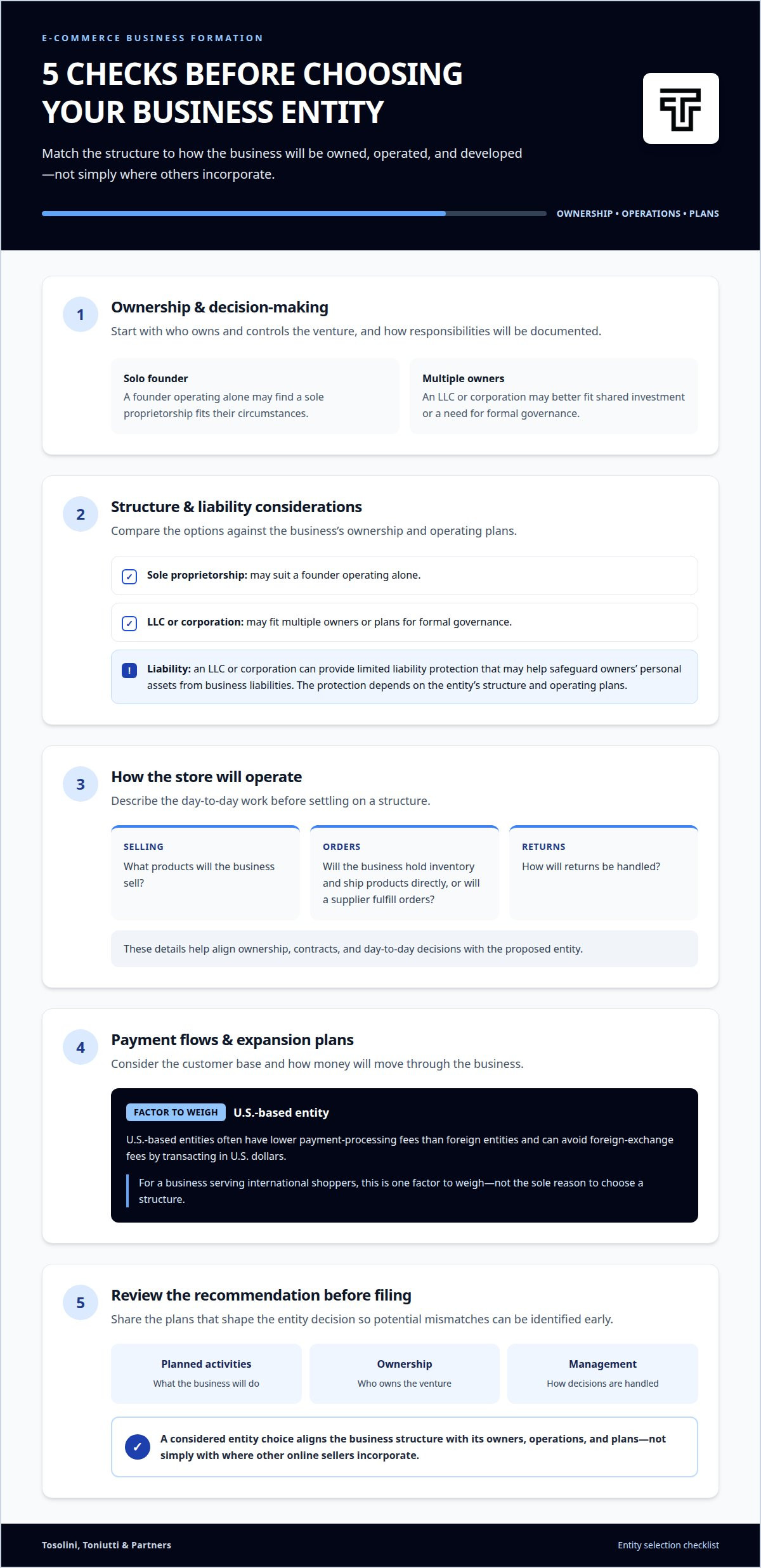
Have a formation professional assess ownership and how the company will operate. A solo founder selling digital products has different governance needs from partners sharing investment and decision-making. US business formation for e-commerce should reflect who owns and controls the venture, and how responsibilities will be documented as it develops.
Compare a sole proprietorship, LLC, and corporation against those circumstances. A sole proprietorship may suit a founder operating alone, while an LLC or corporation may better fit multiple owners or plans for formal governance. An LLC or corporation can provide limited liability protection that may help safeguard owners’ personal assets from business liabilities. The right choice depends on the entity’s structure and operating plans.
Describe how the business will sell, process orders, and handle returns. A retailer that holds inventory and ships products directly may have different operational needs from a seller whose supplier fulfills orders. These details help determine how ownership, contracts, and day-to-day decisions should align with the proposed entity.
Include payment flows and expansion plans in the analysis. U.S.-based entities often have lower payment-processing fees than foreign entities and can avoid foreign-exchange fees by transacting in U.S. dollars. For a business serving international shoppers, this is one factor to weigh, not the sole reason to choose a structure.
Review the recommendation before preparing formation documents. Share the planned activities, ownership arrangements, and management approach so potential mismatches can be identified early. This makes US business formation for e-commerce a considered decision, not a filing choice based only on where other online sellers incorporate.
Registering company, DBA, trademark, and domain names with professional support
Coordinate state filings and brand-name decisions before investing in an online storefront. Legal support can align company records with the names customers see across sales channels, an important part of US business formation for e-commerce.
Choose a Registered Agent and Business Address with Professional GuidanceConfirm the registered-agent and business-address rules for the formation state. Requirements vary, so legal support can identify the applicable filing details and explain how the business will receive official notices. The same review can account for annual report requirements and deadlines, helping owners keep state records current.
Form an LLC or Corporation with Professional SupportProvide the proposed company name, owner details, business address, and a clear description of activities. A formation professional uses this information to prepare the state filing for an LLC or corporation and check for consistency. Review ownership and management details before submission, since errors can complicate banking, contracts, or later changes to the business.
Register Company and DBA Names with Professional SupportDistinguish the legal company name from the public-facing brand. If a store operates under another name, a DBA filing may be relevant; the process depends on the jurisdiction. Legal support can coordinate the name details so marketplace accounts, including Amazon, reflect the intended business identity.Before investing in branding, assess the legal name, domain, and brand name across social media channels. A domain requires regular renewal, while trademark registration is separate from forming a company or registering a DBA. Treating these as distinct steps makes US business formation for e-commerce more coherent and avoids assuming one filing covers every use.
Applying for an EIN with professional assistance
Coordinate the EIN application with the business’s formation details. Provide the exact legal name, entity type, business address, and ownership information in the company’s records. Consistent details help prevent mismatches across tax paperwork, banking records, and e-commerce platforms.
Confirm which owner information the application requires before submitting it. A professional can organize the responsible party’s identifying details and ensure the business name matches its formation documents. This preparation is particularly important when owners live outside the United States or plan to sell to U.S. consumers.
Choose an application route that fits the owner’s tax identification circumstances. If an owner already has a separate TIN, the owner can apply for an EIN for the business by mail or fax. Legal support can prepare the application information for the selected route and help avoid inconsistent entries.
Account for the IRS online EIN Assistant’s stated service history when planning the application. Its outage ran from December 30, 2025 until January 5, 2026. A professional can distinguish that past interruption from the business’s current filing needs and organize the next steps around the selected application method.
Keep the EIN record aligned with the business’s operations. After receiving the number, provide it to financial institutions and platforms that request it. Legal support can help organize formation and tax records so the business can manage revenue, payments, and account setup using consistent company information.
Tosolini, Toniutti & Partners
Tosolini, Toniutti & Partners can assist when a founder’s U.S. business plans intersect with immigration goals. Entity choice, company registration, and residence planning are distinct considerations, but they may shape the same launch strategy. Identifying the specific legal question helps keep the next step focused.
A founder preparing to relocate while building an online business, for example, may need to consider business plans alongside longer-term U.S. residence goals. Tosolini, Toniutti & Partners assists individuals and corporate clients with Green Cards. This service may be relevant when permanent residence is part of the founder’s broader U.S. plans, rather than when the only question is how to register an e-commerce company.
Consider immigration early if launching the business is connected to a planned move or changing residence goals. Discussing the intended business activity alongside personal circumstances can help frame the immigration question clearly. Keep company formation decisions distinct, and do not assume that registering an entity determines an immigration outcome.
Prepare a concise description of the business, the founder’s role, expected operating plans, and residence objective. These details provide practical context without confusing business registration with immigration eligibility. The next step depends on whether a Green Card question is part of your plans. Not every e-commerce startup requires immigration advice.
For guidance on how Green Card planning relates to your circumstances, contact Tosolini, Toniutti & Partners.
Frequently Asked Questions
What business structure is best for a US e-commerce business: sole proprietorship, LLC, or corporation, and how can a professional help choose?
There is no single best structure: the choice depends on ownership, operations, and growth plans. An LLC or corporation can provide limited liability protection, and a professional can compare those options with a sole proprietorship in light of the founder’s circumstances. A solo seller and a business with several owners, for example, may need different management arrangements. Review tax treatment separately with qualified tax advice.
What are the state filing fees and ongoing costs to form and maintain a US business?
Costs depend on the state, entity, and ongoing filing requirements. For a useful budget, separate state filing charges from recurring obligations, registered-agent arrangements, accounting, and tax compliance. Legal support can map the applicable items to the chosen structure and state.
Should a professional help form an e-commerce business in the home state, Delaware, or Wyoming?
Choose a formation state by comparing where the owners and business will operate with each state’s filing and ongoing requirements. Delaware or Wyoming is not automatically preferable for an online seller. A professional can assess the company’s operating footprint, ownership, and anticipated compliance work, then explain the trade-offs of forming there rather than in the home state before documents are filed.
What licenses, permits, and registrations does a US e-commerce business need?
Required registrations depend on the products, business activities, and states where the company operates or sells. Legal support can help identify relevant federal, state, and local requirements based on that profile. Sales tax is a separate matter: a seller may need to collect and remit tax in a state after meeting its economic nexus threshold, even without forming an entity there.
How can a professional help get an EIN, and does an online seller need one?
Legal support can organize the company’s name, entity details, address, and responsible-party information for an EIN application. Whether a seller needs an EIN depends on its circumstances and applicable tax or administrative requirements, so the same obligation should not be assumed for every online seller. If an owner already has a separate TIN, the business can apply for an EIN by mail or fax.



Comments