

How to Apply for a Codice Fiscale from the US

For most U.S. applicants, the first step is the Italian consulate responsible for their place of residence. To apply for an Italian tax identification number from the United States, prepare Form AA4/8 and follow that consulate’s application process. The number is a 16-character personal tax identifier.
If you’re figuring out how to get a Codice Fiscale from the US, you may be unsure whether you need one, which documents to prepare, or how to complete the application. The right route depends on your circumstances, so first identify where and why you’re applying.
This guide explains what the Italian tax identification number is, how to prepare for an application, and how to complete Form AA4/8. It also outlines the application routes for non-EU citizens, so you can identify the next step for your circumstances.
Table of Contents
What Is the Italian Tax Identification Number?
Understand the number’s role before choosing an application route. Italy’s personal tax identification number identifies individuals in dealings with public authorities and other administrations. It is not a visa or residence permit, and it does not replace a passport or other identity document. If you live outside Italy, you can apply through the Italian consular authorities responsible for your country of residence.
Apply through the Italian consulate responsible for your U.S. residence if you are applying from abroad. U.S. citizens use their regional Italian Consulate, and applicants abroad can submit Form AA4/8 through the consulate in their country of residence. Foreign citizens should follow the instructions of the consular office responsible for their address. This identifies the correct route without assuming every U.S. consulate uses the same submission process.
Consider using a representative if you’re applying from outside Italy. A foreign citizen who is not resident in Italy may authorize a representative to submit the application at an Italian Revenue Agency office. Give the representative written authorization and the documents needed for the filing. Check the handling office’s instructions for any specific requirements for the delegation.
Apply in person at an Italian Revenue Agency office if you are in Italy. Foreign citizens may request the number after entering the country, providing personal data and the address for tax purposes where the card should be delivered. Non-EU citizens must prove their right to stay in Italy, even temporarily. For entry connected with employment or family reunification, the Single Desk for Immigration can issue the number.
Book an in-person appointment for a first application at an Italian office. Applicants applying for their first Italian tax identification number must book an in-person appointment and appear in person for identity verification, according to Agenzia delle Entrate. Follow the booking process for the office you plan to visit, then bring your application and identity document. An online calculator may produce a code that looks correct, but only a code issued by the Italian Revenue Agency is legally valid.
Know the cost and validity before submitting. Is there a fee to obtain the number from the United States? No. It is free to obtain and valid for life. If your application is delayed or rejected, contact the office handling it, ask what action is needed, and provide corrected or missing information. To verify a number issued abroad, rely on the official certificate, not an online-generated result.
Preparing for an Italian Tax Identification Number Appointment
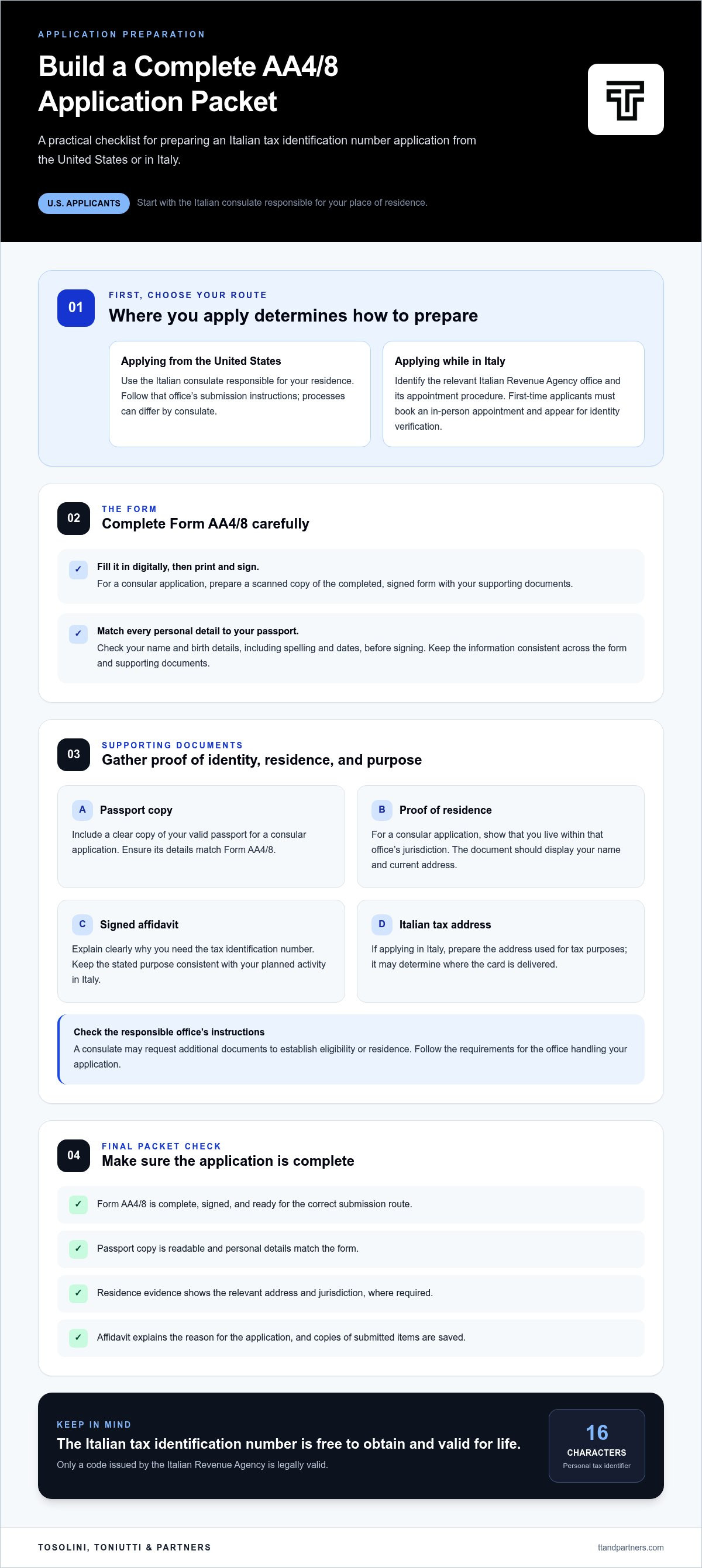
Identify the office responsible for your application before gathering documents. If applying from the United States, use the Italian consulate responsible for your residence and follow its submission instructions. If applying in Italy, identify the relevant Italian Revenue Agency office and its appointment procedure. These are separate routes, so prepare for the process that matches your location. A consular application and an in-person appointment may require different arrangements.
Complete Form AA4/8 digitally, then print and sign it. For a consular application, prepare a scanned copy of the signed form with the supporting documents. Compare each personal-data field against your passport, including your name and birth details. Consistent information helps the office match the application to your identity documents. Review spelling and dates before signing, rather than relying on corrections after submission.
Prepare a clear copy of your valid passport. A consular application requires a passport copy. For a first application at an Italian Revenue Agency office, applicants must attend in person for identity verification, according to the Italian Revenue Agency. Keep the passport details consistent across Form AA4/8 and any supporting statement. The passport should remain valid during your planned stay or work in Italy.
Document your residence in the consular district. A consular application must include proof that you live within that office’s jurisdiction. Choose a document that clearly shows your name and current address, and make sure the address matches the application. If applying in Italy, prepare the address used for tax purposes, since it may determine where the card is delivered. Keep a copy of your residence evidence with your application records.
Write a signed affidavit explaining why you need the tax identification number. State the purpose clearly and keep it consistent with your planned activity in Italy. Include the affidavit with the completed, printed, signed, and scanned AA4/8 form, passport copy, and residence proof. Consular offices may request other documents to establish eligibility or residence, so review the responsible office’s instructions before submitting your packet.
Organize the application as a complete set before sending it or attending. Check that the form is signed, the passport copy is readable, the residence evidence shows your address, and the affidavit explains the request. Save a copy of every submitted item for follow-up. If your plans also involve an Italian immigration matter, Tosolini, Toniutti & Partners can guide you through the related legal steps.
Completing the AA4/8 form
Use Form AA4/8 for your first Italian tax identification number application. Work from the current form provided for the consular or Italian Revenue Agency process you are following. Complete it digitally before printing, then sign it by hand if submitting through a consulate. A typed form is easier to review for consistent personal data than handwritten entries, but the required signature still matters.
Select the correct applicant type and request purpose. For a first-time Codice Fiscale application, enter Applicant Type Code 01. The form should make clear that you are requesting an Italian tax identification number, rather than asking for a duplicate or another service. If you are completing the form for a foreign citizen’s minor child, identify the request type using code 10.
Enter your name as it appears on your identity document. If you are a married foreign applicant, use the surname shown on your passport, not your birth surname. Compare each name field with your passport before signing. Consistent details help the consulate or Italian Revenue Agency verify your identity.
Write dates in the required day/month/year order: dd/mm/yyyy. Check the day and month carefully, especially if your supporting documents use the U.S. month/day/year convention. For example, a date written as 04/09/2026 on the Italian form means the fourth day of September. Do not assume the same sequence applies across every document in your packet.
Complete place-of-birth details with care. The place-of-birth component in an Italian Codice Fiscale consists of 4 characters, so the form’s birth information should match your official records. Use the country and place details requested by the form rather than shortening or adapting them. If your records present the place differently, keep a clear copy available to support the entry.
Review the signature and submission format for your specific office. Consular applications require a digitally completed, printed, signed, and scanned AA4/8 form. Applicants in Milan must complete and hand-sign the form; electronic signatures are not accepted there. Because this Milan instruction is location-specific, don’t treat it as a universal rule for every consulate or Revenue Agency office.
Make a final comparison before submitting the application. Check the applicant type code, name, birth details, date format, purpose, and signature against the identity document and supporting papers. For a minor’s application, confirm that the parent or legal guardian submits it. A complete, legible AA4/8 form gives the office a consistent set of details to process and issue the tax code.
Tax identification numbers for non-EU citizens
Match the application route to your immigration purpose. A Codice Fiscale identifies foreign citizens in dealings with Italian public authorities and other administrations. For non-EU citizens, the process can depend on whether you are applying for entry, arranging a residence permit, studying, or handling an administrative matter. First identify the purpose, then establish whether to apply through an Italian office or a consulate in the United States.
For entry connected with employment or family reunification, follow the immigration procedure in Italy. Non-EU citizens applying for entry for either purpose can obtain a tax identification number through the Single Desk for Immigration. This route ties the number to the relevant entry process, rather than treating it as a separate request at a local tax office. Keep your immigration documents consistent with the personal details used in the application.
If you need a residence permit issued or renewed, note the role of police headquarters. Italian police headquarters assign tax identification numbers to foreign nationals who need a residence permit issued or renewed. This means the number can be handled within the permit procedure. Keep the identity and immigration documents used for that process together, so the details match across the application and permit records.
If you are already in Italy, establish your right to stay before applying directly. Non-EU citizens requesting a tax identification number through an Italian Revenue Agency office must prove they have the right to stay in Italy, even temporarily. A foreign student staying less than 90 days may apply at any Italian Revenue Agency office. A student staying more than 90 days must first apply for a residence permit at the Questura and receives the number during that procedure.
If you remain in the United States, determine whether the consular route applies to your case. In the New York consular district, foreign citizens may request a Codice Fiscale through the consulate only when it is needed for online procedures or they cannot delegate a representative to apply in Italy. The district rule makes the purpose of the request important. State it clearly and prepare documents that support the stated need.
Consider delegation if you are not resident in Italy and can arrange a representative there. Foreign citizens who are not residents in Italy may delegate a representative to submit the application at an Agenzia delle Entrate office in Italy, according to Consolato Generale d'Italia a New York. Coordinate the application documents and authorization with the representative before submission. This route can provide an alternative to applying through the consulate when an in-country filing is suitable.
Keep your immigration and tax-code steps aligned. A Codice Fiscale does not replace permission to enter or stay in Italy. For example, a student planning a stay beyond 90 days follows the residence-permit process before receiving the number. Use the route tied to your purpose, whether that is an entry application, permit procedure, or direct request supported by proof of temporary stay.
What the Codice Fiscale is
Use the Codice Fiscale as an Italian personal tax identification number. It identifies an individual in dealings with Italian public authorities and other administrations. It is not a passport, identity card, visa, or residence permit. Keep those documents available when an institution needs both identity evidence and your tax code. The number remains useful for administrative purposes even when you live abroad.
Understand the code’s structure to check that its components match your details. An individual’s Italian tax code has 16 alphanumeric characters. Three letters represent the surname, and three represent the given name. Five characters relate to the date of birth and sex, while four identify the place of birth. A final check letter completes the code.
Compare the issued code with your application details and identity documents. Check your name against your passport, then compare the recorded birth information with the details you supplied. If a certificate contains an error, report it promptly to the issuing consular office. The office has only a few hours to void an incorrect certificate, so don’t leave a discrepancy unreported.
Keep the certificate as evidence of the code assigned to you. For applicants receiving a certificate abroad, the document records the issued number and can be presented for purposes permitted by law. Store a clear copy with your passport and application form, while retaining the original certificate safely. This makes it easier to provide consistent personal details when an Italian administration requests them.
Rely on an officially issued code, not an online calculator’s result. Online tools can generate a code that appears correct, but only a code issued by the Italian Revenue Agency is legally valid. A calculated match is not a substitute for an official certificate. Use the code shown on the certificate issued through the proper application route when completing Italian administrative paperwork.
Use the tax code as an identifier, not as a substitute for advice on a specific transaction. For example, a property matter may involve separate legal and administrative steps beyond identifying the parties. Keep your Codice Fiscale consistent across documents and coordinate it with the relevant transaction records. Tosolini, Toniutti & Partners provides real estate closing support for Italian property transactions.
Tosolini, Toniutti & Partners: E-2 VISA
Tosolini, Toniutti & Partners can help if your plans extend beyond obtaining an Italian tax identification number to U.S. immigration matters. A Codice Fiscale application and a Green Card are separate processes, each serving a different purpose. If you’re considering U.S. permanent residence as part of a broader cross-border plan, the firm provides Green Card assistance. Discuss your situation and how the immigration steps relate to your plans before deciding what to pursue next. For guidance on a Green Card matter, contact Tosolini, Toniutti & Partners.
Plan Your Next Cross-Border Step
A clear plan for how to get a Codice Fiscale from the US can support the practical steps in your Italian plans. The next decision may involve a separate immigration or business objective, so consider how each process fits your broader goals before moving forward. A tax identification number does not itself resolve immigration questions, and those should be approached as distinct matters.
Tosolini, Toniutti & Partners assists with E-1, E-2, and O-1 visas. If your plans involve U.S. immigration, the right path depends on your circumstances and the objective you’re pursuing. A focused discussion can help you understand which questions to address and what information may be relevant to your next step.
Contact Tosolini, Toniutti & Partners to discuss your plans, and take the next step with clarity.
Frequently Asked Questions
What is it for?
A Codice Fiscale helps identify you in administrative and financial dealings in Italy. For example, it may be needed when buying or selling property, dealing with public authorities, or renting real estate for more than 30 days. It links a person to records and transactions, but it doesn’t replace identity documents or immigration permission. Before applying, identify the specific Italian activity that requires the code.
What is an Italian Codice Fiscale and who needs one?
It’s an Italian tax identification number assigned to an individual. Italian citizens and foreign nationals may need one for dealings with Italian administrations or certain transactions. A U.S. resident planning an Italian property purchase, for instance, may need the code for related administrative steps. The reason for applying helps determine which authority handles the request and what supporting documents to prepare.
Can a U.S. citizen apply for an Italian Codice Fiscale from the United States?
Yes. If you’re deciding how to get a Codice Fiscale from the US, apply through the Italian consulate responsible for your place of residence. Start by identifying the consular district for your home address, then follow that office’s process. Consular procedures can differ, so don’t assume a submission method used in one district applies across the United States. Prepare your documents according to your responsible office’s instructions.
Which Italian consulate handles Codice Fiscale applications based on U.S. residence?
The consulate responsible for your place of residence handles your application. Determine the district using your current U.S. address, rather than choosing an office based on convenience or travel plans. If you move, use the consular jurisdiction covering your new residence. The relevant district’s instructions govern how to submit the application and which supporting documents to include.
What documents are required to apply for a Codice Fiscale through an Italian consulate?
Prepare a completed and signed AA4/8 form, a copy of your valid passport, proof of residence in the consular district, and a signed statement explaining why you need the code. These documents allow the office to compare your identity, address, and stated purpose. A consulate may also request other evidence to establish residence or eligibility, so organize your documents around the specific application route.
How do you submit a Codice Fiscale application to an Italian consulate in the U.S.?
Submit the application using the method set by the consulate responsible for your residence. For example, applicants in the New York consular district must email applications individually from their own email address, using their name and a request for a certificate in the subject line. That office accepts submissions Monday through Thursday, between 8:00 a.m. and 3:00 p.m. Other districts may use different instructions.
Is there an official Codice Fiscale application form, and how do you fill it out?
Yes. Form AA4/8 is used to request a Codice Fiscale. Complete it digitally, enter personal details consistently with your passport, print it, and sign it. For a first-time application, use Applicant Type Code 01. Write dates in day/month/year order, and review your name and birth details before submitting. A foreign citizen’s minor child requires request type code 10.
How long does it take to get a Codice Fiscale from a U.S. consulate?
There isn’t one processing period for every U.S. consulate. If you’re planning how to get a Codice Fiscale from the US, allow for the time needed by your responsible office and submit a complete, readable application. A missing signature, unclear passport copy, or mismatch between the form and supporting documents may require follow-up. Use the consulate’s process for updates on your application.



Comments