

How Italians can apply for adjustment of status with Form I-485

Form I-485 is the U.S. Citizenship and Immigration Services application to adjust status to lawful permanent resident. For Italians, filing is generally possible only when a visa is available in the relevant immigrant category and the applicant meets the requirements for that category.
The process can feel complex because eligibility, petition timing, and travel or work plans are closely connected. This guide explains how to prepare an I-485 application, when concurrent filing may be possible, and what to expect from biometrics and an interview. It also covers work authorization and travel documents, so you can see how each step fits into the wider path to permanent residence.
Table of Contents
What is the Adjustment of Status I-485 form?
Form I-485 is the U.S. Citizenship and Immigration Services application to adjust status to lawful permanent resident while in the United States. The eligibility review for I-485 adjustment of status for Italians starts with the applicant’s immigrant category, visa availability, and category-specific filing requirements.
Check I-485 Eligibility Categories
Identify the immigrant category supporting your application before preparing Form I-485. Categories include family-based and employment-based applications, asylum, certain special immigrant cases, registry, and adjustment under section 245(i). Italian citizenship alone doesn’t establish eligibility. For an I-485 adjustment of status for Italians case, the underlying category and available immigrant visa determine whether adjustment is possible.
Review Eligibility and Filing Requirements
Before filing, confirm that your immigration category allows adjustment of status and that an immigrant visa is available. In employment-based cases, check the underlying petition and priority date. The priority date generally must be current under the U.S. Department of State’s Visa Bulletin for the relevant category. Follow the instructions for your category, include required supplements, and sign the application.
Match your circumstances to a category. If a U.S. employer is sponsoring you, examine the employment-based pathway and its immigrant petition. Family-based applicants rely on a qualifying relationship. An asylum applicant must have filed Form I-589 before beginning the Form I-485 process. The category determines which supporting evidence and forms apply.
Confirm visa availability. Applicants generally cannot file Form I-485 until a visa is available in their immigrant category. Check the relevant category and priority date together; Italian citizenship does not make a visa immediately available. If no visa is available, filing may need to wait until the category permits it.
Prepare required medical evidence. Applicants required to submit Form I-693 must submit it with Form I-485, or USCIS may reject the application. Make sure the medical form is complete and included where required. For online filing, upload the completed form and keep the original and civil surgeon’s envelope until USCIS makes a final decision.
Assess prior status and employment carefully. An overstay or work without authorization can affect eligibility, and its consequences depend on the immigrant category and case circumstances. Disclose the history accurately and assess whether an exception applies before filing. A possible basis for permanent residence does not make prior immigration history irrelevant.
Check the applicable filing fees. Confirm which amounts apply to the applicant’s age and filing circumstances before submitting.
Concurrent filing of immigrant petitions and I-485
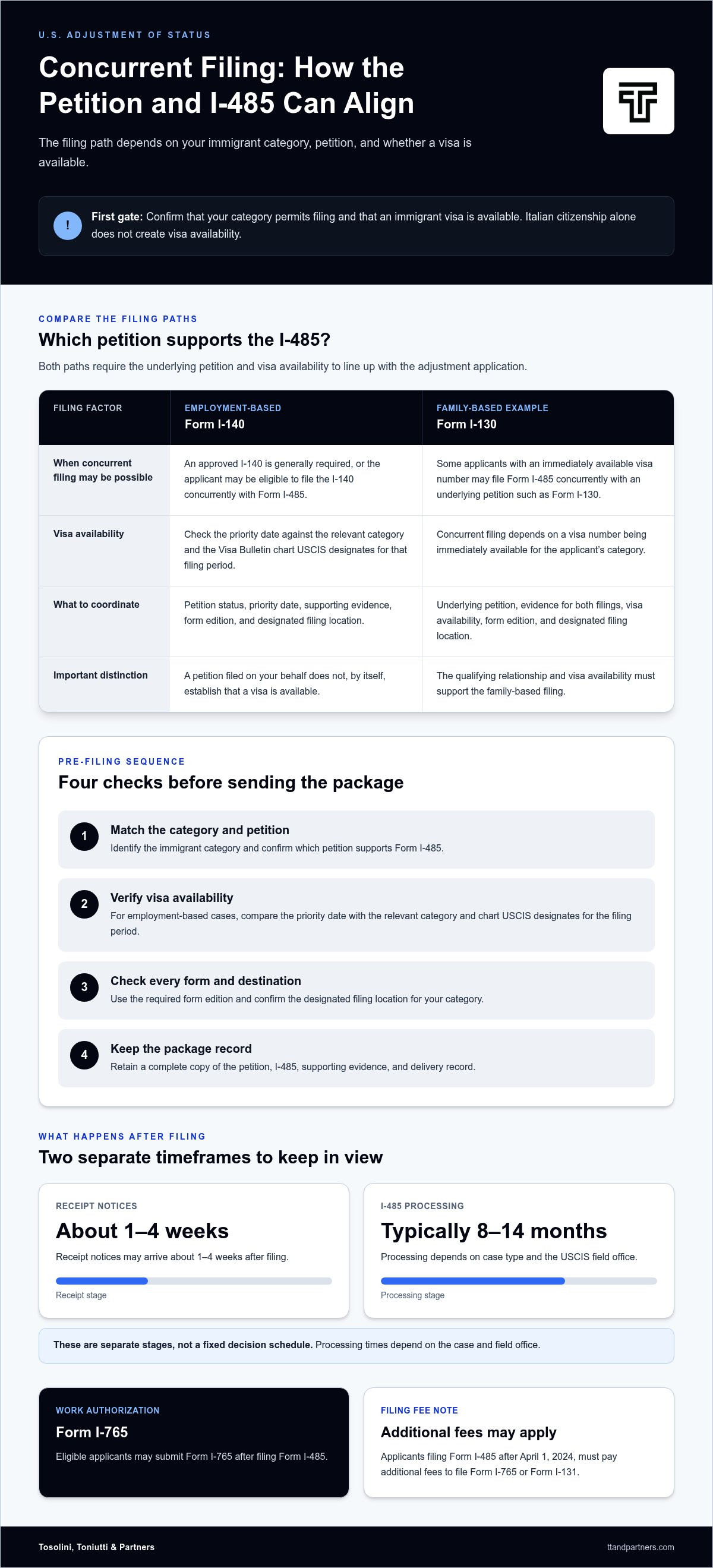
Concurrent filing can bring an immigrant petition and Form I-485 into the same filing window, but eligibility depends on the category and visa availability. For Italian applicants, coordinate the petition, priority date, form edition, filing location, and any request for work authorization.
Coordinate Immigrant Petitions and I-485 FilingFirst, identify the immigrant petition supporting your application and whether your category permits concurrent filing. For employment-based adjustment of status, an applicant generally must have an approved I-140 immigrant petition or be eligible to file the I-140 concurrently with Form I-485, according to U.S. Citizenship and Immigration Services.Some applicants with an immediately available visa number may file Form I-485 concurrently with an underlying petition, such as Form I-130. Assemble evidence for both filings and ensure the petition supports the basis stated on Form I-485. A petition filed on your behalf does not by itself establish that a visa is available.
Check the Form Edition and Filing LocationBefore mailing an application, match the form edition to the filing date. USCIS required applicants filing Form I-485 on or after September 18, 2026, to use the edition dated September 18, 2026. An older edition can disrupt an otherwise complete submission, so review the date printed on every form in the package.Also confirm the designated filing location for your category. USCIS changed the mail filing location for Form I-485 on October 7, 2026. Applications sent to prior locations during the 30-day grace period were accepted if postmarked by November 9, 2026.
Review Visa Bulletin and Priority DatesCompare your priority date with the relevant category and date in the U.S. Department of State’s Visa Bulletin before submitting Form I-485. For many employment-based cases, the priority date must be current; Italian citizenship does not replace this requirement or independently create visa availability.Use the Visa Bulletin chart USCIS designates for the filing period, and distinguish it from the Final Action Dates chart. If your priority date is not eligible for filing, prepare the petition and supporting evidence, then check the relevant bulletin again as it changes.
Track the Filing and Processing TimelineKeep a complete copy of the petition, Form I-485, supporting evidence, and delivery record. Receipt notices may arrive about 1-4 weeks after filing, while Form I-485 processing typically takes 8 to 14 months, depending on case type and USCIS field office. These are separate stages, not a fixed decision schedule.After filing, eligible applicants may submit Form I-765 for employment authorization. Applicants filing Form I-485 after April 1, 2024, must pay additional fees to file Form I-765 or Form I-131. If your petition timing or filing date raises questions, discuss your immigration circumstances.
What Does This Mean for Current or Future Applicants?
Whether you are filing now or preparing for a future application, keep your forms complete, current, and consistent with your eligibility category. Changes in address, policy, family circumstances, or a denial notice may affect what you need to do next.
Update an Address During a Pending ApplicationReport a move promptly and update the address connected to every pending case. According to U.S. Citizenship and Immigration Services, people who change their address must notify USCIS within 10 days of moving to the new address. Keep the confirmation with your case documents, and make sure household members with separate applications update their own records.Update your address with USCIS so future correspondence, including biometrics and interview notices, reaches you. If a notice goes to an old address, you could miss an appointment or a request that requires a timely response.
Consider Effects on Pending and Future ApplicationsReview how any change in your circumstances relates to the basis of your pending I-485. USCIS issued adjustment-of-status policy guidance on May 22, 2026, but has not instructed applicants to withdraw, amend, or refile pending cases solely because of that policy change. Keep notices and submitted documents together.Before filing, confirm that the same immigrant category and supporting petition still apply. A change in employment, family relationship, or visa availability may affect the evidence or timing required. Keep copies of updated petitions and all USCIS correspondence.
Review Employment- and Family-Based ApplicationsFor an employment-based Green Card case, track the underlying petition and priority date. In many employment-based adjustment cases, the priority date must be current under the U.S. Department of State’s Visa Bulletin. If a permanent job offer changes, review whether the application’s basis or supporting documents also need attention.For a family-based case, identify which relatives may apply as dependents. A spouse and unmarried children under age 21 may be eligible to apply for a green card as dependents of an I-485 applicant. Each person needs an application reflecting their own information and supporting documents.
Address Denial Risks and Further OptionsBefore filing, check for common problems: an unsigned Form I-485, missing required evidence, or filing when a visa isn’t available. USCIS rejects unsigned applications, and applicants required to submit Form I-693 must include it with Form I-485. These are preventable filing issues, not substitutes for meeting the category’s eligibility requirements.Read a denial notice carefully; it may say whether an appeal is available, although applicants generally cannot appeal a denial. Form I-290B is used for appeals and motions related to adjustment decisions. Refiling requires a fresh review of eligibility, visa availability, and the denial grounds before another application is submitted.
Biometrics appointments and interviews
After filing Form I-485, prepare for the biometrics notice and any interview USCIS schedules. Keep the appointment notice and your submitted application together.
Attend a Biometrics Appointment
Attend the biometrics appointment listed in your USCIS notice at the designated Application Support Center. Read the notice carefully and bring it with you. If the date or location creates a conflict, follow the notice’s instructions rather than missing the appointment. USCIS uses biometrics as part of its background checks for adjustment applicants.
Complete Biometrics and Background Checks
Allow USCIS to collect your fingerprints as instructed at the appointment. Fingerprints collected for Form I-485 background checks are valid for 15 months from the date the FBI processes them. Keep the appointment notice and any related USCIS correspondence with your records, so you can identify which application and biometrics step each notice concerns.
Attend an Interview
Prepare for the interview by reviewing the information and evidence submitted with Form I-485. Bring originals of documentation submitted with the application, including passports, official travel documents, and Form I-94, whether expired or not. An interview may be part of the adjustment process, but personal interviews are not automatic for employment-based applicants.
Before the biometrics visit, compare the notice with your current case records. Confirm the appointment date, location, and any instructions stated by USCIS. Bring the notice so staff can connect the appointment to your Form I-485. Keep a copy of the notice afterward with your application materials.
After fingerprints are collected, retain any receipt or appointment record USCIS provides. The FBI processing date determines the 15-month validity period for fingerprints used in background checks. If USCIS later sends another notice, compare its details with your prior biometrics records and follow the new notice’s instructions.
Before an interview, organize originals alongside copies of the documents you submitted. Check that your passport, official travel documents, and I-94 are accessible, including an expired I-94. Review your application for consistency, and prepare clear explanations for any differences between the submitted records and your current circumstances.
If USCIS schedules an interview, attend on the date and at the place stated in the notice. Most employment-based applicants are exempt from personal interviews, so do not assume an interview is automatic. If an attorney represents you, coordinate your records and interview preparation with them.
Employment authorization and travel documents
While Form I-485 is pending, separate the documents that support permanent residence from applications for work authorization and travel documents. Prepare each form according to its purpose and your case category.
Organize the supporting documents. Match each document to the information in Form I-485 and the immigrant petition. The application calls for address history covering the previous five years and two color passport-style photos measuring 2 by 2 inches (50 by 50 millimeters). Check that names and dates align across submitted records.If your case requires Form I-693, submit it with Form I-485; USCIS may reject an application without it. For an online filing, upload the completed medical form and keep the original and civil surgeon’s envelope until USCIS makes a final decision on Form I-485.
File for employment authorization separately. Form I-765 is used to request employment authorization during the adjustment process. Filing Form I-485 does not itself provide work authorization, so prepare the I-765 as a separate application when seeking authorization while your green card case is pending.Applicants who file Form I-485 after April 1, 2024, must pay additional fees to file Form I-765 or Form I-131. The estimated employment authorization approval period in the described process is approximately 5 to 11 months. Keep the I-765 receipt and decision with your immigration records.
Plan travel document requests around your travel needs. Form I-131 is used to request travel documents during the adjustment process. A Form I-485 receipt is not a travel document; keep the separate I-131 filing and its notices organized. The estimated average processing time for Form I-131 in the described process is about 11 months.The general timeline places travel documents around 8 to 14 months after filing. These estimates describe different measures, so plan using your own filing and notice dates rather than treating either period as a guaranteed arrival date. Before leaving the United States, make sure you understand which document you have obtained and its terms.
Keep each family member’s paperwork distinct. A spouse or eligible child with a separate adjustment application should maintain a separate set of forms, receipts, and supporting evidence. For example, label each member’s Form I-765 and Form I-131 records with that applicant’s name and receipt number to prevent confusion.Use a simple filing sequence: retain copies of submitted forms, track each receipt, and store USCIS notices with the corresponding application. For guidance on how these filings fit your immigration matter, discuss your application and document plan.
Tosolini, Toniutti & Partners: E-2 VISA
Tosolini, Toniutti & Partners assists individuals and corporate clients with Green Card matters. If you are considering an employment-based or family-based path, review how your eligibility category, immigrant petition, and filing history fit together.
That review can help clarify which documents support your case and how Form I-485 relates to your broader immigration plans. It is particularly relevant when a pending application, prior status history, or a change in circumstances raises questions about the next filing step.
Contact Tosolini, Toniutti & Partners to discuss your Green Card matter and next steps.
Shape Your Next Immigration Step
The next step is to connect your immediate filing decision with the longer-term direction you want your life or career in the United States to take. For Italians considering the I-485 adjustment of status process, that means viewing the application within its specific eligibility category and broader immigration plans, rather than treating one form as the whole strategy.
Tosolini, Toniutti & Partners works on Green Card matters as well as E-2, E-1, and O-1 visa matters. The relevant path depends on your circumstances and objectives. A focused discussion can help you identify the questions to resolve before moving forward with an immigration matter.
Contact Tosolini, Toniutti & Partners to discuss your next step. A considered plan can make the process ahead clearer and more purposeful.
Frequently Asked Questions
Why is the I-485 Application Important?
Form I-485 lets an eligible person in the United States apply to become a lawful permanent resident without first completing immigrant visa processing abroad. It also gives USCIS a structured record of the applicant’s eligibility, immigration history, and supporting evidence. For example, a person relying on an employer petition uses the application to request permanent residence based on that employment category.
Who is eligible to file Form I-485 for adjustment of status while in the United States?
Eligibility depends on the applicant’s immigration category, visa availability, and whether the category’s requirements are met. An Italian applicant considering I-485 adjustment of status for Italians should first identify the basis for the application, such as a qualifying family relationship or employment petition. Physical presence in the United States and Italian citizenship alone do not establish eligibility; certain immigration histories may also affect the analysis.
Can Italian citizens adjust status through family, employment, or other immigration categories?
Yes. Italian citizens may apply through qualifying family-based and employment-based categories, as well as certain other pathways, including asylum or special immigrant classifications. The category determines the evidence and petition needed. An employment-based case, for example, is connected to an immigrant petition, while a family-based case rests on a qualifying relationship. Eligibility depends on the category’s requirements, not nationality alone.
Which forms and supporting documents are required with an I-485 application?
Form I-485 is the central application, but the accompanying forms and evidence depend on the applicant’s category. A filing may include evidence supporting the underlying petition, identity and travel documents, photographs, address history, and Form I-693 when required. Use the current instructions to assemble the applicable package. A practical approach is to group documents by the eligibility requirement each one supports.
Can I-485 be filed concurrently with Form I-130 or Form I-140, and when?
Concurrent filing is available only when the applicant’s category and visa availability permit it. Some applicants with an immediately available visa number may submit Form I-485 with Form I-130. For employment-based adjustment, U.S. Citizenship and Immigration Services says an applicant generally needs an approved I-140 or must be eligible to file it concurrently. The petition type and filing date both matter.
What are the steps and processing times for I-485, biometrics, and the USCIS interview?
After filing, applicants follow USCIS notices, attend biometrics, and appear for an interview if scheduled. The described processing estimate for Form I-485 is 8 to 14 months, depending on the case type and USCIS field office. Most employment-based applicants are exempt from personal interviews. Keep notices organized by date so you can distinguish an appointment instruction from a request for additional evidence.
Can applicants travel or work while I-485 is pending, and what permits are needed?
A pending I-485 does not itself provide work authorization or serve as a travel document. Applicants seeking employment authorization may file Form I-765, and those seeking a travel document may file Form I-131. These are separate requests, so keep their receipts and decisions distinct from the main application. Before making plans, review the document issued and the conditions that apply to its use.
How does I-485 differ from consular processing for Italian citizens?
Adjustment of status is a request to become a permanent resident from within the United States. Consular processing instead involves applying for an immigrant visa through a U.S. consular post abroad. For an Italian applicant, the I-485 adjustment of status for Italians route is available only when the person qualifies to adjust inside the country; location, immigration history, and category help determine the appropriate process.



Comments