

Green Card Abandonment Risk: How to Prove You Kept Status

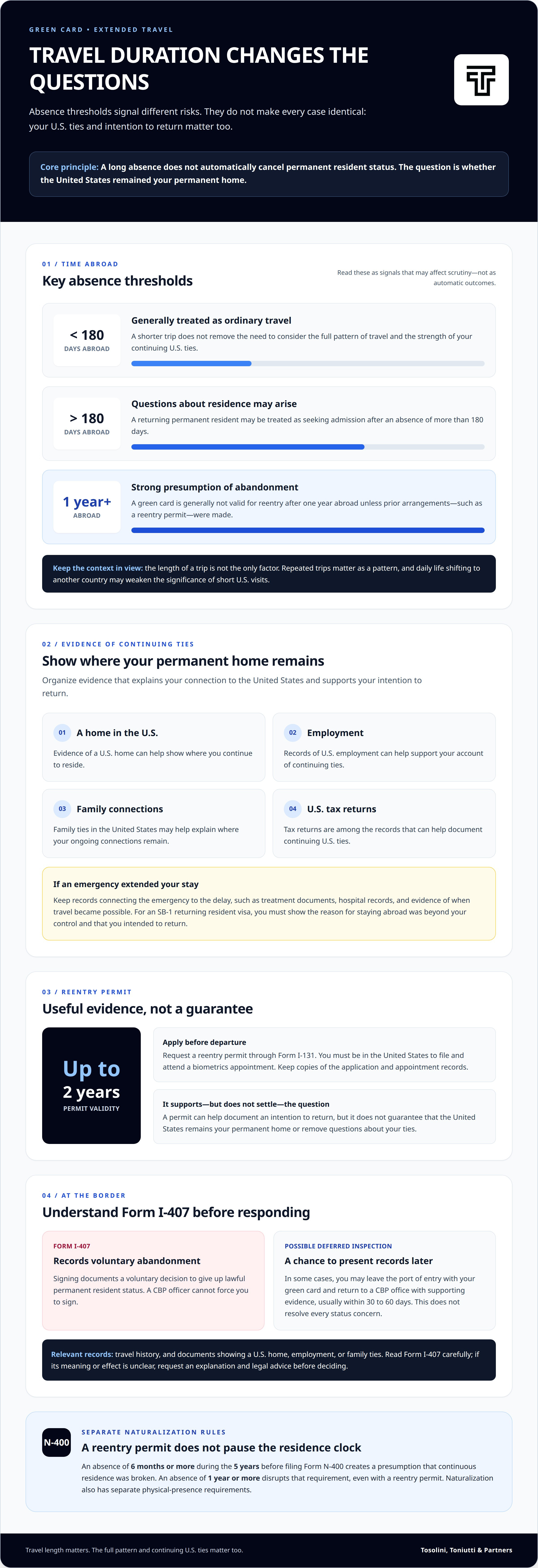
Repeated trips can create green card abandonment risk even when no single absence tells the whole story. An absence of 12 months or longer creates a strong presumption that a permanent resident has abandoned U.S. residence, but the length of a trip is not the only factor: the strength of a resident’s continuing ties to the United States also matters.
It’s understandable to focus on the calendar, especially when work, family responsibilities, or other commitments require extended time abroad. To show that you maintained your status, explain how your travel fits with an ongoing intention to make the United States your permanent home, and support that explanation with evidence of your ties.
This article explains what kinds of evidence can help, how trips of different lengths may affect your status, and what options may arise if CBP questions you at the border. It also covers how a reentry permit fits into longer stays abroad. According to U.S. Citizenship and Immigration Services, a reentry permit is valid for up to 2 years.
Table of Contents
How do I prove I did not abandon my green card?
Show that the United States remained your home while you were abroad. A reentry permit can support that evidence, but it does not resolve every question about your residence or plans to return.
Reentry Permits and Form I-131
A reentry permit is a travel document requested through Form I-131, Application for Travel Documents, Parole Documents, and Arrival/Departure Records. A lawful permanent resident must be in the United States to file Form I-131 and attend a biometrics appointment. This means the application process must begin before departure, not after settling abroad. Plan the filing while you are still present in the country, and keep copies of the application and appointment records with your travel documents.
Permit Validity During Long Absences
U.S. Citizenship and Immigration Services states that a reentry permit is valid for up to 2 years. It can help document a returning resident’s intention to come back after an extended absence, but it is not an unlimited travel authorization. Compare the expected time abroad with the permit’s validity before departure. If circumstances change and the stay may exceed its validity, the permit alone may not address the resulting return or status concerns.
Living Abroad With a Reentry Permit
Yes, a lawful permanent resident can face green card abandonment risk while living abroad, even with a reentry permit. The permit supports an intention to return, but does not guarantee that the United States remains the person’s permanent home. Evidence of a home, job, family connections, and U.S. tax returns prepared with international tax professionals like InterUSA Tax & Accounting can help show continuing ties. Repeated short visits may carry less weight if daily life has shifted to another country.
Naturalization has a separate continuous-residence test. U.S. Citizenship and Immigration Services says an absence of six months or more during the five years before filing Form N-400 creates a presumption that continuous residence was broken. A reentry permit does not pause that clock. Keep travel dates and records of U.S. ties organized, especially when planning long absences before naturalization.
Does staying abroad more than one year automatically cancel my green card?
No. An absence of one year or more does not automatically cancel permanent resident status, but it can create a strong presumption of abandonment and affect return. After more than 180 days abroad, a returning permanent resident may be treated as seeking admission.
Absence Duration and Abandonment Risk
Absence thresholds signal different risks; they do not make every case identical. A trip under 180 days is generally treated as ordinary travel, while a longer absence can prompt questions about whether the United States remains your residence. At one year abroad, the risk increases: your green card is generally not valid for reentry unless you made prior arrangements, such as obtaining a reentry permit. The key issue is whether your travel was temporary and your permanent home remained in the United States.
Exceptional Absences and Medical Emergencies
A medical emergency can explain why a planned temporary trip became an extended absence. Keep records that connect the emergency to the delay, such as treatment documents, hospital records, and evidence of when travel became possible. For an SB-1 returning resident visa, the applicant must show that the reason for remaining abroad was beyond their control and that they intended to return to the United States. Those facts help explain the length and circumstances of the absence.
After one year abroad without a valid reentry permit, a permanent resident may need an SB-1 visa to return. Approval requires evidence of the original intention to return; it is not automatic. If a valid permit covered the absence, it can support reentry, but it does not erase questions about whether the United States remained your permanent residence. The reason for travel and your continuing ties still matter.
Naturalization has separate residence and physical-presence requirements. U.S. Citizenship and Immigration Services says an absence of six months or more during the five years before Form N-400 creates a presumption that continuous residence was broken. An absence of one year or more disrupts that requirement, even with a reentry permit. The permit also does not pause the naturalization residence or physical-presence clocks.
Form I-407 and options at the border
At a U.S. port of entry, CBP may question a permanent resident about extended travel and intent to live permanently in the United States. U.S. Citizenship and Immigration Services states that Form I-407 records voluntary abandonment of lawful permanent resident status.
Signing the form documents a voluntary decision to give up permanent resident status. A CBP officer cannot force a resident to sign, and the decision must be voluntary. Read the form carefully and understand its consequences before deciding. If its meaning or effect is unclear, request an explanation and legal advice before making a decision.
CBP assesses whether a lawful permanent resident intends to continue living permanently in the United States. A long absence, a home established abroad, or few ongoing U.S. ties may prompt questions. If officers suspect abandonment, they may take serious action at the border. A returning resident can explain their travel history and present documents showing continuing U.S. residence, such as evidence of a home, employment, or family ties.
In some cases, deferred inspection may allow a resident to leave the port of entry with the green card and return to a CBP office with supporting evidence, usually within 30 to 60 days. This provides a chance to present records after the immediate border encounter; it does not resolve every status concern. Keep copies of travel records and documents relevant to the reason for the extended stay.
Form N-470 concerns preserving residence for naturalization in certain government-service situations; it is distinct from Form I-407 and does not record voluntary abandonment. A resident considering government service abroad should separate the naturalization question from the decision to surrender immigration status. If an officer presents Form I-407, ask which issue is being addressed before signing any document. The form’s voluntary nature makes understanding that distinction essential.
Green card abandonment during extended or repeated international travel
Repeated trips can raise questions even when no single absence lasts a year. CBP may consider the overall pattern: time spent abroad, the purpose of each trip, and whether the United States remains your home. Green card abandonment risk can increase when repeated travel suggests that your everyday life has shifted to another country. Brief visits to the United States may not, by themselves, demonstrate continuing residence.
When possible, keep each absence under 180 days and spend most of your time in the United States. After more than 180 days abroad, a lawful permanent resident may face questions on return or referral to secondary inspection. A reentry permit can support a planned extended absence, but it does not replace evidence of continuing U.S. ties or resolve every concern about residence.
Build a consistent record linking your travel dates and reasons to your continuing ties. U.S. income tax returns for the past three years, prepared with the assistance of professionals such as Wright CPAs, LLC, can help document your connections to the country. Records of a U.S. home, job, or close family ties may provide further context. Evidence should also explain why an absence lasted longer than expected and how your plans relate to returning. A series of short visits may carry less weight if your primary home and daily responsibilities are abroad.
Before taking another long trip, assess green card abandonment risk in light of your full travel history, especially if your job, home, or family is abroad. Consider how each absence fits with your intention to maintain U.S. residence rather than viewing trips in isolation. To discuss how your travel history may affect your status, request a review of your circumstances.
Tosolini, Toniutti & Partners: GREEN CARD
Tosolini, Toniutti & Partners assists individuals with Green Card matters when extended or repeated travel raises questions about maintaining permanent resident status. If your travel history includes lengthy absences, changing ties to the United States, or questions at the border, legal guidance can help you understand the relevant evidence and available options. A careful review can bring together your travel dates, reasons for being abroad, and continuing U.S. connections, so your circumstances are considered as a whole.
For support with a Green Card matter, contact Tosolini, Toniutti & Partners.
Make your next travel decision with clarity
Your next step is to assess your plans before another trip changes the picture. Consider how future travel fits with your long-term home, work, family responsibilities, and immigration goals. A clear understanding of these priorities can help you prepare for future decisions with greater confidence.
If your plans also involve business or extraordinary-ability immigration, Tosolini, Toniutti & Partners handles E-1, E-2, and O-1 visa matters alongside Green Card work. The right path depends on the purpose of your plans and the facts of your situation. Addressing questions early can help you make informed choices before travel or a border inspection becomes urgent.
For guidance on your circumstances and green card abandonment risk, contact Tosolini, Toniutti & Partners. Thoughtful planning can help you approach the next stage with greater confidence.
Frequently Asked Questions
How long can a green card holder stay outside the United States?
There is no single absence length that guarantees a green card holder can return without questions. A trip shorter than one year generally allows you to use a green card for reentry, but your travel pattern and continuing U.S. ties still matter. For example, frequent short visits may not resolve concerns if your home and daily life have shifted abroad. Consider the purpose and expected duration of each trip.
Can immigration take my green card at the airport?
At an airport, CBP may question you about residence and travel, and a long absence may lead to secondary inspection. An officer cannot force you to sign Form I-407, which records voluntary abandonment of permanent resident status. If asked to sign, understand the form’s effect before deciding. You can explain your circumstances and present relevant records, such as evidence of your U.S. home or employment.
How to qualify for returning resident status?
To seek an SB-1 returning resident visa, show that circumstances beyond your control kept you abroad and that you intended to return to the United States. Apply using Form DS-117 with supporting documents at the U.S. embassy or consular office closest to you. Evidence might include medical records explaining an unavoidable delay and documents showing your original return plans. A consular officer applies a high threshold, and approval is not automatic.
What is a reentry permit and when do I need one?
A reentry permit is a travel document that can support a permanent resident’s stated intent to return after an extended stay abroad. Consider applying before departure if you expect a lengthy absence or repeated travel that could raise questions about your U.S. residence. Form I-131 must be filed while you are in the United States, and you must attend a biometrics appointment. The permit does not itself guarantee continued status.
How long can a green card holder stay outside the U.S. without risking abandonment?
No specific trip length removes all abandonment concerns, because the full travel pattern and location of your primary ties matter. Absences under 180 days are generally treated as ordinary travel, while longer stays can invite closer questions. Keep a clear record of trip dates, reasons for travel, and connections to the United States. Repeated visits may carry limited weight if your actual home is abroad.
Does a trip abroad of more than 6 months affect green card status or reentry?
Yes. After an absence of more than 180 days, a lawful permanent resident may be treated as seeking readmission and become subject to grounds of inadmissibility. That does not automatically cancel the green card, but CBP may ask about your residence and travel. For naturalization, U.S. Citizenship and Immigration Services says an absence of six months or more during the relevant five-year period creates a presumption that continuous residence was broken.


Comments