

E-2 Visa for Italian Investors: What Counts as a Substantial Investment

The amount in your bank account doesn’t make an investment substantial. For the E-2 visa for Italian investors, there’s no fixed minimum: the investment must be committed and at risk, tied to a real operating business, and substantial in proportion to what that business costs. Funds that are merely intended for investment or left uncommitted in an account generally won’t meet that test.
It’s understandable to focus on the amount, but the source, commitment, and exposure of the funds matter too. This article explains how Italian nationals qualify, what makes an investment substantial and genuinely at risk, and how the business’s purpose and financial prospects shape the assessment.
It also outlines what to expect from E-2 processing in Rome, including the factors that can affect the timeline. The aim is to clarify how the investment, enterprise, and application fit together before you decide how to proceed.
Table of Contents
Considering a US investment with an E-2 visa?
An E-2 enterprise must be a real operating business, and its investment must support activity beyond passive ownership. To qualify, the enterprise must also show capacity to provide more than a minimal living for the investor and family, or make a significant economic contribution; planned hiring can help describe that contribution, but headcount alone is not the test.
Qualifying Operating Enterprises
A qualifying enterprise conducts genuine commercial activity rather than holding assets speculatively or remaining idle. Owning property or holding funds alone does not establish an operating business. For example, a trading company’s business plan should describe its services, customers, operations, and expected income, not simply the investor’s ownership stake.
Evidence of Non-Marginality
Non-marginality evidence explains how the enterprise can produce more than minimal income or contribute significantly to the U.S. economy. A business plan can connect projected sales, expenses, staffing, and operating milestones to that outcome. For a new enterprise, the Electronic Code of Federal Regulations states that projected capacity to generate income beyond a minimal living for the investor and family should be realized within 5 years after startup.
That 5-year horizon makes credible projections important. They should show how the business moves from launch to sustainable operations, with assumptions tied to its products, services, and anticipated demand. The investor’s spouse and family are relevant to the minimal-living analysis, while employee plans can clarify how the enterprise expects to operate and grow. Projections should describe a coherent business, not an unsupported promise of future success.
Timing and conduct also matter. According to the U.S. Department of State, conduct inconsistent with E-2 status within 90 days of a visa application or admission can trigger a presumption of misrepresentation. For an E-2 visa for Italian investors, the business plan, ownership structure, and actual activities should tell a consistent story: an investor developing and directing an operating enterprise, rather than merely holding assets or working outside the stated purpose.
How Long Does an E-2 Visa Take in Rome?
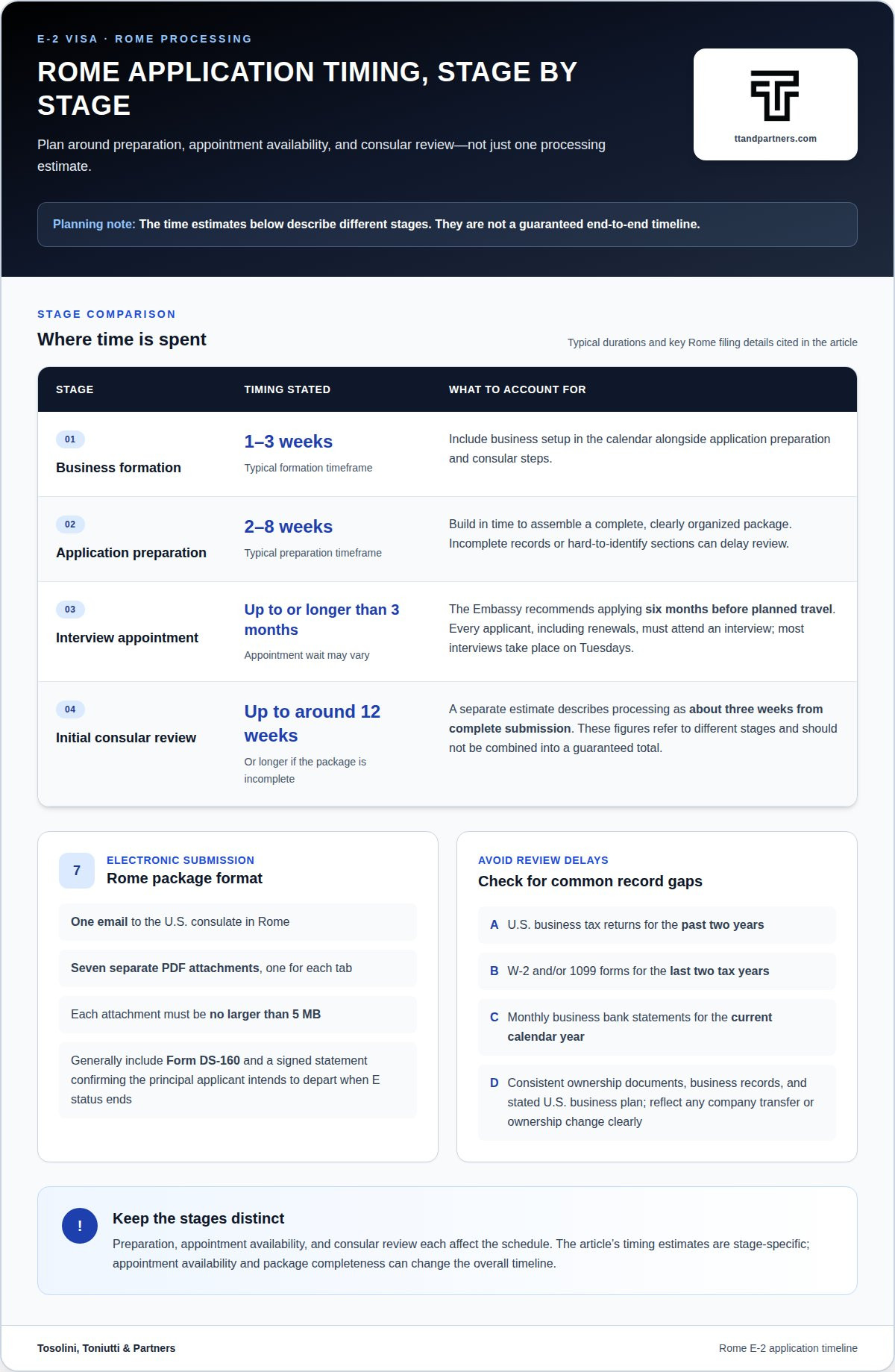
Rome processing involves application preparation, electronic submission, an interview, and consular review. The total timeline depends partly on appointment availability and whether the package is complete.
Electronic Submission and Consular Processing
Italian nationals submit E-2 applications and supporting documents electronically to the U.S. consulate in Rome. The package goes in one email with seven separate PDF attachments, one for each tab; each attachment must be no larger than 5 MB. Applicants generally submit Form DS-160 and a signed statement confirming the principal applicant intends to depart when E status ends.
Every applicant, including someone renewing an E visa, must attend an interview. Most interviews take place on Tuesdays. Incomplete records or materials arranged so that required sections are hard to identify can delay review.
Rome Application Timing and Common Mistakes
The U.S. Embassy in Italy recommends applying six months before planned travel. Interview appointments may take up to or longer than three months to obtain. Preparation typically takes 2-8 weeks, while forming the business typically takes 1-3 weeks, so the calendar should include each stage rather than only consular review.
Rome’s initial review can take up to around 12 weeks, or longer if the package is incomplete. A separate estimate places processing at about three weeks from complete submission. These figures describe different stages and shouldn’t be treated as a guaranteed end-to-end timeline.
Common record gaps include missing U.S. business tax returns for the past two years, W-2 and/or 1099 forms for the last two tax years, or monthly business bank statements for the current calendar year. Business-structure inconsistencies can also complicate the file: ownership documents, business records, and the stated plan to develop and generate income in the United States should align. A company transfer or change in ownership should be clearly reflected in the application materials.
To coordinate the filing schedule with planned travel, discuss your application timeline.
E-2 treaty investor visa eligibility for Italian nationals
Italian nationals may qualify because Italy has a commerce and navigation treaty with the United States. Nationality is only the starting point: the applicant must invest in a qualifying U.S. enterprise and enter the country to develop and direct it.
Control may be shown through ownership or operational authority. According to U.S. Citizenship and Immigration Services, an Italian E-2 investor can demonstrate control of the U.S. enterprise through at least 50 percent ownership or operational control. An applicant with less ownership may therefore need evidence that their role gives them meaningful authority over the enterprise’s operations.
The applicant’s role must fit the business structure and the purpose of the visa. The investor should be prepared to explain how they will develop and direct the enterprise, supported by ownership records and a clear account of their business responsibilities. At the consular interview, the role should align with the enterprise’s activities and the stated purpose of travel.
Eligible family members may accompany the principal investor as dependents. According to U.S. Citizenship and Immigration Services, an unmarried child under 21 years old of a treaty investor may qualify for a derivative E visa. A spouse and minor children can generally accompany the investor; dependent children may attend school in the United States but may not work. A spouse in valid E dependent status is generally authorized to work.
The E-2 is a nonimmigrant visa and does not itself lead to a green card. EB-5 is an immigrant-visa route, so the two categories serve different immigration purposes and have distinct eligibility frameworks.
For an E-2 application, the central questions are whether the applicant has Italian nationality, has committed qualifying investment funds, and will develop and direct the enterprise. A worker who is not the principal investor may also qualify in an executive, supervisory, or highly specialized role. Their duties and expertise must fit the position claimed; simply being an employee of an Italian-owned business does not by itself establish E-2 eligibility.
Substantial investment requirements
For an Italian treaty investor, substantiality depends on the enterprise’s cost and the funds committed to it. The evidence must demonstrate a proportionate investment that is genuinely exposed to business risk.
No Fixed Minimum Investment
The E-2 rules set no fixed minimum investment amount for Italian applicants. That matters because a figure alone cannot establish whether an investment is substantial. The assessment considers the total cost of establishing or purchasing the specific enterprise and how much of that cost the investor has committed. There is no USD 100,000 minimum rule for an E-2 case.
Investment Proportionality
Proportionality compares the investor’s qualifying investment with the cost of creating or buying the enterprise. The test uses an inverted sliding scale: a larger share may be expected for a lower-cost business, while a somewhat lower percentage may still be substantial for an enterprise costing USD 300,000 or more. The embassy assesses the investment in the context of the business, not as an isolated sum.
The same contribution might cover a substantial share of one venture’s startup costs but a much smaller share of another’s. The relevant comparison is between qualifying funds committed and the enterprise’s actual cost.
Funds at Risk and Source Evidence
Evidence of the source of funds should trace the investor’s control of the money and its lawful origin through relevant financial and transaction records. Evidence of at-risk investment should show that the funds are committed to the U.S. enterprise and exposed to possible loss, rather than simply being held for later use.
Money left in a personal bank account without a qualifying commitment generally does not demonstrate investment. A loan secured by the enterprise’s assets does not count toward measuring the investment; a loan may count when the investor is personally liable and the business’s assets do not secure it. For a purchase held in escrow, funds must be irrevocably committed to E-2 purposes and returned only if the visa is refused. The planned business must also support the investor’s purpose to develop and direct it, rather than rely on passive ownership.
Discuss your E-2 investment evidence before finalizing the transaction structure.
Tosolini, Toniutti & Partners
Tosolini, Toniutti & Partners helps Italian nationals assess how their investment, business structure, and immigration objectives fit together. Turn to the firm when you’re evaluating whether your enterprise and supporting evidence align with E-2 requirements, or when you need to understand how a possible future Green Card goal relates to a temporary visa strategy.
For an E-2 matter, the firm’s work can address the application’s legal framework and the relationship between the investment and the investor’s role in the U.S. business. This guidance is especially relevant before finalizing a transaction or submitting a consular application, when decisions about ownership, funds, and business operations shape the case.
Contact Tosolini, Toniutti & Partners to discuss your immigration objectives.
Shape Your Next U.S. Immigration Decision
Planning an E-2 visa for Italian investors means aligning a business opportunity with your wider personal and professional goals. Before moving forward, consider how your intended role, long-term plans, and any future change in direction fit together. A clear view of those priorities can help frame the next legal decisions.
Tosolini, Toniutti & Partners assists with E-2, E-1, and O-1 visas, as well as Green Cards. If you’re weighing a treaty-based business route against another immigration objective, professional guidance can help you understand which questions deserve attention and how the options relate to your plans.
Contact Tosolini, Toniutti & Partners to discuss your U.S. immigration goals and consider a considered path forward.
Frequently Asked Questions
What Counts as an At-Risk E-2 Investment?
An at-risk investment is capital committed to the enterprise and genuinely exposed to possible loss. Supporting records might include bank transfers, paid business expenses, purchase documents, or an escrow agreement showing that funds are committed to the transaction. The evidence should connect the lawful source of the money to its use in the U.S. business. Funds simply held in a personal account do not demonstrate that commitment.
Can I Use a Franchise for an E-2 Visa?
A franchise may be considered if the investment supports a genuine operating enterprise, rather than a speculative or idle asset. The application should make the franchise’s business activity clear, including the investor’s role, the funds committed, and how the enterprise will operate. For example, a franchise purchase file can explain the transaction and planned operations. The franchise label alone doesn’t establish that the investment meets E-2 requirements.
Can My Spouse Work and My Children Study on an E-2 Visa?
Generally, an E-2 investor’s spouse may work in the United States based on valid E dependent status, while dependent children may attend school but may not work. The spouse’s work authorization depends on holding valid dependent status; it is distinct from the principal investor’s business role. For instance, a child may attend school as a dependent, but a job would not be permitted under that dependent status.
Does an E-2 Visa Lead to a Green Card?
No, E-2 status is nonimmigrant status and does not itself provide a route to a Green Card. A person may pursue a separate immigrant-visa process, but the E-2 and immigrant classifications have different purposes and requirements. An immigrant petition alone does not automatically end E-2 eligibility: applicable rules state that admission, a change of status, or an extension cannot be denied solely because an immigrant petition was filed or approved.
E-2, L-1 or Other Routes?
The right route depends on the purpose of the U.S. activity. E-2 is tied to developing and directing an invested enterprise; E-1 is a treaty-trader route, while L-1 concerns an intra-company transfer. These categories are not interchangeable. A person expanding an existing company may need to assess the transfer structure, while an investor building a U.S. business should examine the investment and control requirements relevant to E-2.
How Can an Immigration Attorney Help You Maintain E-2 Status?
An immigration attorney can help keep the visa filing, business records, and the investor’s activities aligned with the E-2 purpose. For example, counsel can review whether proposed changes in ownership, duties, or business operations affect the case, and help prepare an extension or renewal package. The investor remains responsible for complying with the terms of their status; legal support helps identify issues before business decisions create inconsistencies.



Comments