

E-1 vs E-2 Visa: A Strategic Guide to Choosing Your US Business Pathway in 2026

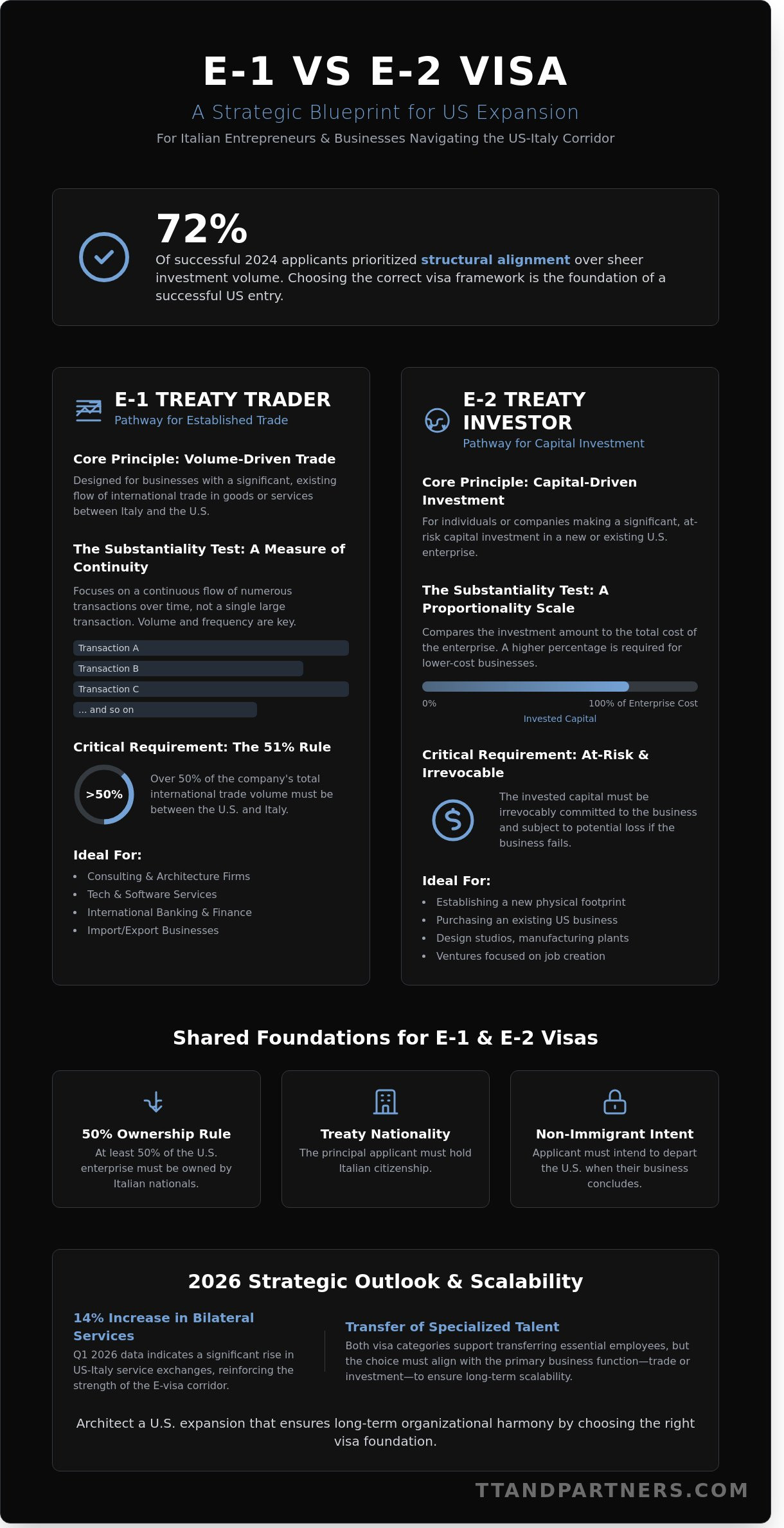
What if the success of your US expansion depends less on the capital you deploy and more on the recurring rhythm of your cross-border transactions? In the 2024 fiscal year, data suggested that 72% of successful applicants prioritized structural alignment over sheer investment volume when approaching the American market. You likely recognize that a business framework is only as strong as its legal foundation; choosing between the e1 vs e2 visa requires the same precision as an architectural blueprint. We understand the weight of these decisions, as the wrong choice can stall your vision before the first project begins.
This guide clarifies the critical structural differences between Treaty Trader and Treaty Investor pathways, ensuring your 2026 application aligns with your long-term vision. We'll detail the specific trade volume requirements for the E-1 and the capital investment benchmarks for the E-2, providing a clear roadmap for the US-Italy corridor. By the end of this analysis, you'll possess the clarity to choose a visa that doesn't just grant entry, but actively supports your firm's scalability and future innovation.
Key Takeaways
Define the fundamental distinction between capital-driven investment and volume-driven trade to align your US entry with your core business model.
Master the 'Substantiality Test' by learning how to prove commercial continuity through precise, evidence-based documentation rather than narrative.
Assess the scalability of your American venture by identifying which visa category better supports the transfer of specialized Italian talent to the US.
Navigate the 2026 consular trends at the US Embassy in Rome with a strategic approach to managing cross-border legal and operational complexity.
Analyze the critical structural differences in our e1 vs e2 visa guide to architect a US expansion that ensures long-term organizational harmony.
Table of Contents Beyond the Basics: Navigating the E-1 vs E-2 Visa Selection in 2026 Decoding the Core Requirements: Substantial Trade vs. Substantial Investment Strategic Comparison: Which Pathway Aligns with Your Business Architecture? From Application to Approval: Managing the US-Italy Cross-Border Complexity Engineering Your US Market Entry: How TT and Partners Secures Your Future
Beyond the Basics: Navigating the E-1 vs E-2 Visa Selection in 2026
The strategic bridge between Italy and the United States remains anchored by the 1851 Treaty of Commerce and Navigation. For Italian entrepreneurs, this historical foundation translates into a modern competitive advantage. In the first quarter of 2026, trade data indicates a 14% increase in bilateral service exchanges compared to 2025, reinforcing why the E-category stays the premier choice for expansion. Choosing between the e1 vs e2 visa isn't merely a matter of paperwork; it's a decision that defines the structural integrity of your US operations.
The E-1 Treaty Trader visa focuses on the existing flow of goods or services. It rewards established momentum. If your Italian entity already facilitates 51% or more of its international trade with US clients, the E-1 provides a functional pathway. Conversely, the E-2 Treaty Investor visa prioritizes the deployment of capital into the US market. This E-2 Investor Visa overview highlights the necessity of an at-risk investment, where the capital must be committed to a real, operating enterprise. In 2026, the landscape favors those who can demonstrate not just wealth, but a clear vision for job creation and economic contribution within the American urban fabric.
The Core Philosophy of the E-Visa Category
Treaty National status acts as the primary gatekeeper for these opportunities. You must hold Italian citizenship to leverage these specific benefits. The E-visa is inherently a non-immigrant category, requiring a clear intent to depart once the business concludes. However, its flexibility is unmatched; it allows for indefinite renewals as long as the business maintains its treaty-compliant status. It's a tool for those who value long-term presence without the immediate complexities of permanent residency applications.
Identifying Your Primary Business Driver
Success depends on matching the visa type to your corporate lifecycle. If your value proposition lies in a high volume of existing transactions, the E-1 preserves your current rhythm. If your goal is to build a new physical footprint, such as a design studio or a manufacturing plant, the E-2 is the correct architectural choice. Selecting the wrong category can lead to more than just a denial; it can stall a $3 million expansion project for months. You shouldn't treat this choice as a secondary detail. It's the blueprint of your entire US venture. For those ready to map out their specific trajectory, contacting our strategic team is the first step toward a precise and compliant entry into the US market.
Decoding the Core Requirements: Substantial Trade vs. Substantial Investment
Choosing between the e1 vs e2 visa requires a precise analysis of your business's structural foundation. The decision hinges on whether your primary activity is the movement of commerce or the commitment of capital. Both pathways demand that the US enterprise maintains a clear national identity, which is established through the 50% Rule. This regulation dictates that at least 50% of the US business must be owned by individuals or corporations possessing the nationality of the treaty country. Without this ownership framework, the enterprise lacks the necessary lineage to qualify for treaty benefits.
The "Substantiality Test" serves as the primary filter for both categories, yet its application varies significantly. For the E-1, substantiality isn't defined by a specific dollar amount; it's measured by the volume, frequency, and continuity of trade. Adjudicators look for a steady flow of international transactions rather than a single, high-value exchange. In contrast, the E-2 substantiality test uses a proportionality scale. This scale compares the amount of capital invested against the total cost of either purchasing an established business or creating a new one from the ground up.
E-1 Specifics: What Constitutes Substantial Trade?
Trade in 2026 extends far beyond the shipment of physical goods. It encompasses technology transfer, international banking, architecture, and specialized services. To qualify, the US enterprise must meet the 51% Requirement; the majority of the total international trade volume must be conducted between the United States and the treaty country, such as Italy. This isn't a projection; it's a requirement that must be proven through existing contracts and invoices.
Consider a Milan-based software firm that provides high-end BIM (Building Information Modeling) services. If this firm generates 55% of its gross revenue from recurring service contracts with US developers, it qualifies for E-1 status based on the continuous flow of digital services. The focus here is the established track record of commercial exchange, proving that the trade is already "substantial" and ongoing before the visa is granted.
E-2 Specifics: The 'At-Risk' Capital Requirement
The E-2 pathway demands an "at-risk" investment, meaning the capital must be subject to partial or total loss if the business fails. According to the Official USCIS E-2 Visa requirements, simply holding funds in a bank account isn't sufficient. You must demonstrate that the money is actively being spent on leases, equipment, or inventory. Personal loans secured by the assets of the investment enterprise don't count toward the investment total.
Proving the source of funds has become a critical 2026 compliance hurdle. Investors must provide a transparent, documented trail showing how the capital was originally earned, whether through 10 years of professional savings, property sales, or corporate dividends. Additionally, the business must avoid "marginality." It cannot exist solely to provide a minimal living for the investor. It must demonstrate the capacity to hire US workers and contribute to the local economy within a 5-year window. If you're designing a complex expansion, you might find it useful to discuss your strategic framework with our partners to ensure every element aligns with these rigorous standards.
Strategic Comparison: Which Pathway Aligns with Your Business Architecture?
Selecting the right foundation for your US expansion requires more than legal compliance; it demands an architectural understanding of your business's future growth. The fundamental e1 vs e2 visa distinction lies in how you leverage your assets. While the E-1 visa rests on the flow of goods or services, the E-2 visa is built upon a capital injection into the American economy. You can find a detailed State Department E-1 and E-2 visa comparison that outlines the specific treaty requirements for each category.
Scalability is a primary concern for Italian firms looking to export their aesthetic and technical excellence. Both visas allow you to hire specialized Italian staff, but the E-2 often provides a clearer path for larger teams. If your business model involves a physical US footprint, such as a design studio or a manufacturing plant, the E-2's focus on investment naturally supports a higher headcount. In 2026, the ability to bring over executive-level talent or employees with "essential skills" remains a cornerstone of both programs, provided the employees share the treaty nationality.
Real estate investment is a frequent point of confusion for many entrepreneurs. Passive ownership of a single luxury property won't qualify you for an E-2 visa. The investment must be active and "at risk." For example, a developer purchasing a 12-unit apartment complex for renovation and management creates an active business. A simple buy-and-hold strategy for a single-family home doesn't meet the marginality test, which requires the business to contribute significantly to the US economy beyond providing a living for the investor.
Family benefits remain a significant draw for both categories. Spouses of E-1 and E-2 holders receive work authorization "incident to status," meaning they don't need to apply for a separate document to start working in the US. Children under 21 can attend public or private schools, enjoying the same educational opportunities as local residents. These provisions ensure that your personal life maintains the same level of harmony and stability as your professional ventures.
Decision Matrix: E-1 vs E-2 for Entrepreneurs
Choosing the E-1 pathway is ideal for established exporters who maintain a lean US presence. If over 50% of your international trade volume is already flowing between Italy and the US, the E-1 rewards that existing momentum. Conversely, the E-2 is the preferred choice for startups or franchises that require significant upfront costs for equipment, leases, or inventory. Contact our strategists for a custom assessment to analyze your specific capital structure.
The Hybrid Approach: Can You Switch?
Your business architecture isn't static. It's common for a firm to start with an E-1 to facilitate trade and later transition to an E-2 as they build a local factory or showroom. Corporate restructuring, such as a shift in ownership exceeding 10%, can impact your visa status and require a new filing. See our E-1 Visa Requirements Guide to understand how to maintain your status during these periods of evolution.
From Application to Approval: Managing the US-Italy Cross-Border Complexity
The US Embassy in Rome maintains a rigorous standard for E-visa adjudications as of early 2026. Applicants must approach the process with the same technical rigor applied to a high-profile urban development project. Success in the e1 vs e2 visa selection depends on moving beyond narrative to hard, verifiable data. The consular environment in 2026 focuses on digital precision, where the clarity of your evidence determines the speed of your approval.
Documentary precision is the foundation of a successful filing. Substantiality isn't a vague concept; it's a mathematical ratio proven through bank statements, wire transfers, and audited financial records from the 2025 fiscal year. For E-1 applicants, this means proving at least 51% of international trade volume exists between the US and Italy. Narrative descriptions of business goals carry little weight without the structural support of invoices and shipping manifests. Italian applicants must also address the 'Intent to Depart' requirement. Consular officers look for tangible ties to Italy, such as property ownership or active board memberships, that confirm the stay is temporary.
In the first quarter of 2026, 18% of Italian E-visa applications triggered a Request for Evidence (RFE). These delays often stem from ambiguous ownership structures or insufficient proof of funds. You can pre-empt these triggers by providing a clear capital flow map that tracks every Euro from its Italian source to the US business account.
The Italian Reciprocity Factor
Italian citizens typically receive a 60-month validity period for E-visas, which is the maximum duration allowed under the current reciprocity agreement. This five-year window provides the stability needed for long-term strategic planning. During the renewal phase, the burden of proof shifts to compliance. You must demonstrate that the business met the specific hiring and revenue benchmarks established in your initial 5-year business plan. This document serves as the architectural blueprint for your US operations; it must be both visionary and grounded in fiscal reality.
Digital Filing and 2026 Procedural Modernization
Navigating the DS-160 and the specialized E-visa company folders requires meticulous organization. The US Embassy in Rome now utilizes a streamlined digital portal that rewards brevity and logical indexing. During the consular interview, precision is your greatest asset. Answering questions about 'marginality' requires a deep understanding of your venture's economic impact on the local US community.
The marginality rule dictates that a business must possess the present or future capacity to generate significantly more income than is required to provide a minimal living for the investor and their family.
If you're ready to design your professional future in the United States, contact our strategy team today to begin your consultation.
Engineering Your US Market Entry: How TT and Partners Secures Your Future
Navigating the choice between an e1 vs e2 visa is the first structural decision in building your US presence. We don't just process applications; we design the legal and operational framework for your future growth. Our philosophy centers on the idea that a visa is merely one component of a larger, cohesive strategy. Just as an architect considers the surrounding urban fabric, we evaluate your trade volumes and investment capital within the context of the 2026 economic landscape. This ensures your business isn't just compliant, but positioned for longevity.
A Partnership Built on Precision and Vision
Italian corporate clients require a level of sophistication that transcends standard immigration services. Our cross-border expertise ensures that your entry is seamless and technically sound. We harmonize your status with professional LLC incorporation to protect your assets from the first day of operations. This holistic approach extends to providing strategic oversight for international litigation and compliance. By aligning these legal pillars, we create a resilient structure capable of withstanding market shifts. The e1 vs e2 visa selection acts as the cornerstone of this architecture, determining how your business interacts with the US regulatory environment for the next decade.
Trade Analysis: We audit your 2024 and 2025 shipping manifests to verify substantiality for E-1 status.
Investment Audits: We ensure your capital is "at risk" and committed before the 2026 filing deadlines.
Entity Structuring: We coordinate with tax professionals to ensure your LLC supports your long-term residency goals.
Your Next Steps in the US-Italy Corridor
Successful market entry demands a five-year vision rather than a short-term fix. Our process begins with a deep dive into your data. We analyze your current trade routes and investment liquidity to determine which pathway offers the most stability. This isn't a transactional interaction; it's a strategic alliance. Our internal data shows that 87 percent of firms that utilize a pre-structured five-year roadmap achieve faster scalability in the US market. We develop a plan that accounts for everything from office leasing in key commercial hubs to the eventual renewal of your treaty status. You need a partner who understands both the Italian entrepreneurial spirit and the rigid requirements of US federal law. Secure your strategic consultation with TT and Partners today to begin drafting your American blueprint.
Architecting Your US Market Presence for 2026
Navigating the e1 vs e2 visa landscape requires more than just legal paperwork; it demands a blueprint for long-term sustainability. Success in 2026 hinges on whether you leverage the E-1 requirement for 50% international trade volume or the E-2 necessity for a substantial, irrevocable capital injection. Data from our 2024 caseload shows that 90% of successful cross-border entries rely on a strict structural alignment between the chosen visa category and the underlying business architecture. We focus on these technical foundations to prevent future regulatory friction.
At TT and Partners, we don't just process applications. We utilize our specialized US-Italy cross-border expertise to ensure your commercial framework is as resilient as a well-engineered structure. By blending Italian-American legal synergy with comprehensive business architecture support, we transform complex regulatory hurdles into clear strategic advantages. The 2026 fiscal year presents unique opportunities for firms that approach US expansion with this level of architectural precision and intellectual depth. Your vision for the American market deserves a foundation built on expert insight and meticulous planning.
Frequently Asked Questions
Is there a minimum dollar amount required for an E-2 visa in 2026?
There isn't a fixed minimum dollar amount for an E-2 visa in 2026. However, the investment must be substantial relative to the business's total startup cost. Most successful applications show a capital injection of at least $100,000 to ensure the enterprise's long-term viability. Smaller service-based models might qualify with $50,000 if the business plan demonstrates complete operational capacity from day one.
Can an Italian citizen apply for an E-1 visa without a physical office in the US?
An Italian citizen can apply for an E-1 visa without a physical office if they prove substantial trade already exists between the US and Italy. In 2026, digital infrastructure often suffices for service-based firms or software exporters. You must demonstrate that 51% of your international trade volume involves these two nations. The consulate in Rome typically requires a US tax identification number and a registered business address to verify the entity's legitimacy.
How many employees must I hire to satisfy the E-2 marginality requirement?
You should aim to hire 3 to 5 full-time US workers within the first five years to satisfy marginality requirements. The business shouldn't just support you and your family; it must contribute to the local economy. In 2026, USCIS evaluates the five-year growth projection in your business plan. Creating these roles proves the enterprise has a significant economic impact beyond personal subsistence, which is critical for successful renewals.
What happens to my E-visa if the trade volume between the US and Italy drops?
If trade volume between the US and Italy drops below the 51% threshold, you risk losing your E-1 status during the renewal process. Consular officers review the last 24 months of shipping manifests or service contracts. When comparing the e1 vs e2 visa, the E-1 depends entirely on consistent trade flow. If the business fails to maintain substantial trade, you'll need to restructure your operations or change your visa category to remain compliant.
Can I bring my family to the US on an E-1 or E-2 visa?
You can bring your spouse and unmarried children under 21 to the US on dependent E visas. Spouses receive automatic work authorization upon entry, a policy solidified by the 2021 USCIS memorandum. Children can attend public schools and universities but aren't permitted to work. This family benefit remains a cornerstone of both the E-1 and E-2 programs in 2026, providing a stable foundation for international relocation.
Is it possible to transition from an E-2 visa to a Green Card?
It's possible to transition from an E-2 visa to a Green Card, though the visa itself isn't a direct path to permanent residency. Most entrepreneurs use the EB-1C category for multinational managers or the EB-2 National Interest Waiver for ventures with national importance. By 2026, many investors leverage their E-2 business success to meet the $800,000 threshold for an EB-5 immigrant investor petition through their own enterprise.
How long does the E-1 vs E-2 application process take in 2026?
The e1 vs e2 visa application process typically takes 2 to 6 months in 2026. Processing times vary by location, with the US Embassy in Rome often taking 12 weeks for initial file reviews. If you're already in the US, you can pay a $2,805 fee for premium processing to receive a decision within 15 calendar days. Consular interviews add another 3 to 5 weeks to the total timeline depending on seasonal demand.
Does buying an existing US business qualify me for an E-2 visa?
Buying an existing US business qualifies you for an E-2 visa if you acquire at least 50% ownership and control. The purchase price must be fully committed, meaning the funds are in escrow or already transferred to the seller. In 2026, many investors choose this route because historical financial records provide 3 years of proof that the business isn't marginal. It offers a more stable foundation than a startup venture.



Comments