

Cross-Border Commercial Dispute Lawyer for US-Italy Cases

A contract can appear commercially clear and still leave the central dispute unresolved. Unlike a domestic agreement, a US-Italy contract must account for different legal systems, languages, and courts. Its governing law, jurisdiction, and dispute-resolution terms matter from the outset. A cross-border commercial dispute lawyer can assess how those terms affect the options available when a disagreement arises.
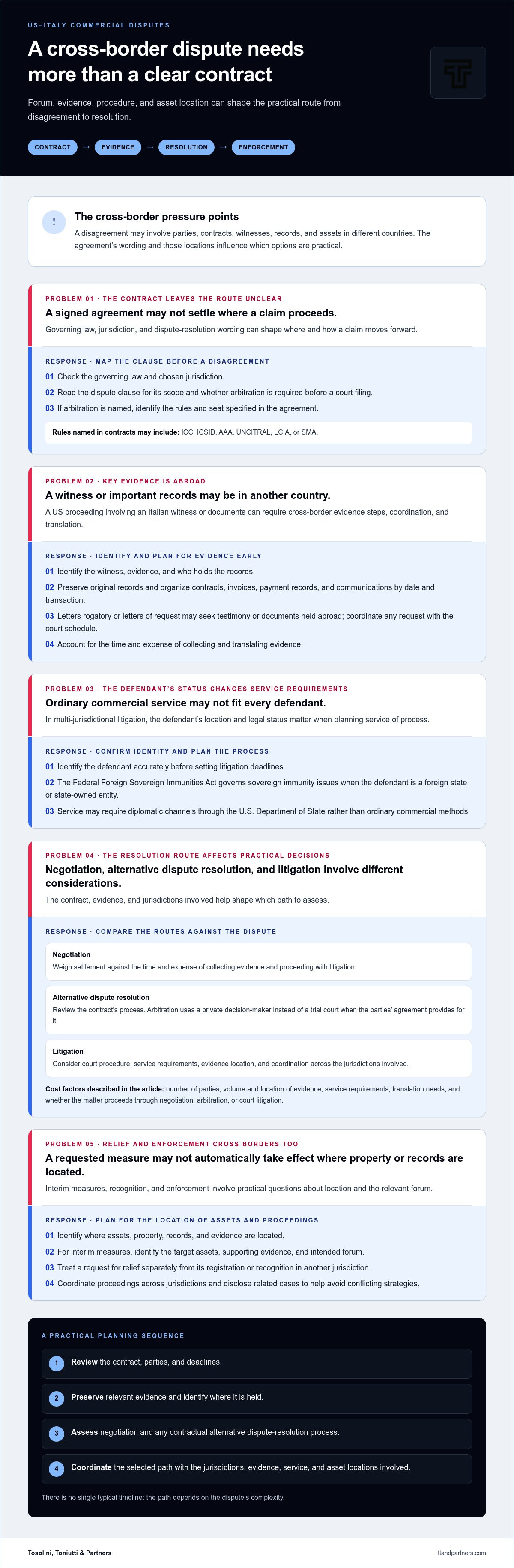
A signed contract may seem to promise a straightforward route to resolution. Across borders, however, the wording of the agreement and the locations of the parties, evidence, and assets can determine whether negotiation, arbitration, or litigation is the practical next step, and how a resulting decision may be enforced.
This article explains how international contracts differ from domestic agreements and what to consider when planning a dispute strategy between the United States and Italy. It also looks at how parallel proceedings, foreign evidence, and enforcement can shape business decisions before and during a dispute.
Table of Contents
What is cross-border dispute resolution?
Cross-border dispute resolution concerns commercial conflicts involving parties, transactions, evidence, or assets in different countries. An international commercial dispute attorney should understand relevant US and Italian procedures, arbitration options, and cross-border evidence. When assessing counsel, look for experience with comparable agreements and jurisdictions.
International Arbitration Options
Arbitration uses a private decision-maker instead of a trial court when the parties’ agreement provides for it. A clause may select ICC, ICSID, AAA, UNCITRAL, LCIA, or SMA rules, or set out a process under case-specific rules. Check which rules are named, where the arbitration is seated, what disputes fall within its scope, and whether arbitration is required before a court filing. These choices shape the procedure.
International distributor and sales representative agreements deserve particular attention. For example, a US company appointing an Italian distributor can define the territory, sales responsibilities, payment terms, termination, governing law, and dispute resolution. The contract should distinguish a distributor that purchases and resells goods from a representative who arranges sales. That distinction can affect the evidence and arguments if performance or termination is disputed.
Witness Examinations Across Borders
A key witness may live in Italy while litigation proceeds in the United States. Letters rogatory or letters of request can seek testimony or documents held abroad. Requests may pass through official diplomatic channels to foreign judicial authorities, with local courts carrying them out. Identify the witness, relevant evidence, and requested examination early, then coordinate the request with the court schedule.
Provisional Remedies and Interim Measures
Interim measures address urgent concerns before a final decision, such as preserving evidence or protecting assets. Their practical value depends on where the property or records are located and whether the requested measure can take effect there. Treat the request for relief separately from its registration or recognition in another jurisdiction. Before seeking cross-border effect, identify the target assets, supporting evidence, and intended forum.
Contracts involving trade secrets also require careful handling of evidence and confidentiality. The European Union Directive (EU) 2016/943 concerns the protection of trade secrets. In a US-Italy dispute, identify sensitive commercial records before producing or requesting documents, and consider how disclosure could affect the parties’ position. The agreement’s arbitration and court clauses, the evidence’s location, and the relief sought help determine the appropriate resolution path.
When reviewing international arbitration provisions, consider whether UNCITRAL Rules displace direct trial litigation. Assess the selected procedure alongside the forum the parties intended.
Negotiation, alternative dispute resolution, and litigation
For a US-Italy commercial conflict, the contract and the parties’ locations shape the available routes. Negotiation, alternative dispute resolution, and litigation each involve distinct decisions about evidence, procedure, and enforcement.
Service of Process Across Jurisdictions
In multi-jurisdictional litigation, service of process must account for the defendant’s location and legal status. The Federal Foreign Sovereign Immunities Act governs sovereign immunity issues when the defendant is a foreign state or state-owned entity. Service may require diplomatic channels through the U.S. Department of State rather than ordinary commercial methods. Identify the defendant accurately and plan service before setting litigation deadlines.
If a non-U.S. company is defending a claim in the United States, map the parties, relevant agreements, and records before choosing a response. A US-Italy sales dispute, for example, may require coordination between U.S. court proceedings and evidence held in Italy. Relevant counsel experience should include cross-border commercial litigation, court procedure, and coordination across the jurisdictions involved.
Fees, Evidence, and Practical Risks
Legal fees depend on the case. Cost factors include the number of parties, the volume and location of evidence, service requirements, translation needs, and whether the matter proceeds through negotiation, arbitration, or court litigation. Before proceeding, organize contracts, invoices, payment records, and communications by date and transaction.
Evidence located abroad can add practical steps: identify its custodian, preserve original records, and determine how testimony or documents may be obtained. A U.S. court dispute involving an Italian witness, for instance, may require an international judicial assistance request. Consider the time and expense of collecting and translating evidence, as well as coordinating the process, when weighing settlement against litigation.
When choosing counsel in the United States, compare experience with international commercial disputes, the relevant jurisdictions, and the type of claim. Focus on counsel authorized to handle the U.S. proceedings and able to coordinate foreign-law issues.
Resolution Steps and Typical Timelines
Start by reviewing the contract, identifying the parties and deadlines, and preserving relevant evidence. Then assess negotiation and any contractual alternative dispute resolution process before choosing litigation. There is no single typical timeline: the path depends on the dispute’s complexity, service, evidence location, procedural choices, and whether the parties reach an agreement.
During negotiations, define the business outcome sought and the evidence that supports it. If talks fail, assess the agreement’s dispute provisions and prepare the appropriate proceeding. A cross-border commercial dispute lawyer can organize these steps and coordinate the U.S. strategy with the Italian elements. For a US-Italy matter requiring coordinated court strategy, discuss international litigation with Tosolini, Toniutti & Partners.
Proceedings under multiple jurisdictions’ laws and languages
US-Italy proceedings can involve different legal systems, languages, and business practices. The contract, the parties’ locations, and the dispute’s factual connections help frame which courts may be involved and which law may govern.
Start with the signed agreement and its amendments. Identify the jurisdiction clause, governing-law clause, dispute process, currency terms, and any language provision. Then compare those terms with the parties’ actual conduct. For example, a contract naming one forum may exist alongside performance, payments, and records connected to another country. Mapping these details helps counsel assess how the dispute may proceed.
Local Counsel Coordination
When proceedings involve both the United States and Italy, counsel in each jurisdiction can address local procedure while coordinating a shared factual strategy. Assign responsibility for pleadings, evidence, deadlines, translations, and client updates. A shared chronology helps U.S. and Italian counsel align their analysis without assuming that the same procedural steps apply in both places.
Set a clear communication structure early. The company’s legal department can identify decision-makers, preserve relevant records, and direct questions through a central contact. Counsel can maintain consistent versions of contracts, witness accounts, and transaction records. For example, if an Italian sales record conflicts with a U.S. invoice, resolve the discrepancy before relying on either document in a submission.
Jurisdiction and Governing-Law Terms
A jurisdiction clause addresses where the parties have agreed to bring disputes; a governing-law clause identifies the law selected to interpret their agreement. Review them separately. Choosing a court does not, by itself, resolve every question about applicable law or the court’s authority over a defendant.
Personal jurisdiction concerns whether a particular court may exercise authority over a party. A court may also consider whether another forum is more appropriate. For a US-Italy transaction, assess the parties’ connections, contract language, performance, witnesses, and record locations. These facts help frame arguments about the proper forum.
Language requires its own document-control process. Identify the contract’s controlling language, compare translated versions, and flag terms whose meaning may shift between them. A dispute involving an Italian distributor, for example, may turn on a sales obligation described differently in the English and Italian texts. Record which version each party negotiated and signed, then connect it to the evidence and claims.
Private communications also need disciplined handling across teams. Separate legal analysis from business records, preserve relevant messages, and agree on how counsel will review materials before use. A coordinated approach helps prevent inconsistent positions across jurisdictions while keeping the factual record clear and usable in each proceeding.
Judgment enforcement and enforcement defense
A judgment or arbitration award has practical value only if the winning party can pursue it against reachable assets. In a US-Italy dispute, map the debtor’s assets, where the decision originated, and where enforcement is sought before choosing the next steps.
Begin by identifying the decision to be enforced and the relief it grants. Distinguish a court judgment from an international arbitration award, then locate the corporate debtor’s property and relevant financial relationships. A decision issued in one country does not, by itself, transfer assets in another. Enforcement depends on the forum, the decision, and the assets targeted.
For a foreign judgment, assess recognition requirements and filing windows in the jurisdiction where enforcement is planned. The Hague Convention (2019) is a framework whose statutory filing windows may govern foreign judgment recognition. Build the enforcement calendar around the applicable forum’s procedure, and preserve the judgment, supporting records, and evidence of service. Early planning helps avoid treating recognition and collection as a single procedural step.
Defending against enforcement begins with a careful review of the decision and the enforcement request. Compare the judgment or award with the underlying agreements, identify the named parties, and examine whether the claimed assets belong to the debtor. A corporate structure can affect which property is relevant. Keep ownership records, transaction documents, and payment histories organized for the forum considering enforcement.
Cross-border payments require a separate sanctions-screening analysis. Office of Foreign Assets Control (OFAC) rules apply when screening international settlement funds and judgment awards. Parties whose payments involve restricted jurisdictions must obtain specific OFAC licenses before executing wire transactions. Screen foreign payors, financial intermediaries, and ultimate beneficial owners against federal blocked-party registries before funds move. Settlement payments and judgment awards both require this careful review.
International arbitration awards also require an enforcement strategy tied to where collection will occur. Identify the award debtor’s assets and the jurisdictions where they are located. Then coordinate enforcement with related proceedings, payment restrictions, and available records. A collection plan should distinguish documented assets from those requiring further investigation, while preserving a consistent account of the transaction and award.
For a US-Italy matter, prepare a practical enforcement file: the final decision, relevant agreements, proof of service, asset and ownership records, and payment documentation. Counsel can use these materials to assess recognition, anticipated objections, and the sequence of actions. This preparation connects the legal outcome to the commercial objective and helps reduce avoidable gaps between judgment and collection.
Anti-suit injunctions and disclosure of parallel proceedings
A US-Italy commercial conflict can lead to proceedings in both countries, especially when parties dispute the contract’s forum or pursue separate remedies. An anti-suit injunction is an order directed at a party that restricts its pursuit of litigation in another forum. Its role in an international dispute depends on the court considering the request and the proceedings already underway.
Before seeking or responding to an injunction, build a clear chronology. Record when each claim began, which parties are named, what relief each proceeding seeks, and how the claims relate to the same transaction. For example, a U.S. action for unpaid invoices and an Italian case concerning termination may overlap without raising identical issues. Comparing pleadings and requested remedies helps counsel describe their relationship accurately.
Disclosure of parallel proceedings supports consistent case management. Prepare an up-to-date schedule identifying each court, country, case number, party, filing date, and procedural status. Include arbitration proceedings involving the same agreement or conduct. Update the schedule when a claim changes, a hearing is set, or an order issues. This record helps counsel avoid inconsistent descriptions before U.S. federal or state courts and foreign courts.
When an injunction is requested, review the contract’s forum and dispute-resolution terms alongside the actual filings. Identify whether the other proceeding concerns the same parties, obligations, and requested relief. Then organize the relevant agreements, pleadings, and court orders for the decision-maker. A party resisting an injunction can use these materials to explain why a foreign case addresses distinct issues or remains relevant to the dispute.
Orders in one country do not automatically resolve every question in another. Track what each order directs, whom it binds, and which proceeding it addresses. Maintain a shared matter chronology and promptly circulate new orders to counsel handling each jurisdiction. For instance, assess an order affecting a U.S. filing alongside the Italian case schedule before taking steps that could conflict.
For corporate parties, parallel litigation also creates practical coordination demands. Assign one person to maintain the proceedings list, preserve filings and orders, and route updates to the responsible legal teams. Keep key agreements and transaction records consistent across submissions. A complete record of filings, communications, and procedural changes helps counsel explain the full dispute without conflating separate claims.
If your US-Italy matter involves proceedings in both countries, discuss a coordinated litigation strategy with Tosolini, Toniutti & Partners before positions diverge across forums.
Tosolini, Toniutti & Partners: E-2 VISA
Tosolini, Toniutti & Partners can assist when a US-Italy business dispute also raises an individual’s immigration needs. Its Green Card service is relevant to people pursuing permanent residence in the United States, including business owners managing personal and corporate considerations alongside a commercial conflict. Immigration planning is distinct from resolving the dispute, but coordinating the two matters can help keep decisions aligned.
If your cross-border business situation includes a Green Card matter, consider addressing that need alongside the broader legal strategy. Contact Tosolini, Toniutti & Partners to discuss your circumstances.
Set a deliberate course for your next move
A cross-border commercial dispute lawyer can turn a complex international matter into a coordinated legal strategy. Start by clarifying what your business needs to protect, which decision must come first, and how the dispute connects to your wider plans in the United States and Italy.
For business owners whose legal planning also involves U.S. immigration, Tosolini, Toniutti & Partners offers E-2 VISA, E-1 VISA, and O-1 VISA services. Keeping those considerations in view can help align business decisions with personal priorities as the matter develops.
Contact Tosolini, Toniutti & Partners to discuss your next steps. A clear plan can turn uncertainty into purposeful action.
Frequently Asked Questions
How are international contracts different from domestic contracts?
International contracts must address cross-border issues that a domestic agreement may not cover. A US-Italy supply agreement, for example, should clarify governing law, forum, dispute process, contract language, payment currency, and how notices are delivered. Consider where each party will perform and where key records or assets may be located. Clear drafting helps reduce uncertainty if performance changes or a disagreement develops.
What does a cross-border commercial dispute lawyer do?
A cross-border commercial dispute lawyer assesses the contract, parties, evidence, and jurisdictions, then advises on a dispute strategy. The work may include evaluating negotiation or arbitration options, coordinating litigation steps, and planning for evidence held abroad. For example, counsel handling an unpaid-invoice claim may organize transaction records and compare the requested relief with related proceedings in another country.
Which U.S. courts have jurisdiction over an international commercial dispute?
No single U.S. court automatically hears every international commercial dispute. The relevant forum depends on the contract’s court-selection terms, the parties’ connections to the United States, and the nature of the claims. A company considering a filing should map where the agreement was negotiated and performed, where the parties operate, and where relevant conduct occurred. These facts help frame the jurisdiction analysis.
How are international arbitration clauses and foreign judgments enforced in the United States?
Start with the agreement: identify whether it requires arbitration and which rules and process it selects. Some international commercial contracts require arbitration before a trial-court action. For a foreign judgment, identify the recognition process and applicable filing window in the forum where enforcement is sought. The Hague Convention (2019) is a framework whose statutory filing windows may govern foreign judgment recognition.
What laws and treaties govern cross-border commercial disputes involving U.S. companies?
No single law governs every US-Italy commercial dispute. The contract’s governing-law terms and the dispute’s subject matter shape the rules to consider. For trade-secret claims, the U.S. Defend Trade Secrets Act is dated 2016, according to the United States Congress. Federal Rule of Civil Procedure 26 is cited for evidentiary discovery obligations in cross-border sovereign litigation. The parties, claims, and evidence determine which authorities matter.
How do U.S. litigation, international arbitration, and mediation compare for commercial disputes?
U.S. litigation places a dispute before a court; international arbitration uses a decision-maker under the process selected by the parties. Mediation helps parties explore a negotiated resolution without replacing their decision-making with an arbitrator’s ruling. Compare the contract’s dispute clause, the remedy sought, and the locations of evidence and assets. A business seeking an enforceable decision may weigh different considerations from one prioritizing a negotiated outcome.



Comments