

Correcting Errors on Italian Vital Records and How to Amend Them

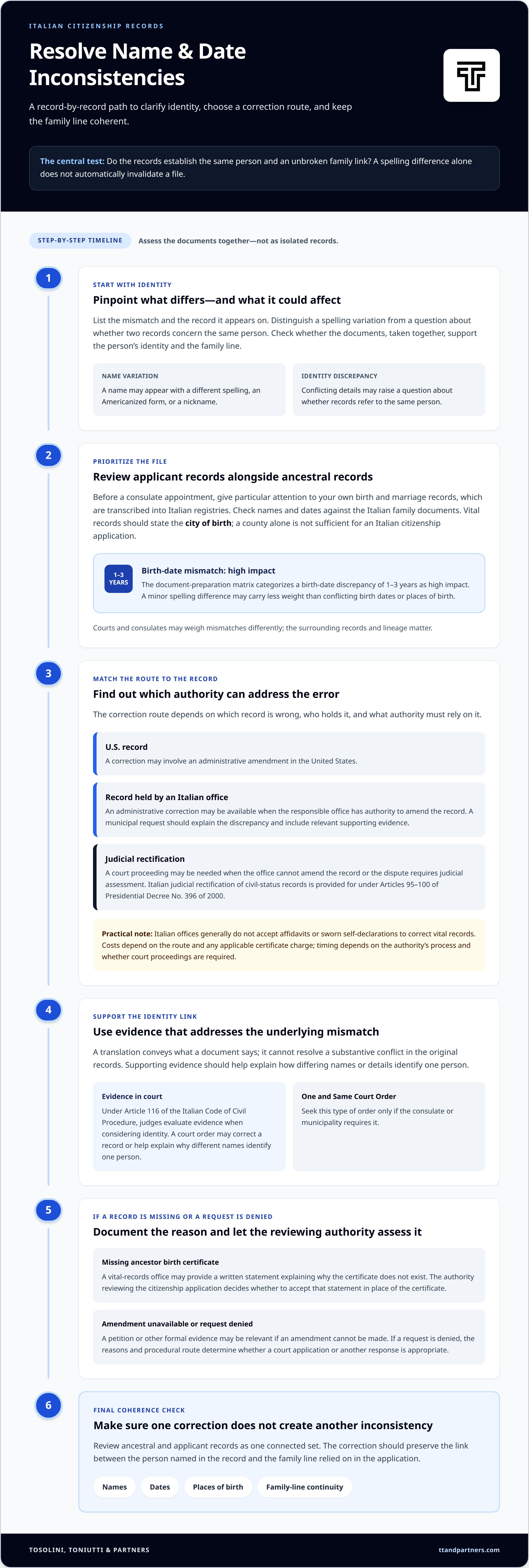
A spelling difference doesn’t automatically invalidate an Italian citizenship file. The key question is whether the records still establish the same person and an unbroken family link. Correcting errors on Italian vital records may involve an administrative amendment in the United States or, for an Italian civil-status record, judicial rectification under Articles 95-100 of D.P.R. 396/2000. The appropriate route depends on which record is wrong and which authority must rely on it.
It’s understandable to worry that a changed letter, date, or place of birth could undermine an application. The significance depends on how the discrepancy affects identity and the documentary chain, not simply on whether records differ. This article explains how name and date inconsistencies are assessed, when a surname variation may matter, and what options may be available if an amendment cannot be made. It also explains why reviewing ancestral and applicant records together can help keep the file coherent.
Table of Contents
How a lawyer can obtain corrections to Italian vital records and resolve name discrepancies
The right route depends on the record, the discrepancy, and the authority that must rely on it. For citizenship applications, correcting errors on Italian vital records should support the intended procedure, not simply pursue the quickest option.
Choosing a Correction Route with Legal Guidance
A lawyer identifies which authority holds the record and what the reviewing consulate, municipality, or court needs it to establish. The applicant’s records, the precise mismatch, and the intended citizenship procedure all shape that assessment. A request to an Italian municipality should explain the discrepancy and include relevant supporting evidence. Italian offices generally do not accept affidavits or sworn self-declarations to correct vital records.
Administrative and Court Procedures
An administrative correction is handled by the responsible office when it has authority to amend the record; a court proceeding may be needed when it does not. A lawyer can frame a municipal request around the record and supporting documents, then assess whether the office can address the error or judicial rectification is necessary. Costs depend on the route and any applicable certificate charge. Timing also depends on the authority’s process and whether court proceedings are required, so there is no single timeframe for every correction.
Court Orders and Identity Evidence
Italian judicial rectification of civil-status records is a remedy under Articles 95-100 of Presidential Decree No. 396 of 2000. Under Article 116 of the Italian Code of Civil Procedure, judges evaluate evidence when considering identity. A court order may correct a record or help explain why differing names identify one person. A One and the Same Court Order should be sought only if a consulate or municipality requires it. If a request is denied, the reasons and procedural route determine whether a court application or other response is appropriate.
Eligible Records and Correctable Errors
Birth, marriage, and death records can all contain discrepancies relevant to an Italian citizenship application. Whether an error can be corrected administratively depends on the record-holding office’s authority to amend it; a mismatch affecting identity may instead require judicial rectification. The key distinction is whether the office can amend the error directly or a court must assess the dispute. The correction route should preserve the connection between the person named in the record and the family line relied on in the application.
How Do You Legally Resolve Name and Date Inconsistencies?
For Italian citizenship by descent, records must establish a coherent identity and family line. Plan corrections to Italian vital records around the documents and authorities involved, rather than treating each record as an isolated task.
Discrepancies Before a Consulate Appointment
Prioritize discrepancies in your own birth and marriage records before a consulate appointment, because those records are transcribed into Italian registries. Names and dates should align with the Italian family documents submitted with the application. Vital records should also state the city of birth; a county alone is not sufficient for an Italian citizenship application. These mismatches can affect how your identity is established, so review them alongside inconsistencies in ancestral records.
Spelling Variations and Identity Issues
A spelling variation changes how a name appears, while an identity discrepancy raises a question about whether records concern the same person. A minor orthographic difference may carry less weight than conflicting birth dates or places of birth. A birth-date discrepancy of 1-3 years is categorized as high impact in the document-preparation matrix. Courts and consulates may weigh mismatches differently, so the surrounding records and lineage matter.
Inconsistent documents can weaken a citizenship file even when each record appears credible on its own. While certified services such as DTIS-Kenya Technologies ensure foreign records are translated faithfully, a translation only conveys a document’s contents and cannot resolve a substantive conflict in the original records. An Americanized surname or documented name change may require evidence linking the different forms to one person. The legal and practical significance depends on how the discrepancy affects identity continuity and the descent claim.
If an amendment is unavailable, a petition or other formal evidence may be relevant to the authority reviewing the file. Simply submitting more translations will not resolve an underlying factual mismatch. A focused legal review can assess the discrepancy across the complete set of records and clarify an appropriate response. For guidance on correcting errors on Italian vital records before an appointment, seek legal guidance on Italian citizenship.
Will a minor spelling difference in my ancestor’s surname disqualify my application?
A spelling difference does not, by itself, establish that an ancestor’s identity is different. U.S. records from the early 1900s sometimes contain misspelled or Americanized Italian surnames, nicknames, and conflicting dates. The key is whether the documents together support the same person and family line. In decision 14194/2024, the Italian Court of Cassation ruled that lineage may be proved by means other than a birth certificate.
If an ancestor’s birth certificate is missing, the reason matters. A vital-records office may provide a written statement explaining why the certificate does not exist, but the authority reviewing the citizenship application decides whether to accept it in place of the certificate. If no civil registry existed when the ancestor was born, written confirmation from the Italian town hall can document that fact. Where no birth registry existed, a parish baptismal certificate authenticated by the authorized bishop’s office may provide supporting evidence.
Naturalization documents can help establish when an ancestor became a U.S. citizen, a date that affects the citizenship-by-descent chain. If naturalization occurred before the ancestor’s child was born, the chain described in the rules is broken; if it occurred after the child’s birth, citizenship passed to that child at birth. If a naturalization record contains an inconsistent name, consider its timing alongside the other records. U.S. naturalization records cannot be corrected for someone who is deceased.
For an amendment request, supporting documents should link the disputed spelling or date to the person named in the record. Some states allow descendants to amend marriage and death records with required evidence, but requirements vary by state. If an old record cannot be found or amended, a formal explanation from the record office can clarify the gap. A lawyer can organize birth, marriage, death, and naturalization documents by person and date, then identify which evidence supports each link. This keeps the proposed amendment aligned with the full citizenship file instead of treating one certificate in isolation.
Correcting errors on ancestral and applicant records
A citizenship-by-descent file depends on a coherent lineage, not isolated certificates. Corrections to an ancestor’s and an applicant’s records therefore call for one coordinated review.
Ancestral Record Corrections
Ancestral corrections address errors in records that establish links between generations. Most U.S. states do not allow descendants to correct the birth record of someone who has died, so the available route depends on the state and record type. Eligibility and evidence requirements vary by state. Articles 95 and following of Presidential Decree No. 396/2000 govern rectification of Italian civil-status records.
A coordinated strategy matters because separate amendments can create new inconsistencies. The correction plan should account for every affected record and how it supports the lineage. If a record cannot be amended, the reason can inform the evidence submitted with the application. After a correction, review the full file again to identify any mismatches it may have introduced.
Applicant Record Corrections
Applicant corrections focus on the records used to identify the applicant and their children under 18. For citizenship by descent, those records should match the applicant’s original birth certificate. Errors on an applicant’s own birth or marriage record can affect the information transcribed into Italian registries, so correcting them before submitting the application helps maintain consistency.
The amendment strategy should connect applicant records with ancestral documents instead of treating each certificate as a separate task. A change to a name or date on one record may reveal a mismatch elsewhere in the file. If a consular officer says a discrepancy needs a remedy, applicants should agree in writing on the proposed solution. Review all corrected records together before submission and check that the amendments have not created new inconsistencies.
For a coordinated review of records and lineage, contact Tosolini, Toniutti & Partners.
Tosolini, Toniutti & Partners
Tosolini, Toniutti & Partners helps assess how record discrepancies relate to an Italian citizenship matter and its wider legal context. This is useful when ancestral documents, applicant records, and the correction route must be considered together before an application is submitted. A review can clarify which inconsistencies affect identity or lineage and how they may intersect with other immigration matters, including a Green Card case. A coordinated legal assessment helps frame the issue and identify the next step based on the records and the authority reviewing them.
For guidance on your records and immigration matter, contact Tosolini, Toniutti & Partners.
Move forward with a clear correction strategy
The next step is to connect the record issue to the purpose it must serve. A correction has greater practical value when its scope, supporting documents, and intended use are considered together from the outset. This helps keep correcting errors on Italian vital records focused on a meaningful outcome, rather than an isolated change that leaves the underlying question unresolved.
Before proceeding, consider what decision the corrected record needs to support and which authority will review it. A legal discussion can then focus on the relevant records, the nature of the discrepancy, and the available course of action. This is especially useful when an amendment could affect multiple documents or require coordination across jurisdictions.
If you’re ready to discuss the records and your next step, contact Tosolini, Toniutti & Partners. A considered approach can bring greater clarity to the process and help you move forward with confidence.
Frequently Asked Questions
How can a lawyer help amend Italian vital records?
A lawyer can identify the authority responsible for the record and assess which correction route fits its intended use. For example, a citizenship file may involve records issued in both the United States and Italy. A lawyer can organize the relevant documents and explain how each discrepancy affects the application. This review helps distinguish an amendment request from a court proceeding or an explanation linking identities.
What happens if there are discrepancies or incorrect names?
A name discrepancy may raise questions about whether records refer to the same person, but a spelling variation alone does not automatically disqualify an application. For example, a different spelling alongside matching family details may carry less weight than conflicting names and birth dates. The reviewing authority considers the records as a whole; the response may involve an amendment or additional evidence linking the names.
Which office handles corrections to Italian vital records in Italy?
The municipality that holds the Italian civil-status record is generally the starting point for an administrative correction request. If the record concerns a birth, marriage, or death registered there, the request should identify the entry and explain the error with relevant evidence. If the municipality cannot make the correction administratively, rectification may require a court proceeding under Articles 95-100 of D.P.R. 396/2000.
What documents are required to correct an error on an Italian vital record?
The required documents depend on the error and the authority handling the request. The file generally centers on the record containing the error and evidence supporting the correct information. Related birth, marriage, or death records may help connect names, dates, or family relationships. If the record cannot be found, a written statement from the responsible office explaining its absence may help the authority assess the file.
Can an Italian consulate in the United States correct an Italian vital record?
An Italian consulate’s role in a citizenship application differs from a municipality’s responsibility for an Italian civil-status entry. A consulate may assess whether a discrepancy affects the submitted file and explain what needs attention. Correcting the record may require action through the municipality that holds it or, if administrative correction is unavailable, a judicial route in Italy.
When is a court order required to correct an Italian vital record?
A court order may be needed when the responsible vital-records office cannot make the requested amendment directly or the relevant authority requires a judicial decision. The circumstances matter: some U.S. states require a court order for particular corrections, while Italian civil-status rectification follows a court process. A judge may assess identity evidence and the connection between the disputed record and the person named in it.

Comments