

2026 Compliance Guide for US-Based Italian Firms

Updated: 11 minutes ago
What if a compliance risk is not one overlooked filing, but a gap between the teams and systems managing your US and Italian operations? For Italian businesses, corporate compliance for US-based Italian companies is not a single checklist. The right priorities depend on how the business is structured, where it operates, and how its workforce is organized.
That complexity is real. Corporate, employment, and immigration considerations can intersect with decisions made in Italy, so clear ownership and reliable records matter in day-to-day operations. A missed obligation or unclear internal responsibility can disrupt the business. A well-designed process helps teams identify issues and coordinate a response.
This 2026 guide offers a practical way to assess the areas that matter to your company, assign responsibility for ongoing obligations, and build a regular review routine. It explains how to coordinate US corporate requirements, workforce and immigration matters, and Italian business operations as parts of one operating system, rather than separate checklists. It also covers how cross-border legal counsel can help align decisions across both countries.
Table of Contents
What Corporate Compliance Means for US-Based Italian Companies
Corporate compliance is the system of decisions, assigned responsibilities, records, and review practices a company uses to identify and meet obligations that apply to its operations. It is not a one-time incorporation task. Forming an entity establishes a starting point; compliance management continues as the business hires, signs agreements, changes its activities, or expands into additional jurisdictions. For corporate compliance for US-based Italian companies, the framework needs to connect US operations with relevant decisions and information held in Italy.
A formation step or filing may be complete while the company still needs a reliable way to maintain records, assign internal tasks, and recognize when a change calls for a fresh review. The broader idea of regulatory compliance is useful: organizations translate applicable requirements into processes and controls. The specific processes depend on the company’s circumstances.
Why the company structure and operating footprint matter
Italian ownership does not create one universal checklist for US operations. The questions to assess can vary with the entity type, the company’s activities, its workforce, and the jurisdictions where it operates. A business with employees and customer-facing operations may need to examine different issues from a business with a narrower presence or different operating model. These factors guide the assessment; they do not point every company toward the same structure or location.
At launch, clarify what the proposed entity is intended to do, how it will relate to the Italian business, and who will make or carry out key decisions. Then identify recurring responsibilities and assign an owner to each. A practical starting map can include:
Structure: Which US entity is involved, and what role does it serve?
Footprint: Where does the company operate, and where are its activities carried out?
Workforce: Who works for or represents the business, and which immigration or employment questions need review?
Records: Where are agreements and company decisions documented, and who maintains them?
Where US and Italian business operations intersect
Cross-border coordination often involves ownership information, decision-making, personnel, contracts, and business records. For example, a decision made by leaders in Italy may shape how a US entity operates, while US personnel may negotiate agreements or manage work connected to both sides. Keeping these links visible helps the business distinguish US operating questions from Italian-side corporate decisions without assuming that one automatically resolves the other.
Entity formation is an early design choice, not a substitute for ongoing coordination. An LLC may be one option to consider, but the appropriate structure depends on the company’s circumstances and objectives. A focused LLC incorporation guide can help frame formation questions. The broader compliance review should then reflect the company’s actual activities, workforce, jurisdictions, and cross-border decision flow.
The Core Compliance Areas Italian-Owned US Businesses Should Map
A useful compliance map connects legal questions with the people and processes responsible for handling them. For corporate compliance for US-based Italian companies, the areas to assess commonly include corporate governance, commercial activity, workforce arrangements, immigration, contracts, and business records. This is a framework for identifying questions, not a universal list of obligations. The relevant analysis depends on what the company does and where it operates.
Separate legal review from internal operational controls. Legal review helps determine which requirements apply and how a decision should be structured. Internal controls help the company carry out and document its chosen process. For example, counsel may review who has authority to approve an agreement; an internal control can record the approval and retain the signed version. That control supports the process but does not replace legal analysis.
Corporate, commercial, and recordkeeping questions
Start by mapping the entity’s governance documents, decision-making authority, and relationship to the Italian business. Identify who can approve significant commitments, who reviews commercial agreements, and where the final decisions and signed documents are stored. Consistent records make it easier to establish what was decided, who made the decision, and the business context.
Formation is only one part of the picture. An LLC may suit some businesses, but no entity type is automatically right for every company. Consider formation choices alongside the intended activities and operating footprint. A background guide to US company structure and LLC incorporation can help frame that initial question. Separately, map potentially applicable filings and deadlines, then verify them against current, authoritative guidance for the company’s entity and jurisdictions.
Governance: Document decision authority and the records supporting key approvals.
Contracts: Identify who reviews, approves, signs, and retains agreements, including cross-border commercial arrangements.
Records: Set a consistent location and process for maintaining entity, decision, and contract information.
Filing calendar: Assign responsibility for identifying applicable filings and confirming current deadlines.
Workforce and immigration coordination
Hiring plans and cross-border personnel movements can raise related but distinct questions. A planned hire may call for employment analysis, while a person’s proposed role or movement between the United States and Italy may also require immigration review. Treat immigration as its own workstream and coordinate it with workforce planning rather than using it as a substitute for employment analysis. E-1 and E-2 visas may be relevant in some business contexts; assess their relevance against the company’s circumstances.
Assigning clear ownership across functions matters because no single team necessarily holds all the information needed to identify, document, and review connected corporate, workforce, immigration, and contract questions.
For Italian-side context in cross-border planning, the U.S. Department of State 2025 Investment Climate Statements: Italy provides background on Italy’s investment climate. Use this context alongside a company-specific review, not as a substitute for assessing US operating questions.
When corporate and immigration questions overlap, cross-border legal coordination can help clarify how the workstreams relate to one another.
How to Prioritize Compliance Risks Without Relying on a Generic Checklist
A useful priority map starts with the business as it operates, not with a generic list of rules. For corporate compliance for US-based Italian companies, assess each question through four lenses: the activity involved, the jurisdiction connected to it, the people affected, and the potential impact of a delayed or incorrect decision. This framework organizes the review; it does not replace legal analysis of the company’s specific circumstances.
A practical method for ranking compliance questions
Begin with an inventory of entities, operating activities, personnel, contracts, and jurisdictions. For each item, record the decision it may affect, when action may be needed, and who holds the relevant information. Prioritize issues that could interrupt business activity or require timely specialist review. If the legal position is uncertain, flag it for review against current authoritative sources instead of filling the gap with an assumption.
Sort the resulting questions into three review windows:
Launch decisions: Resolve questions that shape entity setup, planned activities, initial contracts, or workforce arrangements before the company acts on them.
Recurring reviews: Assign routine checks for records, agreements, and known obligations, with a named owner and a documented review date.
Event-triggered reassessments: Revisit the map when the company changes its activities, operating footprint, workforce plans, decision-makers, or cross-border arrangements.
Use a simple working matrix to turn these categories into accountable tasks. The examples below are prompts, not a statement that every company has the same obligations.
Risk area
|
Internal owner
|
Review trigger
|
Records to maintain
Entity and governance
| Corporate lead | Formation, material decision, or structural change | Entity documents and decision records
Contracts and commercial activity
| Business or contract lead | New agreement, renewal, or changed business activity | Drafts, approvals, and signed agreements
Workforce and immigration
| Human resources with immigration coordination | Hiring plan, role change, or cross-border personnel movement | Relevant personnel and review records
Jurisdiction and operations
| Operations lead with legal input | Entry into a new jurisdiction or change in operating footprint | Activity and jurisdiction inventory
Common coordination gaps between teams
Problems often arise at handoffs. A corporate team may approve a new operating plan without knowing that finance is changing how a transaction is handled. Human resources may plan a hire without the information needed for immigration review. These are coordination risks, not proof that a specific legal requirement has been missed. A shared change log and clear escalation route can help teams surface dependencies early.
Keep the framework proportionate. Unclear ownership can leave a task unattended, inconsistent records can obscure what was decided, and untracked changes can make an earlier review outdated. A central register provides visibility, but it cannot make every company compliant by itself. Each priority still needs an accountable owner, supporting records, and jurisdiction-specific analysis when the circumstances call for it. For businesses seeking practical models of operational compliance and bookkeeping management, corporate service providers such as Count On Me illustrate how structured accounting workflows keep day-to-day operations aligned with regulatory standards.
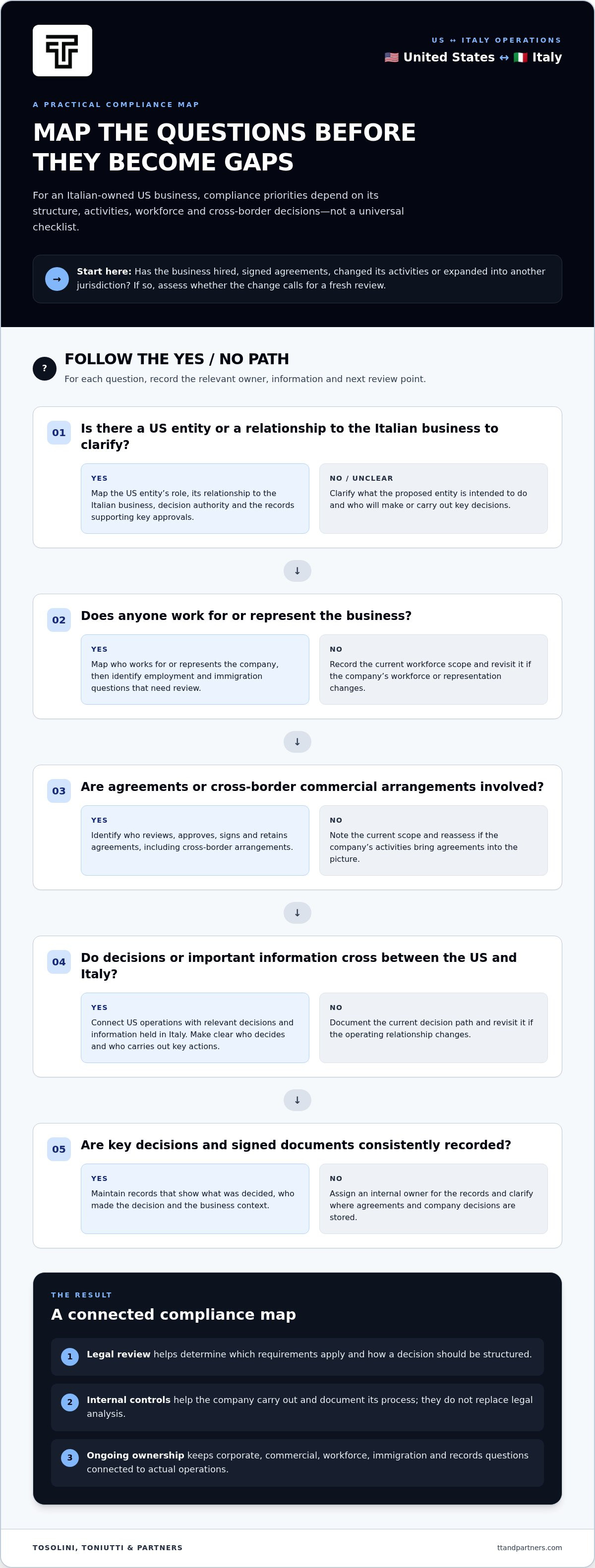
Build a Repeatable US-Italy Compliance Review Process
A durable review process turns scattered information into a clear record of what the company has assessed, who is responsible, and what should happen next. For corporate compliance for US-based Italian companies, the process should connect US operating details with relevant decisions and records in Italy, while leaving legal conclusions to a company-specific review.
Create a compliance calendar and responsibility map
Begin with a current inventory of the entities, activities, jurisdictions, personnel, and contracts within the review’s scope. Assign owners for corporate records, workforce information, immigration coordination, and commercial agreements. Each owner should know what information to maintain, how to flag a change, and where to escalate a question that needs legal analysis.
Then establish a repeatable workflow:
Inventory: Record the entities, operations, people, and agreements within the review’s scope.
Identify: List potential obligations and confirm which apply to the company’s circumstances and jurisdictions.
Assign: Name an internal owner for each confirmed item and identify cross-functional dependencies.
Schedule: Enter verified legal deadlines separately from internal reminders and planning milestones.
Document and escalate: Store evidence of completion, note unresolved questions, and route uncertain or time-sensitive issues for appropriate review.
For every confirmed obligation, record its responsible owner, authoritative source, verified deadline, and evidence of completion. Do not treat an internal reminder as a legal deadline. Before adding or changing a filing date, verify it against current, authoritative guidance relevant to the company and its jurisdiction. If the governing information is unclear, mark the item for review rather than presenting an unverified date as fact.
Keep cross-border decisions and records aligned
Set a consistent method for sharing approved corporate and personnel information with the people who need it in the United States and Italy. For example, a change to a business activity or a planned personnel move should reach the relevant corporate, human resources, and immigration owners before their records or decisions become outdated. Document who can approve key decisions and where supporting records are maintained.
Review the process whenever the company changes its structure, activities, personnel, contracts, or operating footprint. A short change notice can identify what changed, when it took effect, which owners need to assess it, and whether the existing review remains current. This keeps the framework responsive without assuming every change creates the same legal issue.
Cross-border legal coordination can help connect corporate, commercial, and immigration questions when decisions involve both countries. Tosolini, Toniutti & Partners brings a US-Italy perspective to these matters. For guidance on coordinating a company-specific review, contact the cross-border legal team.
When Cross-Border Counsel Can Help Italian Companies Manage US Compliance
A practical compliance framework helps a company identify and assign questions, but some decisions call for legal analysis tailored to its structure and operations. Cross-border counsel can be useful when a corporate decision in Italy affects US activities, when commercial agreements connect the two operations, or when workforce plans raise immigration questions alongside business considerations. A dispute involving parties or records in both countries can also make coordinated analysis valuable.
These issues are connected, but they are not interchangeable. A corporate structure question may influence how the business organizes its US operations; an immigration question concerns a person’s proposed work or movement; a commercial review considers the relevant agreements. Treating each as a distinct workstream while sharing the facts needed for analysis helps decision-makers see where one choice may affect another.
Tosolini, Toniutti & Partners provides cross-border legal services in corporate and commercial law, immigration, real estate, and litigation, representing Italian individuals and corporate entities in the United States and Italy since 2005. Its approach reflects the firm’s commitment: “Your bridge between Italy and the United States.” For companies building corporate compliance for US-based Italian companies into a durable operating framework, this cross-border perspective can bring related legal questions into one conversation without assuming a particular outcome.
What to prepare for an initial case evaluation
A concise, organized overview gives the discussion useful context. Summarize the business, its US activities, ownership structure, connection to the Italian operation, and immediate decisions or concerns. Gather relevant corporate documents, commercial agreements, and personnel information, along with a short note about what has changed or is planned. Focus on records connected to the questions at hand rather than trying to assemble every company document.
It can also help to distinguish confirmed facts from open questions. For example, separate an approved business decision from a proposal still under consideration, and note any dates the company has independently verified. This helps frame the issue without treating assumptions as settled facts. The evaluation is an opportunity to discuss the situation; it does not promise a particular result, timeline, or scope of work.
Coordinate the legal questions across borders
Corporate and immigration questions may need to be considered alongside the business plan, contracts, and workforce information. A proposed personnel move, for instance, may involve immigration review while the company also considers the person’s role in its US operations. Clear coordination helps the company present consistent facts and identify which questions need separate analysis.
For a measured next step, request Tosolini, Toniutti & Partners’ free initial case evaluation, provided without a consultation fee. Organize the relevant information and outline the questions you want to address, then use the firm’s cross-border legal services contact page to begin the discussion.
Make Cross-Border Compliance Part of Your Next Decision
A practical compliance framework is most valuable when it informs upcoming decisions, not only when a filing or question is already pressing. Treat corporate compliance for US-based Italian companies as an ongoing part of planning: revisit responsibilities as operations evolve, keep decision-makers aligned, and bring connected legal questions into view before they become harder to coordinate.
Where corporate, commercial, immigration, real estate, or litigation matters intersect across the United States and Italy, cross-border legal analysis can help clarify the questions to address. Tosolini, Toniutti & Partners represents Italian individuals and corporate entities in both countries and has done so since 2005. The firm’s initial case evaluation is free and provided without a consultation fee.
Take a considered next step: request a free initial case evaluation and outline the business decisions or compliance questions you’re assessing. With clear information and coordinated guidance, your company can move forward with greater confidence.
Frequently Asked Questions
Does an Italian parent company automatically meet US corporate compliance requirements?
No. Italian ownership alone does not determine which US requirements apply. For corporate compliance for US-based Italian companies, the analysis depends on the operating entity’s structure, activities, workforce, and jurisdictions. A parent overseeing a subsidiary may raise different questions from an entity conducting operations directly. Map how the business is organized and what it does, then verify potentially applicable obligations against current authoritative sources and seek legal guidance tailored to those circumstances.
Can one corporate compliance checklist cover every US state?
No single checklist should be treated as universally complete. A checklist can organize tasks, but relevant requirements may differ according to the company’s activities and the jurisdictions where it operates. Maintain a core framework for ownership, responsibilities, records, and review triggers, then add jurisdiction-specific items after checking current official sources. This makes gaps easier to spot without assuming that one company’s checklist fits another’s operations.
Are immigration matters part of corporate compliance for Italian companies in the United States?
Immigration is distinct from corporate compliance, though the issues can intersect. For example, a company planning to bring personnel from Italy into a US role may need to consider immigration questions alongside corporate plans and workforce arrangements. The relevant analysis depends on the people, business, and circumstances involved. Assess immigration as a coordinated workstream, not as a substitute for reviewing corporate and employment matters.
What records should a US-based Italian company organize for a compliance review?
Start with records that explain how the business is structured and operated: corporate documents, contracts, ownership and decision information, workforce records, and documentation showing who handles internal responsibilities. A clear record of a decision’s approval and supporting agreement can help explain the company’s position. The appropriate materials depend on the company’s structure and activities, and keeping these records alone does not establish that all legal obligations are met.
How often should an Italian-owned company review its US compliance framework?
Set review timing around verified deadlines and meaningful changes rather than assuming a universal schedule. A new business activity, change in ownership, revised workforce plan, or expansion into another jurisdiction can prompt an earlier assessment. Assign an owner to monitor those triggers and confirm applicable requirements against current authoritative sources. Keep internal reminders distinct from legal deadlines, and revise the review plan when company-specific needs or verified obligations change.
Can a US compliance issue affect a company’s Italian operations?
It can have cross-border operational effects if the issue involves shared ownership, personnel, contracts, records, or business decisions. For example, a US contract dispute may require decision-makers in Italy to locate relevant agreements or coordinate communications. The legal effect depends on the circumstances and the laws that apply in each jurisdiction. Assess connected questions together, but do not assume a US issue automatically creates a particular legal consequence in Italy.
When should an Italian company seek cross-border legal advice about US operations?
Consider legal advice when formation, planned business activity, personnel, contracts, or a dispute raises connected US-Italy questions. Before a discussion, prepare a concise business overview, identify the decision or concern, and organize relevant corporate, contract, and personnel records. Tosolini, Toniutti & Partners provides an initial case evaluation without a consultation fee. The evaluation is an opportunity to discuss the circumstances, not a promise of a particular result.



Comments