


O-1 Visa: The Complete 2026 Guide to Extraordinary Ability Visas for the US

Updated: Mar 23
The most significant barrier to your expansion into the United States isn't the geographic distance, but the rigid translation of your professional excellence into a legal framework. For Italian architects, designers, and visionaries, securing an O-1 Visa requires more than just a portfolio of high-quality projects. It demands a strategic architecture of evidence. You likely feel that the term extraordinary is an elusive benchmark, especially when trying to align European accolades with American immigration standards.
We recognize that the anxiety of gathering international press or finding a reliable US petitioner can feel as complex as a large-scale urban development project. This guide provides the structural clarity you need to master the O-1 visa requirements for 2026. You'll gain a clear roadmap for documenting your achievements and a strategy for converting this temporary status into long-term residency. We'll examine the eight specific criteria for success and the cross-border legal strategies that bridge the gap between Italian talent and American opportunity.
Key Takeaways
Distinguish between the O-1A and O-1B classifications to precisely align your extraordinary expertise with the most advantageous legal framework.
Navigate the 2026 evidentiary standards by mastering the "totality of evidence" approach to build a robust and undeniable professional portfolio.
Execute a seamless cross-border application for the visto O-1, focusing on strategic document translation and securing essential peer advisory opinions.
Mitigate risks of delays or denials by identifying the specific triggers for Requests for Evidence (RFEs) and avoiding common rhetorical traps.
Develop a visionary long-term plan that transitions your temporary status into permanent US residency through strategic EB-1 bridge planning.
Table of Contents
What is the O-1 Visa? Defining Extraordinary Ability in 2026
O-1 Visa Requirements: The 2026 Evidentiary Framework
The Application Process: From Italy to New York or Miami
Common Challenges: Avoiding RFEs and Denials
Beyond the O-1: Strategic Planning for Italian Nationals
What is the O-1 Visa? Defining Extraordinary Ability in 2026
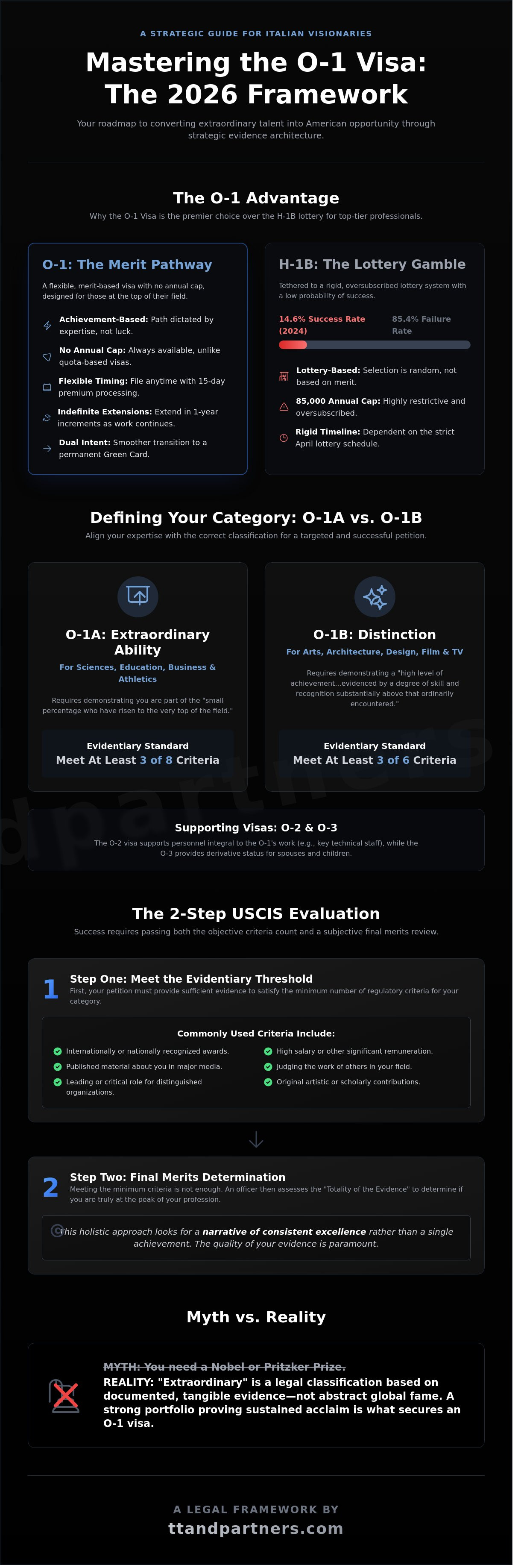
The O-1 visa functions as a high-performance vehicle for international expertise. It provides a non-immigrant status specifically for individuals who've reached the top of their professional hierarchy. In 2026, the O-1 Visa Overview highlights its role as a flexible, merit-based alternative to restrictive quota-based systems. While the H-1B visa remains tethered to a rigid lottery with a success rate that dipped to 14.6% in 2024, the **O-1 Visa **offers a path dictated by achievement rather than luck. It permits an initial three-year residency with no annual cap, allowing for strategic planning and immediate deployment of talent. For Italian professionals, this means bypassing the uncertainty of the April lottery and securing a status that reflects their actual market value and intellectual contribution.
The O-1A vs. O-1B: Which Category Fits You?
The O-1A category serves those in the sciences, education, business, and athletics. It demands "extraordinary ability," a legal standard that requires the applicant to be one of the small percentage who've risen to the very top of their field. The O-1B category, tailored for the arts, uses the "distinction" standard. This is particularly relevant for architects and designers, where prominence and a record of leading projects are key. Motion picture and television professionals are evaluated under a separate "extraordinary achievement" metric. Beyond the individual, the O-2 visa supports essential technical staff, while the O-3 category ensures family unity for spouses and children under 21.
Myth-Busting: You Don’t Need a Nobel Prize
A common misconception is that securing an O-1 Visa requires a Nobel Prize or a Pritzker. The USCIS legal framework is far more nuanced. You must demonstrate "sustained national or international acclaim" by meeting at least three of the ten criteria for O-1A, or three of six for O-1B. In a modern context, this translates to tangible metrics: a salary in the top 10% of your peer group, judging prestigious industry awards, or holding a critical role in a company with significant venture capital backing. Since the January 2022 policy updates, USCIS has become more receptive to STEM evidence and entrepreneurial achievements. Being "extraordinary" is a legal classification based on documented evidence, not an abstract measure of global fame.
The 2026 regulatory environment for this visa category focuses heavily on the "totality of the circumstances." Officers look for a narrative of consistent excellence rather than a single fluke of luck. This holistic approach favors professionals who can document their impact on the urban fabric or technological progress through high-quality evidence. Whether you're an engineer developing sustainable infrastructure or a director shaping cultural narratives, the O-1 provides the legal infrastructure to support your vision in the United States. Key benefits include:
No annual cap: Unlike the H-1B's 85,000 limit, the O-1 is always available.
Flexible timing: Petitions can be filed at any time, with premium processing options for a 15-day turnaround.
Indefinite extensions: While the initial stay is three years, you can extend it in one-year increments indefinitely as long as the work continues.
Dual intent: It allows for a smoother transition to an EB-1 or EB-2 National Interest Waiver green card.
O-1 Visa Requirements: The 2026 Evidentiary Framework
Securing an O-1 Visa requires more than a distinguished resume; it demands a structured narrative supported by objective, high-caliber data. USCIS evaluates petitions through a two-step review process. First, the applicant must meet a specific numerical threshold. For O-1A applicants in science, education, business, or athletics, this means satisfying at least 3 out of 8 regulatory criteria. For O-1B applicants in the arts or motion picture industry, the requirement is 3 out of 6 criteria. Meeting these benchmarks is the foundation of the case, but it's not the finish line.
Adjudicators apply a "Totality of the Evidence" standard, often referred to as the final merits determination. This means that even if you check three boxes, USCIS looks at the entire file to decide if you truly belong to the small percentage of individuals at the very top of your field. For 2026, the evidentiary bar remains high. The Official USCIS O-1 Visa Criteria emphasize that documentation must be contemporary and relevant to the specific niche of expertise. You can't rely on decade-old accolades; the focus is on your current standing and future impact on the US landscape.
Every petition requires a qualified US Petitioner. This entity can be a direct employer, an agent representing multiple employers, or a sponsor. It's the petitioner's responsibility to file the I-129 form. Additionally, a Peer Advisory Opinion is mandatory. This is a written consultation from a US labor organization or a peer group, such as the American Guild of Musical Artists or a specialized scientific body. This document confirms that the position requires someone of extraordinary ability and that the applicant possesses those traits. It's a technical but vital component that adds a layer of professional validation to the legal argument.
Proving Your Case: The Top 3 Evidence Categories
Published material serves as the architectural blueprint of your reputation. In 2026, USCIS increasingly values digital press from major international outlets like Corriere della Sera or specialized journals with high impact factors. Critical roles are equally vital. You must prove your work led to a 15% increase in revenue or a major technological breakthrough for a distinguished organization. Finally, a high salary, documented through 2025 OES data or cross-border tax records, provides undeniable proof of your elite status compared to peers in the same geographic region.
Industry-Specific Evidence for Italians
For Italian professionals in Design and Fashion, success is measured by participation in venues like the 2025 Salone del Mobile or commercial distribution in global flagship stores. In the Technology and Startup sector, evidence shifts toward venture capital funding rounds, patents filed in 2024 or 2025, and a "critical role" in scaling a company’s infrastructure. Academic and Scientific applicants must leverage citation counts, often exceeding 150 for mid-career researchers, and proof of peer review for top-tier journals. Building a case requires the same precision as a complex structural design. If you're ready to bridge the gap between your current achievements and a US career, it's time to consult with strategic partners who understand the nuances of global mobility.
The Application Process: From Italy to New York or Miami
The journey toward an O-1 Visa begins with a foundational assessment of your professional trajectory. It's a process that demands the same precision as a structural blueprint; every document must support the weight of your extraordinary claim. The transition from Milan's design districts or Rome's creative hubs to the competitive landscapes of New York and Miami follows a four-stage architectural framework.
Step 1 involves the strategic extraction of evidence from your Italian career. This isn't just a collection of papers; it's a curated narrative of your impact on the industry. You must gather original contracts, high-circulation press clippings, and evidence of high remuneration. Step 2 shifts the focus to the US, where you secure a Petitioner and a Peer Advisory Opinion. This letter from a professional organization confirms your standing among the elite in your field. For those in academic or research roles, Harvard's Guide to O-1 Visas provides a benchmark for understanding how institutional sponsorship functions within this framework.
Step 3 moves the petition into the hands of USCIS via Form I-129. You'll decide between Regular Processing or the expedited Premium service. Step 4 concludes with the final verification. For those residing in Italy, this involves an interview at the US Consulate in Milan or Naples, where officers verify the intent of your stay. If you're already stateside on a different visa, you may opt for a Change of Status to transition directly into your O-1 Visa functions without leaving the country.
The Importance of Certified Translations
Italian contracts and media coverage require more than simple translation; they need "legalization" for a US context. A title like "Architetto" in Italy carries specific legal weight that doesn't always align with US state licensing requirements. Our offices in Milan and Naples verify these local nuances, ensuring your Italian accolades translate into recognizable US excellence. Accuracy here prevents Request for Evidence (RFE) delays, which affected 28% of petitions in 2025. We ensure that press from Corriere della Sera or specialized journals like Domus is presented with its full cultural and circulation context.
Timelines and Costs in 2026
Budgeting for 2026 requires a clear view of the financial landscape. The USCIS filing fee for Form I-129 is $1,055 for most employers. Premium Processing, which guarantees a response within 15 days, costs an additional $2,805. It's a vital investment for projects with fixed start dates in Miami or New York. Legal fees typically range from $7,000 to $12,000, depending on the complexity of the evidence. While New York processing centers often face higher volumes, Florida's service centers have shown a 12% increase in efficiency for creative visas over the last twelve months. Total timelines range from 2 weeks with Premium Processing to 7 months for regular adjudication.
Initial Evidence Gathering: 4 to 8 weeks.
USCIS Premium Processing: 15 calendar days.
Consular Appointment Wait Time: 14 to 30 days in Milan/Naples.
Total Investment: Approximately $11,000 to $16,000 including all fees.
Common Challenges: Avoiding RFEs and Denials
The path to securing an **O-1 Visa **requires more than just a portfolio of accolades; it demands a cohesive narrative that withstands rigorous scrutiny. USCIS officers often issue a Request for Evidence (RFE) when the link between a candidate's achievements and the regulatory criteria feels tenuous. In 2025, data showed that nearly 28% of O-1 applicants received an RFE, often centered on the "Circular Argument" trap. This occurs when an officer acknowledges the evidence but claims it fails to prove the applicant is among the small percentage who've risen to the very top of their field. To bypass this, every piece of evidence must serve a dual purpose: fulfilling the technical requirement while simultaneously reinforcing a reputation of sustained national or international acclaim.
Expert Opinion Letters act as the structural framework of the petition. They don't just list facts. They translate specialized achievements into a language a generalist officer can digest. A letter from a Pritzker Prize winner or a lead designer at a top-tier firm carries weight because it provides the necessary context for "extraordinary" impact. These letters bridge the gap between raw data and the legal standard of being "extraordinary," ensuring the officer understands the innovation's influence on the global market.
Strategic Responses to USCIS RFEs
When standard benchmarks don't align with a niche role, practitioners rely on "comparable evidence." If a digital architect doesn't have traditional awards, they might present high-traffic GitHub repositories or proprietary software patents as equivalents. Success depends on connecting these dots through a narrative that emphasizes the innovation's influence on the urban fabric. Legal teams with boots on the ground in New York and Miami offer a distinct advantage. They understand that a Miami field office might prioritize the economic impact of a project, while a New York officer might look closer at its cultural prestige.
Selecting the Right Petitioner
Choosing between an employer and an agent dictates your professional mobility. An agent-based petition allows for multiple "gigs" under one umbrella, providing the flexibility creative professionals crave. For those with a vision for their own practice, the "Entrepreneur O-1" is a viable route. By establishing a US-based entity, you can effectively sponsor your own expertise. It's a strategic move that requires precise corporate structuring, particularly if you're looking at How to Form an LLC in Florida as an Italian Citizen to anchor your US operations.
Proving the temporary nature of the stay is a frequent point of friction. While the O-1 Visa is technically a non-immigrant visa, it accommodates "dual intent" better than most. Applicants must demonstrate a clear plan for their three-year stay without appearing to abandon their foreign residence, even if they're eyeing an EB-1 green card later. Clear contracts and a detailed itinerary for the initial 36 months are essential. This timeline should reflect a logical progression of work that justifies the requested duration, moving beyond vague future plans into concrete, dated commitments.
Navigating these complexities requires a partner who understands the intersection of law and creative vision. Consult with our strategic visa partners to build a petition that reflects your true professional standing.
Beyond the O-1: Strategic Planning for Italian Nationals
The successful acquisition of an O-1 Visa represents the cornerstone of a broader professional architecture in the United States. It isn't merely a temporary stop; it's a foundational phase that allows Italian citizens to establish a presence within the American market while preparing for long-term residency. Unlike other visa categories that have rigid expiration dates, the O-1 offers a unique flexibility. After the initial three-year period, you can maintain your status through indefinite one-year increments. This provides a stable environment to execute complex, multi-year projects without the pressure of a hard departure date. By the start of 2026, USCIS data indicates that the O-1 remains one of the most reliable pathways for maintaining high-level talent in the U.S. workforce.
The O-1 as a Bridge to the Green Card
Securing an **O-1 Visa **serves as a powerful evidentiary bridge toward permanent residency. The criteria for the EB-1A "Extraordinary Ability" Green Card mirror the O-1 requirements closely. If you've already met the high bar for the O-1, you possess the structural evidence needed for a Green Card petition. We recommend initiating the EB-1A or EB-1B process at least 18 months before your current status expires. This timeline accounts for current processing speeds and the meticulous curation of your professional portfolio. For those looking to diversify their investment portfolio during this transition, exploring an EB-5 Investor Green Card: Miami Real Estate Guide can provide a parallel path to residency through strategic capital placement.
Managing the "dual intent" aspect is vital. While the O-1 is technically a non-immigrant visa, the legal framework allows for a transition to permanent residency if handled with precision. You don't have to worry about jeopardizing your current status as long as your filings are synchronized. Our team ensures that every petition is designed with this long-term trajectory in mind, preventing the administrative friction that often stalls international careers. We focus on the harmony between your current work and your future permanent status.
The TT & Partners Advantage
At TT & Partners, we view legal representation as a form of strategic design. Our practice is built on the belief that a cross-border journey requires more than just paperwork; it requires a deep understanding of the cultural and professional context of both Italy and the US. We provide a holistic service model that integrates immigration strategy with corporate and real estate expertise, ensuring every element of your move is intentional.
Bilingual precision: We communicate with our clients in Italian to ensure every nuance of their career is captured, while litigating and filing in English with technical mastery.
Tri-city presence: With active offices in New York, Miami, and Milan, we provide real-time support across time zones, ensuring that your case moves forward without delay.
Integrated services: We don't just handle your visa. We assist with the corporate structures and real estate acquisitions that define your new life in America.
Your extraordinary ability deserves a legal partner that matches your level of excellence. Whether you're an architect in Milan or a tech founder in Rome, we provide the blueprint for your American success. Our approach is characterized by the same engineering precision you apply to your own craft. We invite you to Schedule a consultation with our O-1 visa experts today to begin designing your future in the United States.
Architecting Your Professional Future in the United States
Securing an O-1 Visa in 2026 demands more than just talent; it requires a structured, architectural approach to your professional narrative. The current evidentiary framework places a high premium on objective metrics and sustained national acclaim. Success hinges on a strategy that bridges the gap between Italian excellence and American regulatory standards. Since our foundation, Tosolini, Toniutti & Partners has managed complex cross-border transitions from our 4 strategic hubs in New York, Miami, Milan, and Naples. We've refined a methodology that serves high-net-worth individuals and elite talent with the same precision we apply to international legal structures. Our team focuses on the 8 specific USCIS criteria to build a robust case that minimizes the risk of a Request for Evidence. You don't have to navigate these 2026 requirements alone. Your vision for a US career deserves a foundation built on decades of specialized expertise. Let's transform your extraordinary ability into a sustainable American presence.
We look forward to building your future in the United States together.
Frequently Asked Questions
Is the O-1 visa better than the H-1B for Italians?
The O-1 visa offers distinct advantages over the H-1B because it lacks the 85,000 annual cap and the lottery system that dictates H-1B selection. While the H-1B relies on a random draw with a 25 percent selection rate in 2024, the O-1 depends entirely on individual merit. It's a strategic choice for architects or designers with international awards because it allows for an unlimited number of extensions in 1 year increments.
Can I apply for an O-1 visa if I am currently in Italy?
You can initiate the application process for a visto O-1 while residing in Italy by filing Form I-129 with USCIS through a US based agent or employer. Once USCIS approves the petition, you'll attend an interview at the US Consulate in Rome or Milan to obtain the physical visa stamp. In 2023, the US Embassy in Italy reported processing thousands of non-immigrant visas, ensuring that geographic location isn't a barrier for individuals with extraordinary talent.
How long does the O-1 visa last, and can it be extended?
The initial stay for an O-1 visa is granted for a maximum period of 3 years to complete a specific event or project. After this period, you can apply for extensions in increments of 1 year if you demonstrate the need for continued employment. There's no statutory limit on the total number of years you can remain in the US on O-1 status, provided the work remains consistent with your extraordinary ability.
Do I need a job offer in the US to get an O-1 visa?
You must have a formal job offer or a contract from a US employer, US agent, or foreign employer through a US agent to qualify. Self-petitioning isn't permitted, so you need a petitioner to file the I-129 form on your behalf. This requirement ensures that your presence in the US serves a specific professional purpose, such as a 24 month contract to design a sustainable urban complex in New York or Los Angeles.
What is the difference between O-1A and O-1B?
The O-1A classification targets individuals in science, education, business, or athletics, while the O-1B is dedicated to those in the arts, motion pictures, or television. For the O-1B, you must prove distinction by meeting 3 out of 6 specific criteria, such as receiving a 50,000 dollar professional grant or lead roles in critically acclaimed productions. Architects typically apply under O-1B, focusing on the aesthetic and cultural impact of their built environments.
Can my spouse and children work in the US on an O-3 visa?
Family members holding O-3 status are not authorized to work in the United States, though they may attend school or college. This restriction applies to spouses and unmarried children under the age of 21. If a spouse seeks employment, they must independently qualify for a different visa category, such as an H-1B or an L-1, which involves its own specific petition process and 190 dollar filing fee.
How much does an O-1 visa cost in total?
The total cost typically ranges from 5,000 to 12,000 dollars, including legal fees and mandatory government filing costs. The USCIS filing fee for Form I-129 is 460 dollars, while the optional premium processing service, which guarantees a response in 15 days, costs an additional 2,805 dollars. When you factor in the 205 dollar consular fee and attorney costs for compiling a 300 page evidence portfolio, the investment reflects the complexity of the visto O-1 process.
Can I change employers once I have an O-1 visa?
You can change employers, but the new employer must file a fresh Form I-129 petition with USCIS before you begin the new role. The visa is employer specific, meaning your authorization is tied to the entity that sponsored your initial application. If you're working through an agent representing multiple clients, you can add new projects without a new petition, provided the original itinerary included those specific 2026 or 2027 engagements.
Disclaimer
The information provided in this website is offered purely for informational purposes. It is not intended to create or promote an attorney-client relationship, and does not constitute and should not be relied upon as legal advice. We intend to make every attempt to keep this information current. We do not promise or guarantee, however, that the information is correct, complete or up-to-date, and readers should not act based upon this information without seeking professional counsel from a licensed attorney. Transmission of information from this newsletter is not intended to create, and its receipt does not constitute, an attorney-client relationship with Tosolini, Toniutti & Partners or any of its individual attorneys or personnel.



Comments