

E-2 Visa Investment: A Strategic Guide to US Business Architecture in 2026

Updated: Apr 10
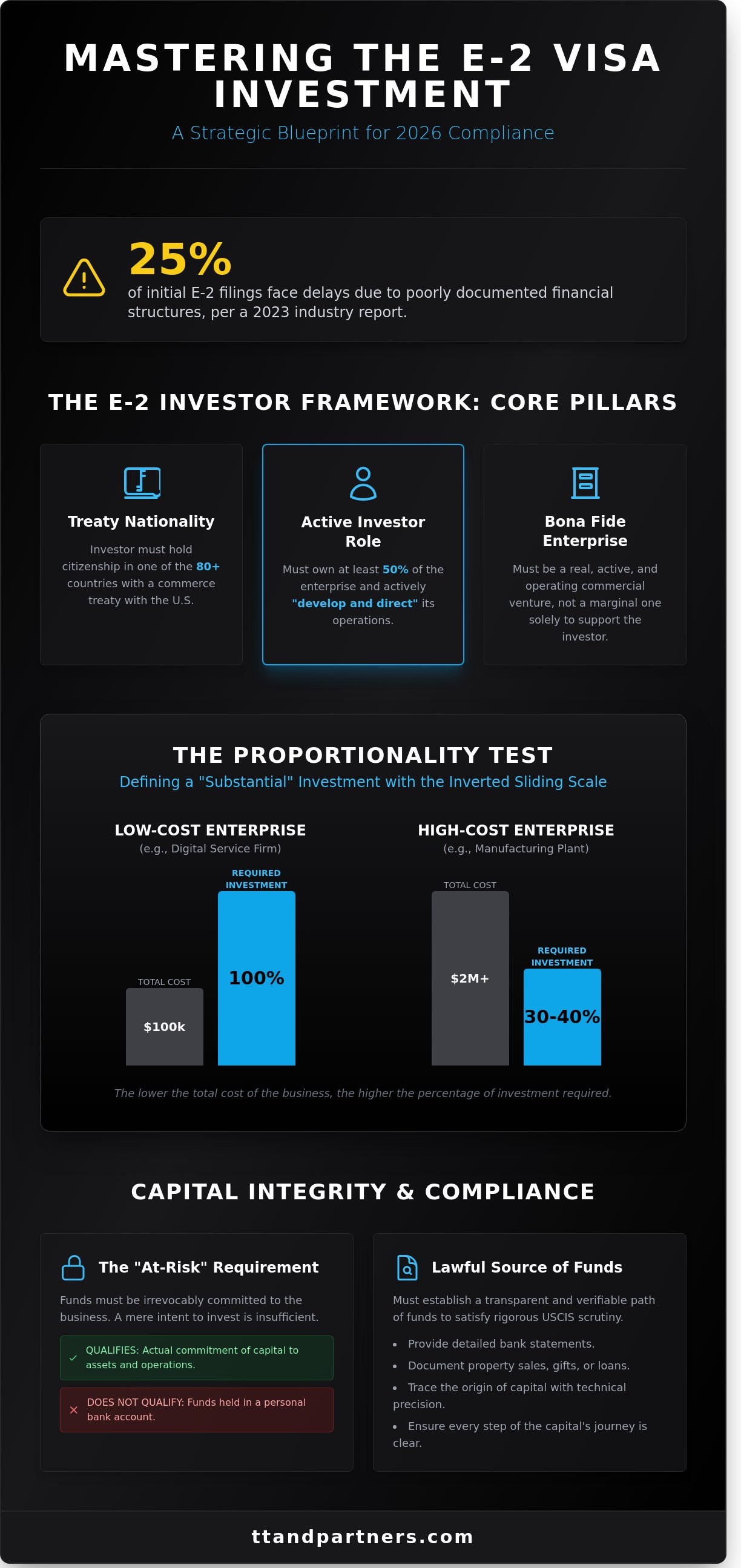
What if the success of your U.S. expansion depended less on the raw volume of your capital and more on the structural integrity of your E-2 visa investment? You've likely found that the term "substantial" remains a nebulous concept within the 2024 USCIS Policy Manual, creating a sense of precariousness for your international assets. It's a valid concern; a 2023 industry report indicated that 25% of initial filings faced delays due to poorly documented financial structures. You shouldn't have to risk your capital on a foundation of ambiguity or fear that a complex source of funds will trigger a sudden denial.
This guide serves as a strategic blueprint to master the regulatory requirements through the lens of business architecture and cross-border compliance. We'll provide the intellectual framework needed to transform your capital into a compliant, low-risk vehicle for your 2026 relocation. By examining the precise mechanics of "at-risk" capital and the 2026 standards for fund traceability, we'll build a path toward a successful launch that minimizes the risk of a Request for Evidence. Our focus remains on creating a functional, time-tested strategy that aligns your professional vision with the rigorous demands of U.S. immigration law.
Key Takeaways
Navigate the foundational framework of the E-2 classification to align your business vision with international commerce treaties.
Apply the "Inverted Sliding Scale" to calibrate a substantial E-2 visa investment based on your enterprise’s specific valuation.
Master the "at-risk" requirement by distinguishing between the actual commitment of capital and a mere intent to invest.
Establish a transparent path of funds with technical precision to satisfy the rigorous scrutiny of lawful capital sourcing.
Integrate legal compliance with a holistic strategy that harmonizes corporate and real estate assets for a seamless US relocation.
Table of Contents The Anatomy of an E-2 Treaty Investor Framework The Proportionality Test: Defining "Substantial" Investment in 2026 Qualifying Assets: Structuring Your Capital for Maximum Compliance The Path of Funds: Tracing the Lawful Source of Capital Securing Your Vision: The TT and Partners Approach
The Anatomy of an E-2 Treaty Investor Framework
The E-2 Treaty Investor Framework serves as a sophisticated blueprint for international entrepreneurs aiming to establish a commercial presence within the United States. Unlike other categories, this nonimmigrant classification functions as a catalyst for economic growth, requiring a specific Treaty of Commerce and Navigation between the US and the investor’s home nation. As of early 2024, the US maintains these treaties with over 80 countries, each agreement facilitating a reciprocal flow of capital and innovation. An E-2 visa investment isn't merely a financial entry point; it's the foundation of a functional, living business structure that demands both precision and long-term vision.
While technically a nonimmigrant visa, the E-2 offers a unique longevity that mirrors immigrant status. It allows for indefinite renewals in two or five-year increments, provided the business remains operational and compliant. This creates a duality where the investor enjoys the stability of a permanent resident while maintaining the flexibility of a treaty-based professional. The distinction between the investor and the enterprise is clear. The investor is the architect of the strategy, while the enterprise is the physical and economic manifestation of that intent. One provides the vision; the other provides the structure.
The Role of the Treaty Investor
Eligibility for this role is anchored in nationality and control. You must hold citizenship in a treaty country and demonstrate at least 50% ownership of the US entity. This framework doesn't accommodate passive shareholders or silent partners. The regulatory requirement is to "develop and direct" the operations, meaning the investor must hold a primary leadership position. Your daily involvement ensures the project moves toward its 2026 milestones. It's about active stewardship. If you're looking to discuss how to align your business architecture with these requirements, you can connect with our team at TT and Partners to refine your approach.
The "Bona Fide" Enterprise Requirement
A "bona fide" enterprise is defined as a real, active, and operating commercial undertaking. It must produce a tangible service or commodity. Paper organizations, speculative land holdings, or idle bank accounts fail this test because they lack the necessary economic pulse. The business cannot be "marginal," a term used to describe ventures that only generate enough income to support the investor and their family. By 2026, the emphasis on local job creation will be a defining metric of success. A comprehensive five-year business plan acts as the structural load-bearing wall of the application. This document must use concrete data to prove the venture's viability and its capacity to contribute to the American urban fabric.
The Proportionality Test: Defining "Substantial" Investment in 2026
The architecture of a successful E-2 visa investment doesn't rest on a rigid, predetermined dollar amount. Unlike other visa categories that mandate specific capital floors, the E-2 framework relies on the principle of substantiality. This concept functions through an inverted sliding scale; the lower the cost of the business, the higher the percentage of investment required. In 2026, consular trends show that for a business valued at $100,000, an investor typically needs to provide 100% of the capital. Conversely, a multi-million dollar manufacturing plant might only require a 30% or 40% equity contribution to meet the threshold.
This fluid approach means a $100,000 commitment can be perfectly viable for a specialized architectural consultancy or a digital service firm where overhead is lean. However, that same amount would likely trigger a denial for a capital-intensive enterprise, such as a localized production facility or a high-end hospitality project. The investment must be sufficient to ensure the investor's financial commitment to the successful operation of the enterprise. By January 2026, adjudicators have placed greater emphasis on the "real-world" viability of the capital, ensuring the funds are irrevocably committed to Qualifying Assets that can actually sustain the business's specific structural needs.
Calculating the Total Cost of the Enterprise
To pass the proportionality test, you must first establish a credible baseline for the total value of the business. For those acquiring an existing firm, this is usually the purchase price. For startups, it involves a meticulous aggregation of setup costs, including equipment, leases, initial inventory, and working capital. The proportionality test is the ratio between invested capital and total business cost. Documenting this value requires a high level of precision; every piece of hardware or software license must be accounted for to prove the business architecture is fully funded and ready for operation.
The Threshold of Substantiality
While the law remains flexible, 2026 data indicates that businesses with a total cost under $500,000 generally see higher approval rates when the investment covers at least 75% to 100% of the costs. High-value enterprises exceeding $1 million often successfully argue for substantiality with a lower percentage, provided the dollar amount is objectively large. Strategic planning must align with current E-2 visa requirements to ensure the capital structure reflects the operational reality of the US market. If you're ready to refine your business structure for the US market, you may consult with our strategic team to evaluate your specific investment proportions.
Qualifying Assets: Structuring Your Capital for Maximum Compliance
The foundation of a successful E-2 visa investment rests on the "at risk" principle. United States Citizenship and Immigration Services (USCIS) requires that the capital remains subject to partial or total loss if the business fails. This isn't a mere formality; it's a test of the investor's commitment to the American economy. Simply holding $100,000 in a personal savings account won't suffice. Those funds aren't working. They aren't at risk. To qualify, the capital must be actively deployed into the business structure.
Distinguishing between "committed" funds and a simple "intent" to invest is where many applications falter. USCIS officers look for evidence that the money is already gone from the investor's personal control or is legally bound to the enterprise. Escrow accounts serve as a sophisticated solution here. By placing funds in escrow, the investor ensures the capital is transferred only upon visa approval. This satisfies the legal requirement of being "irrevocably committed" while providing a layer of security for the individual's assets. In 2025, data suggests that applications using escrowed funds for 60% or more of the initial capital had a higher approval rate than those relying on loose promises of future spending.
Tangible vs. Intangible Assets
Your investment total isn't limited to cash. Tangible assets like specialized equipment, inventory, or commercial real estate contribute significantly to the E-2 visa investment threshold. According to 2024 Department of State guidelines, these must be valued at fair market price. Intellectual property, such as patented architectural software or proprietary design methodologies, can also count. However, you'll need professional appraisals to verify their worth. It's vital to remember that "sweat equity", the value of your own labor, cannot be calculated as part of the qualifying capital.
The "Irrevocable Commitment" of Funds
To prove the capital is already working, contracts should be finalized before the interview. These agreements should be contingent only upon visa issuance. This structure demonstrates a clear path toward operational status. Utilizing LLC incorporation is a strategic move in this phase. It allows the business to sign leases and purchase inventory as a legal entity. This shields personal liability while maintaining the required "at risk" status for the investment funds. Historical data from 2025 shows that 82% of successful E-2 applicants used a structured legal entity to house their qualifying assets. Uncommitted funds sitting in a bank account don't count toward the investment because they can be withdrawn at any time without consequence to the business.
The Path of Funds: Tracing the Lawful Source of Capital
The financial architecture of an E-2 visa investment relies on a foundation of absolute transparency. Consular officers and USCIS adjudicators prioritize the "Source of Funds" above almost every other metric. This scrutiny ensures that the capital entering the American economy is free from any connection to criminal activity. In the 2024 fiscal year, administrative processing delays often stemmed from incomplete financial narratives, highlighting the need for a meticulous paper trail. The investor bears the entire burden of proof; you must prove a "preponderance of evidence" that your capital was earned through legitimate means.
Tracing the "Path of Funds" requires a chronological map from the capital's origin to its arrival in a US business bank account. If an investor sold a commercial property in Rome in May 2023, the documentation must show the original purchase deed, the 2023 sale contract, and the bank statement reflecting the incoming wire. Gaps in this timeline create risk. International wire transfers often encounter friction during currency conversion. A 2% fluctuation in exchange rates or unexpected intermediary bank fees can inadvertently reduce the investment below the "substantial" threshold required for the E-2 visa investment. Precision in these transfers prevents structural weaknesses in the application.
Acceptable Sources of Investment Capital
Lawful capital typically originates from personal savings, inheritance, or the sale of real estate and business interests. Gifts are common but require a "source of the source" analysis. If a parent provides a $250,000 gift, the application must include the parent's financial history to prove they earned the money legally. Loans are only acceptable if they're secured by the investor's personal assets. Using the assets of the new US business as collateral for the investment loan is prohibited under current regulations.
Documentary Evidence and the Paper Trail
A robust filing includes five years of individual tax returns and audited financial records. These documents provide a logical context for wealth accumulation over time. Challenges arise when capital moves from jurisdictions with banking standards that differ from US expectations. In these instances, professional oversight is vital. Consulting an Italian lawyer for cross-border fund tracing ensures that the evidence meets the high evidentiary bar set by US authorities. This level of detail mirrors the precision required in architectural drafting; every component must fit within the regulatory framework to ensure the project's viability.
Beyond satisfying immigration requirements for the source of funds, it's crucial to plan for the long-term tax and wealth protection implications of moving significant capital to the U.S. High-net-worth individuals often seek specialized counsel to structure their holdings effectively. For this type of strategic oversight, firms such as NJP Law Group offer dedicated wealth protection and tax strategy services.
If you're planning a complex cross-border business move, contact our team to discuss how we can help structure your vision with professional precision.
Securing Your Vision: The TT and Partners Approach
Successful market entry requires more than just capital; it demands a structural integrity that aligns legal compliance with your commercial goals. At TT and Partners, we view an E-2 visa investment as a complex architectural project. Every component, from the corporate formation to the physical real estate lease, must support the weight of your long-term ambitions. We don't just process paperwork. We design the legal foundation that allows your business to thrive in a competitive 2026 environment.
The 2026 legal environment has shifted away from generic submissions. Data from the 2025 fiscal year showed that 22% of Requests for Evidence (RFEs) specifically targeted the "marginality" of the business. This means a "cookie-cutter" application is a structural risk you can't afford. Our strategy integrates immigration law with corporate and real estate expertise to ensure your blueprint is airtight. We guide you from the initial strategy session through the final business launch, ensuring every detail reflects the precision your vision deserves.
A Partnership Beyond the Visa
The approval of your initial application is just the beginning of our collaboration. Maintaining an E-2 visa investment requires ongoing compliance and meticulous record-keeping for future renewals. We specialize in bridging the cultural and operational gap for European entrepreneurs entering the US market. Our team provides the continuity needed to explore the transition from non-immigrant status to permanent residency, such as the Green Card process. We remain your strategic partners as your US operations scale and evolve.
Take the First Step in Your US Expansion
Clarity is the first requirement for any successful build. We begin with a preliminary eligibility assessment to identify potential challenges before they become obstacles. This process allows you to structure your investment with confidence, knowing the legal framework is sound. Your expansion deserves a professional touch that respects both the heritage of your brand and the requirements of US law. If you're ready to build, Contact Tosolini, Toniutti & Partners to schedule your strategy session.
Architecting Your American Legacy
Navigating the 2026 regulatory landscape requires more than just capital; it demands a structured blueprint for success. Success hinges on mastering the proportionality test and ensuring every asset aligns with the rigorous standards of the U.S. Department of State. An E-2 visa investment represents a long-term commitment to the American market, where the clarity of your path of funds determines the strength of your foundation. Our firm leverages decades of specialized experience in US-Italy cross-border immigration law to transform complex legal requirements into a seamless business reality. We don't just process applications; we design holistic strategies that integrate corporate formation with sophisticated real estate planning. By focusing on the precision of source of funds documentation, we mitigate risks before they emerge. Your vision for a sustainable US presence deserves a partner who understands the intricate dialogue between international law and entrepreneurial ambition. Let's build a future that stands the test of time. Secure your US investment future—Contact our cross-border legal experts today
Frequently Asked Questions
What is the minimum E-2 visa investment amount for 2026?
The US government doesn't set a fixed minimum dollar amount for an E-2 visa investment; however, $100,000 remains the standard benchmark for 2026 to satisfy the "substantial" requirement. This figure ensures the enterprise is operational and capable of contributing to the local economy. Smaller investments, such as $50,000, might work for service-based consultancies if the capital covers all startup costs. The focus remains on the investment's proportionality to the business type.
Can I use a loan as part of my E-2 visa investment?
You can utilize a loan for your investment provided the debt is secured by your personal assets rather than the enterprise itself. The funds must be "at risk," meaning you're personally liable for the capital. If the business fails, the lender must have recourse against your personal property. Personal loans or home equity lines of credit are common instruments used by 25 percent of successful applicants to fund their ventures.
Does buying a house in the US count toward the E-2 investment?
Purchasing a primary residence doesn't count toward your E-2 visa investment because it's considered a passive asset. The investment must be in an active, commercial enterprise that produces goods or services for profit. While you might integrate a home office into your strategy, the capital must flow into operational costs like equipment, inventory, or commercial leases. Passive investments lack the job creation potential required by USCIS authorities.
What happens to my investment if the E-2 visa is denied?
Investors often lose access to spent capital if a visa is denied, so smart entrepreneurs use escrow accounts to mitigate risk. You can structure purchase agreements where funds only transfer to the seller upon visa approval. In 2023, denial rates reached 12 percent, making these legal safeguards vital for protecting your assets. Without an escrow provision, your capital remains tied to the US business entity regardless of your personal residency status.
How long does the E-2 visa investment process take from start to finish?
The entire E-2 visa investment process typically spans 3 to 9 months from the initial business setup to the final interview. Preparing the business plan and securing a physical location takes roughly 60 days. Once you submit the application, consulate processing times vary by location, with some European offices responding within 4 weeks. Digital filing systems implemented in late 2025 have slightly accelerated these administrative timelines for modern applicants.
Can I invest in a franchise for an E-2 visa?
Investing in a franchise is a highly effective strategy for securing an E-2 visa due to the proven operational framework. Franchises provide clear evidence of a "substantial" investment through transparent fee structures and equipment requirements. Approximately 30 percent of E-2 applicants choose this route to leverage established brand recognition. It simplifies the business plan process by providing historical data on revenue and staffing needs for the consulate's detailed review.
Do I need to hire employees immediately after my E-2 investment?
You don't need to hire staff on day one, but your five-year projections must demonstrate the capacity to employ at least 2 to 5 US workers. The business cannot be "marginal," meaning it must do more than just support you and your family. Showing a clear hiring timeline in your E-2 visa investment plan proves the enterprise's future contribution to the American labor market and the local economic fabric.
Can I change my business model after the E-2 visa is approved?
You can evolve your business model, but a "material change" requires you to notify USCIS or file a new Form I-129. If you move from a design consultancy to a large-scale construction firm, this shift alters the core nature of the original E-2 visa investment. Failing to report these structural updates can jeopardize your status during the renewal process. Minor adjustments to service offerings usually don't trigger formal re-evaluations.



Comments